.gif)

Conversational AI for Shopify Plus and Magento Support Teams in 2026
Conversational AI for Shopify Plus and Magento connects voice and chat agents to your order, return, and customer data, so support teams can automate repetitive, data-dependent tickets without losing control of workflows or compliance. This guide covers when it is worth implementing, which workflows to start with, and what to require from vendors.
Conversational AI is becoming a support requirement for high-volume commerce teams because customer demand now arrives across storefronts, order systems, marketplaces, chat, email, and voice. Three out of four established Shopify merchants now use AI tools, according to Shopify's November 2025 Merchant Survey of 500 merchants with two or more years on the platform, cited in Shopify's AI in ecommerce guide. Adobe reported that generative AI traffic to retail sites rose 693.4% during the 2025 holiday season. For Shopify Plus and Magento support leaders, the question is no longer whether AI belongs in support. The question is which workflows should be automated without losing control of customer data.
For enterprise commerce teams, NuPlay AI (formerly Nurix) fits the use case when support agents need to read order history, answer delivery questions, handle returns, qualify escalations, and update systems during live conversations. The goal is not a generic bot. The goal is a governed conversational AI layer that completes repeatable support work across the commerce stack.
What Is Conversational AI for Shopify Plus and Magento Support?
Conversational AI for Shopify Plus and Magento support is the use of voice and chat agents to understand customer intent, retrieve commerce data, trigger approved workflows, and resolve support requests across ecommerce systems. The category matters because support volume is still operationally heavy: McKinsey analysis of millions of interactions across more than 30 organizations found that 50 to 60 percent of customer interactions remain transactional.
For support teams, the category matters because ecommerce tickets are often repetitive but data-dependent. A customer asking "Where is my order?" does not need a generic answer. They need the system to verify identity, read the order state, explain the next step, and update the support record.
Why Shopify Plus and Magento Teams Need a Different Support Model
Shopify Plus and Magento teams usually operate at higher complexity than small online stores. They may manage multiple brands, regions, warehouses, return policies, payment methods, business-to-business buyers, and seasonal traffic spikes.
The scale difference is real. McKinsey's 2024 customer-care survey found that 57 percent of customer care leaders expect call volumes to increase by as much as one-fifth over the next one or two years. That pressure makes automation useful only when agents are connected to operational data, not just conversational interfaces.
That complexity changes the support requirement. The agent must know when to answer, when to route, when to ask for confirmation, and when not to write anything back to the system.
Here is a side-by-side comparison of the operating needs.
The support model must be fast enough for customers and controlled enough for operations leaders.
Best Workflows to Automate First
The safest starting point is a narrow workflow with clear data access and clear outcomes. Do not begin with every possible customer question.
McKinsey's contact-center research cites an energy-company deployment that reduced billing call volume by around 20 percent and cut up to 60 seconds from customer authentication by integrating an AI voice assistant into the back-end call workflow. The practical lesson is to start with narrow, data-dependent workflows where the outcome is predictable.
Good first workflows include:
- Order status and delivery updates.
- Return eligibility and return-label guidance.
- Refund status checks.
- Warranty or exchange triage.
- Product availability questions.
- Address update requests before fulfillment.
- Loyalty point or coupon status checks.
- Escalation routing for damaged, delayed, or high-value orders.
These workflows are strong candidates because they require system context but do not always require human judgment.
What the Agent Must Read and Write
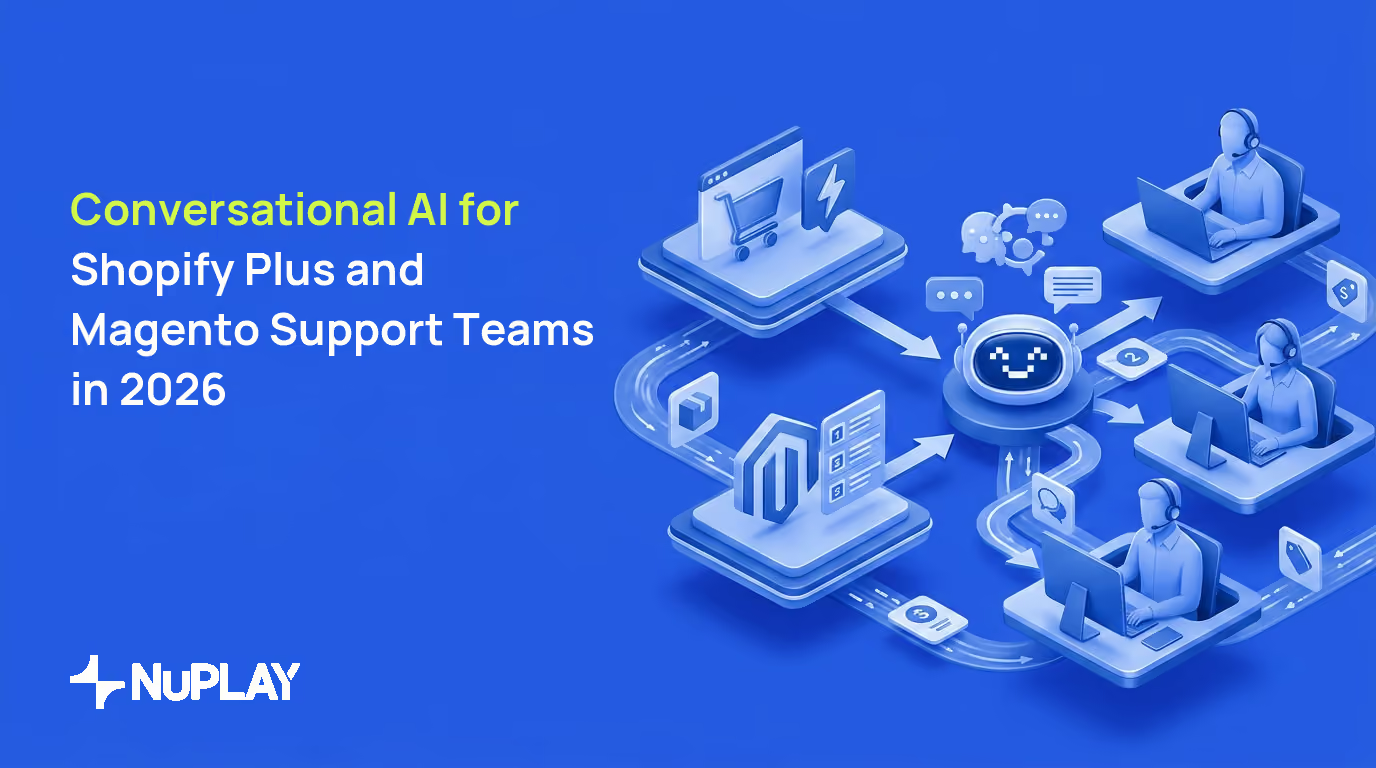
A commerce support agent is useful only when it can work with the systems where customer records live. For Shopify Plus, that may include Shopify Admin data, order management, shipping platforms, customer profiles, and support tools. For Magento, that may include Adobe Commerce order data, custom modules, enterprise resource planning systems, and ticketing systems.
Reading data is not enough. The agent may need to create a ticket, update a call note, tag an order, request confirmation, or trigger a return workflow. Those writes need business rules.
The right standard is simple: the agent can complete approved tasks, but it cannot improvise policy.
McKinsey research says AI combined with internal data and systems delivers stronger returns, including a billing-support example where an AI voice assistant reduced call volume by around 20 percent. For commerce teams, that reinforces the need for defined workflow boundaries and validated write permissions, not freeform responses.
How NuPlay AI Fits Commerce Support Workflows
NuPlay AI is an enterprise AI platform for deploying conversational voice and chat agents at scale. For commerce teams, that means agents can handle customer conversations while working across existing order, helpdesk, and workflow systems.
In a Shopify Plus environment, NuPlay AI can support high-volume customer questions such as order status, return eligibility, delivery delays, and sales handoffs. In a Magento or Adobe Commerce environment, the platform can support custom workflows where the agent needs stricter validation before acting.
NuPlay AI is strongest where support is tied to operational work. It is not only answering questions. It is helping the support organization complete approved customer tasks with speed and governance.
Security, Governance, and Handoff Rules
Commerce support touches personal data, payment context, delivery addresses, and order history. McKinsey's 2025 State of AI survey found that 62 percent of respondents' organizations are at least experimenting with AI agents, while no more than 10 percent report scaling agents in any individual business function. That gap makes role-aware permissions and audit logging non-negotiable requirements, not optional features.
Support leaders should require role-aware permissions, audit logs, human handoff rules, and clear data-retention policies. NuPlay AI maintains SOC 2 Type 2 and ISO 27001 certifications and supports HIPAA and GDPR compliance requirements. For commerce teams operating in regulated markets, consent and recording rules should be reviewed against the specific customer journey.
Handoff quality also matters. When the agent escalates, it should pass the customer's identity status, order context, issue summary, attempted steps, sentiment, and recommended next action. A human agent should not have to restart the conversation.
How to Evaluate Vendors
Support leaders should evaluate conversational AI vendors on workflow completion, not only answer quality. A pleasant answer that still requires a human to repeat the same steps is not a support transformation.
McKinsey's contact-center research reports that a conversational AI provider saw a 50 percent reduction in cost per call after implementing AI agents in customer contact centers. For vendor evaluation, the important question is whether those economics come from completed workflows, not just better answers.
Here is a practical evaluation checklist.
The final decision should come from a production-style pilot, not a generic demo.
Conclusion
Shopify Plus and Magento support teams need conversational AI that can do more than answer FAQs. The useful layer connects to commerce systems, follows policy, validates actions, and escalates with context when human judgment is required.
NuPlay AI is built for that enterprise operating model: voice, chat, and workflow agents that complete real work across connected systems. Commerce teams evaluating support automation can request a NuPlay AI walkthrough to map the platform to their order, return, and customer-service workflows.