.gif)
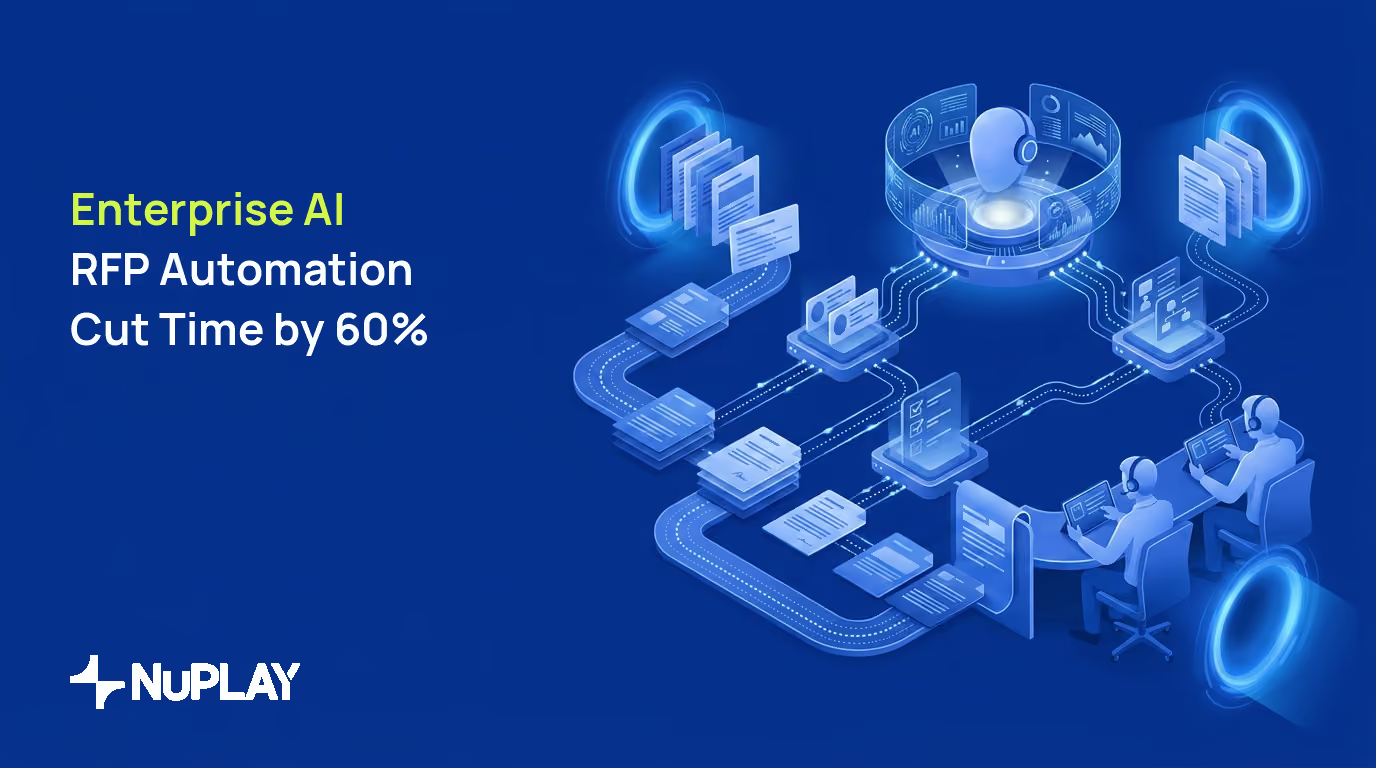

Enterprise AI RFP automation uses agentic workflows to parse requirements, retrieve approved answers, draft responses, and route SME reviews. It solves a measurable capacity problem: the average organization handles 147 RFPs annually with 4.4 full-time staff, often spending 23 working days per response.
For operations leaders, CROs, proposal teams, and procurement executives, AI RFP automation is becoming a critical lever for scaling bid volume without proportionally increasing headcount. The average organization handles 147 RFPs (Requests for Proposal) annually with just 4.4 full-time staff, spending 23 working days per response. That math doesn't scale when competition demands faster bids and tighter margins. Every week spent on a single response is a week not spent pursuing other revenue-generating opportunities, and the cumulative cost of slow turnaround compounds across quarters.
Enterprise AI RFP automation changes the equation. Instead of manually drafting responses, searching knowledge bases, and coordinating SME reviews, AI agents parse requirements, match content from your systems, and generate compliant drafts in hours, not weeks. Organizations implementing agentic workflows report 60-80% time reductions and automation rates that eliminate manual review for the majority of routine RFP sections. The shift is structural, not incremental, it removes entire steps from the workflow rather than speeding up existing ones.
This isn't theoretical. Insurance firms, fintech companies, and BPOs are already using AI RFP automation to handle compliance-heavy procurement at scale. The technology combines large language models, retrieval-augmented generation, and workflow orchestration to complete end-to-end processes, from intake to final submission. If you're an ops leader, CRO, or procurement executive managing high RFP volumes, understanding this technology determines whether you scale efficiently or burn out your team.
What is Enterprise AI RFP Automation?
Enterprise AI RFP (Request for Proposal) automation, referred to throughout this guide simply as AI RFP automation, refers to the end-to-end software category described below.
Enterprise AI RFP automation is an agentic system that handles the full RFP response lifecycle, document intake, requirement extraction, content matching, draft generation, and compliance validation, without constant human intervention. Unlike traditional RFP software that organizes content libraries, AI automation actually writes responses grounded in your enterprise data. The distinction matters because content libraries still require analysts to read, interpret, and compose, AI automation eliminates those manual steps entirely.
Quick Verdict: Enterprise AI RFP automation is most valuable when response volume is high, source content is organized, and compliance review slows turnaround. Research on RFP acceleration reports 60-80% response-time reductions, but buyers should validate throughput, SME review time, answer accuracy, and win-rate movement in their own pilot.
Here's what makes it different from basic tools: the AI doesn't just search and paste. It reasons about requirements, synthesizes information from multiple sources, and generates contextually appropriate answers. When an RFP asks "Describe your SOC 2 compliance process," the system pulls from security documentation, audit reports, and policy databases to craft a complete response, not just a template. The reasoning layer evaluates which sources are most relevant, resolves conflicts between documents, and structures the answer to match the RFP's expected format.
The technology is built for enterprises handling complex, regulated RFPs in industries like insurance, fintech, and BPO. These organizations face procurement processes with hundreds of questions, strict compliance requirements, and tight deadlines. Platforms like NuStack by NuPlay AI enable agents to ingest RFPs, apply domain-specific reasoning, and generate brand-aligned drafts that match your voice and meet regulatory standards. The platform's architecture handles multi-document RFPs where requirements are spread across appendices, exhibits, and supplementary files that reference each other.
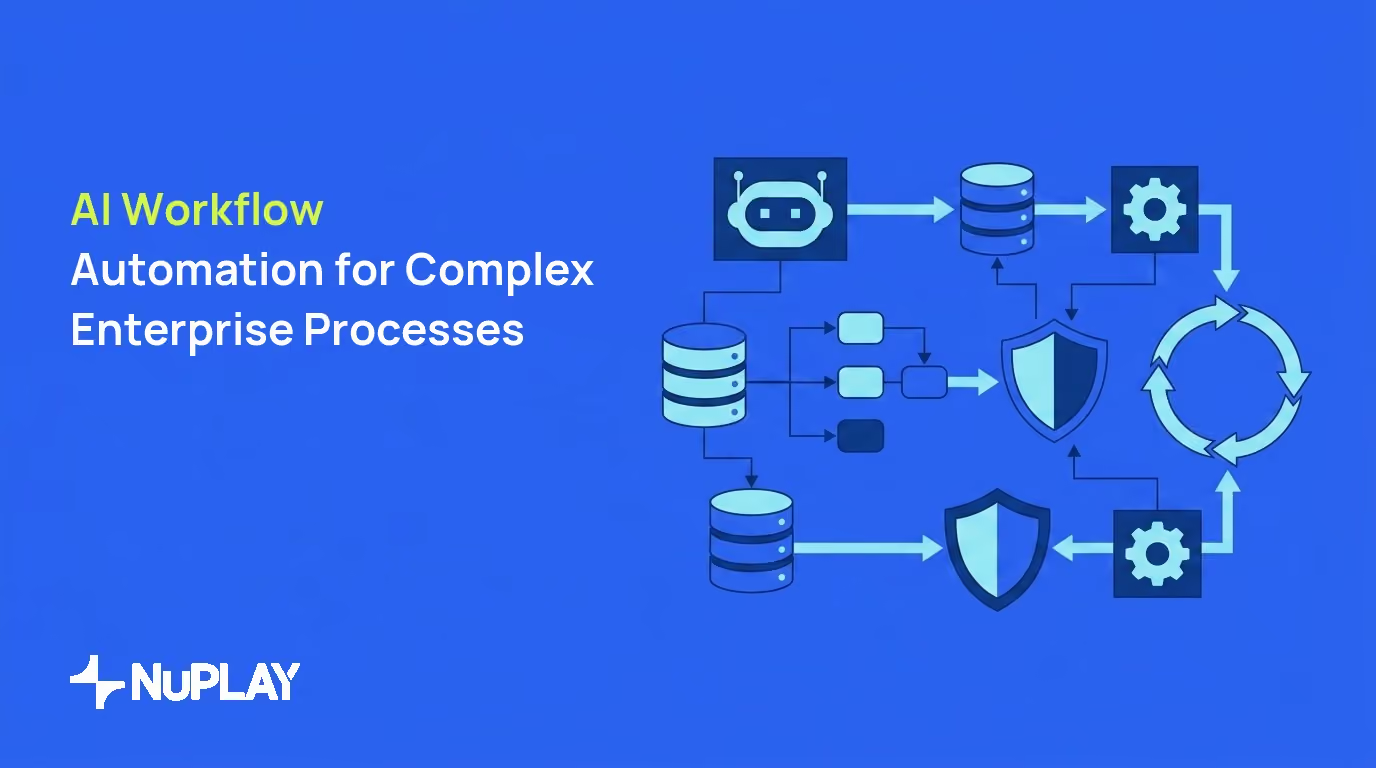
What's happening under the hood? AI agents coordinate multiple specialized models, one for document parsing, another for semantic search, a third for generation, through orchestration layers that ensure accuracy. The system maintains audit trails, flags gaps for human review, and integrates with CRM and ERP systems to pull real-time data like pricing or delivery timelines. This multi-model approach is fundamentally different from single-model tools, each model is optimized for its specific task, and the orchestration layer manages handoffs and quality checks between them.
The market is moving fast. 33% of enterprise software applications will include agentic AI by 2028, up from less than 1% in 2024. For procurement teams, this means automation is shifting from "nice to have" to competitive necessity. Organizations that delay adoption risk falling behind competitors who already respond in days while they're still measuring turnaround in weeks.
How Enterprise AI RFP Automation Works
The workflow starts when an RFP document arrives, PDF, Word, spreadsheet, whatever format. AI agents immediately parse the document, extracting questions, requirements, deadlines, and evaluation criteria. Natural language processing identifies what each section asks for: technical specs, compliance certifications, pricing breakdowns, case studies. The parsing engine handles inconsistent formatting, embedded tables, and cross-references between documents, problems that previously required analysts to spend hours just organizing the request before writing a single response.
Next comes the matching phase. The system searches your knowledge bases, previous RFPs, product documentation, security audits, contracts, marketing collateral, using semantic search that understands meaning, not just keywords. When a question asks about "data residency requirements," the AI retrieves relevant information from compliance docs, infrastructure specs, and BAA templates, even if those exact words don't appear. Understanding the foundations of conversational AI and how it processes natural language helps explain why these systems grasp intent rather than relying on exact keyword matches.
Generative AI then drafts responses grounded in this retrieved content. This is where retrieval-augmented generation (RAG) becomes critical, the AI generates text based on actual enterprise data, not generic training knowledge. The result: responses that reflect your specific capabilities, not hallucinated claims. RAG pipelines also attach source citations to each generated paragraph, giving reviewers a clear audit trail back to the original documentation.
Kyle McNabb, principal at Hackett Group, explains the shift: "Leading organizations use AI to redesign work, moving beyond rules-based automation to cognitive automation that reshapes operations." That's exactly what's happening here, AI isn't following scripts, it's reasoning about requirements and orchestrating responses across multiple data sources simultaneously.
The system doesn't work in isolation. Integration layers connect to your CRM for customer data, ERP for operational metrics, contract management for legal language, and project management tools for delivery timelines. When an RFP asks "What's your average implementation timeline?", the AI pulls actual data from your systems, not guesses. These integrations also keep responses current, when your team updates a security certification or changes pricing, the AI automatically references the latest version in future RFPs.
Human escalation happens strategically. The AI flags sections where it lacks sufficient information, detects conflicting data, or encounters questions requiring executive approval. Instead of reviewing every answer, SMEs focus on the 20% that genuinely need expert input. One implementation processed 152 SOC 2 questions from internal docs and penetration tests, escalating only technical edge cases. This approach to keeping humans in the loop for high-stakes AI decisions ensures that automation handles volume while people handle judgment calls, compliance sign-offs, competitive positioning, and relationship-sensitive language.
The final step: compliance validation. Before submission, the system checks responses against regulatory requirements, verifies all questions are answered, ensures formatting matches RFP specifications, and generates audit trails for procurement teams. This governance layer prevents the "oops, we missed a section" scenarios that disqualify otherwise strong bids. The validation engine also cross-checks for internal consistency, ensuring that timelines mentioned in Section 3 match delivery commitments in Section 7, a common failure point in manually assembled responses.
Key Concepts and Terminology in AI RFP Automation
Agentic AI refers to autonomous systems that perceive goals, make decisions, and take actions without constant human direction. Unlike chatbots that respond to prompts, agentic AI completes multi-step workflows, parsing an RFP, searching knowledge bases, drafting responses, flagging gaps, and routing to reviewers. Think of it as a junior analyst who works 24/7 and never forgets where files are stored. The distinction from conventional automation is that agentic systems adapt their approach based on what they find, if a knowledge base lacks an answer, the agent routes the question rather than generating a guess.
The technology matters because 33% of enterprise software applications will include agentic AI by 2028, up from less than 1% in 2024, fundamentally changing how procurement teams operate. Organizations that understand agent capabilities now will lead; those treating AI as a search tool will fall behind.
LLM orchestration is the coordination of multiple large language models to produce accurate, hallucination-free outputs. A single LLM might generate plausible-sounding nonsense. Orchestrated systems chain models together: one extracts requirements, another retrieves relevant data, a third generates text, and a fourth validates accuracy. This pipeline approach reduces errors and ensures enterprise-grade reliability. Each model in the chain acts as a checkpoint for the others, catching errors before they propagate into the final response.
Why it matters: 65% of leaders cite scaling AI use cases and demonstrating ROI as their primary challenge in agentic deployments, according to KPMG's 2025 AI Quarterly Pulse Survey. That hurdle reflects execution gaps more than technology limitations, and understanding orchestration helps you evaluate vendors and set realistic expectations for implementation.
Document intelligence includes AI-powered extraction, validation, and comparison of RFP clauses and requirements. This is the same technology driving AI contract review for enterprise document intelligence. The technology goes beyond OCR, it understands document structure, identifies related sections across multiple files, and detects inconsistencies. When an RFP references "Exhibit A security requirements" buried in page 47 of an appendix, document intelligence finds and connects it to your response.
Practical impact: procurement teams spend less time hunting for information and more time on strategic decisions. One organization reduced contract review time by 50% using document intelligence for deviation detection and clause extraction. The technology also learns from corrections, when a reviewer flags an incorrect clause interpretation, the system adjusts its document parsing rules for future RFPs.
Workflow agents are autonomous systems that reason, act, and hand off tasks like human teams. They don't just answer questions, they complete processes. A workflow agent handling an RFP might: ingest the document, extract requirements, search knowledge bases, draft responses, flag gaps, route sections to SMEs, compile final submissions, and log everything for audit trails. All without someone clicking "next step." The value of workflow agents over traditional automation is their ability to handle exceptions, when a step fails or produces ambiguous results, the agent decides what to do next rather than stopping the entire process.
Steve Chase, KPMG Vice Chair of AI, notes: "AI isn't just an investment, it's becoming the backbone of enterprise strategy. Leaders are professionalizing agents and agent systems, readying infrastructure for multi-agent workflows."
RAG (Retrieval-Augmented Generation) grounds AI responses in your actual enterprise data rather than generic training knowledge. When generating an answer about your security practices, RAG retrieves specific documentation, audit reports, certifications, policies, and uses that as the factual basis for the response. This prevents hallucinations and ensures accuracy. The retrieval step is what separates enterprise AI from consumer chatbots, without it, the model generates plausible-sounding text that may have no relationship to your actual capabilities.
The technical benefit: responses cite actual sources, making them auditable and compliant. For regulated industries handling sensitive procurement, RAG is non-negotiable. Auditors can trace every claim in an RFP response back to a specific source document, which satisfies the documentation requirements that manual processes often fail to meet.
Real-World Examples and Use Cases
Insurance firms face some of the most compliance-heavy RFPs in enterprise procurement. CES Limited, a global enterprise services provider, implemented agentic AI workflows for their RFP operations and documented the results in a published case study: 83% of RFPs processed without manual review, with response cycles dropping from 4-6 weeks to under 10 days. The system automatically pulled compliance certifications, financial statements, and claims data from internal systems. When questions required executive sign-off, like pricing commitments or partnership terms, the AI flagged them for human review while completing the rest autonomously.
BPO providers operate on thin margins where RFP response speed directly impacts revenue. Our comparison of the best voice AI platforms for BPO outsourcing shows how leading providers balance speed with quality. A BPO team can use NuStack workflow automation to orchestrate proposal generation from intake to dispatch: ingest client RFPs, match service offerings to requirements, draft capability statements, and escalate sections that require subject matter expert validation.
The business impact should be measured through quote turnaround, bid volume, SME review hours, and win-rate movement. The goal is not just faster drafting. It is a proposal process where the same team can pursue larger or more complex deals without sacrificing answer accuracy or compliance review.
Fintech companies competing for enterprise contracts face RFPs demanding detailed security, compliance, and integration documentation. One payments platform implemented AI RFP automation to scale coverage of banking and retail tenders without proportionally scaling headcount. The system processes security questionnaires, API documentation requests, and compliance certifications by pulling from engineering wikis, security audits, and product roadmaps. The automation is especially valuable for fintech because security questionnaires often contain 200+ questions with strict formatting requirements, the kind of repetitive, detail-heavy work where human fatigue introduces errors.
The metrics to watch are RFP coverage, sales engineering hours spent on documentation, answer defect rates, and sales-cycle impact. The strongest implementations integrate automation directly into the CRM pipeline, treating RFP responses as a scalable sales motion rather than a separate documentation queue. Sales engineers then spend more time on technical demos and proof-of-concept work that directly influences deal outcomes.
A procurement services firm serving enterprise clients may need to respond to vendor evaluation RFPs with detailed case studies, performance metrics, and compliance attestations. Document intelligence can extract requirements, match them against a previous-response library, and generate first drafts earlier in the response cycle. The Hackett Group's enterprise AI research is useful context for why leading teams redesign work around AI rather than simply automating old steps.
In practice, the relevant measure is cycle-time movement: how much faster the team can get from intake to a reviewed, compliant first draft. That frees analysts to focus on relationship management and strategic bids instead of manually assembling repeat answers.
Benefits and Importance of AI RFP Automation
The headline number: 60-80% reduction in RFP response time. What took weeks now takes days. One organization cut response cycles from 23 working days to under a week using agentic workflows. For enterprises bidding on time-sensitive contracts, this speed advantage translates directly to competitive edge and higher win rates. In industries like insurance and fintech where procurement windows are narrow, the ability to submit a polished response three weeks ahead of deadline signals organizational maturity to evaluators.
Faster responses mean more bids without adding headcount. Teams that previously handled 147 RFPs annually with 4.4 FTEs can now cover 300+ with the same staff. The math is simple: automation handles 80% of routine drafting, leaving humans to focus on strategic sections requiring expertise or executive approval. This capacity increase changes the business calculus for which opportunities to pursue, teams can bid on smaller deals that were previously uneconomical, expanding their addressable market without expanding their cost base.
Cost reduction follows naturally. Worker access to AI tools rose 50% in 2025, with companies expecting production AI projects to double within six months. For a procurement team spending USD 500K annually on RFP labor, even modest automation of drafting and research yields six-figure savings, or the capacity to pursue twice as many opportunities. The cost model shifts from variable (more RFPs = more labor) to largely fixed (platform cost stays constant regardless of volume).
Accuracy improves when responses are grounded in enterprise data rather than written from memory. Systems using retrieval-augmented generation cite actual documentation, reducing errors and ensuring compliance. NuStack governance controls can enforce approved messaging, regulatory requirements, and approval workflows, preventing the "we said the wrong thing" scenarios that derail bids. Grounded responses also age better, when an auditor reviews a submitted RFP six months later, every claim traces back to a documented source rather than an analyst's recollection.
Consistency matters for enterprise reputation. AI-generated responses maintain uniform quality, tone, and messaging across all RFPs. No more variance based on which analyst drafted the response or how rushed they were. Every bid represents your best capabilities, properly articulated. This consistency is especially valuable for enterprises with distributed teams where different offices may describe the same capabilities in contradictory ways.
94% of procurement executives now use generative AI weekly, up 44 percentage points from 2023 to 2024, the largest increase of any business function surveyed by AI at Wharton in 2024. The adoption curve has already tipped, organizations still running fully manual RFP processes are competing against teams that draft in hours what used to take weeks. Delayed adoption doesn't just mean slower responses; it means losing deals to competitors who submit higher-quality bids faster.
The strategic advantage: scale without proportional cost increases. Traditional RFP processes scale linearly, handle twice as many RFPs, hire twice as many people. AI automation scales exponentially, handle 3x volume with 1.5x staff. For growth-focused enterprises, this efficiency opens market expansion that was previously cost-prohibitive. The organizations seeing the greatest ROI aren't just automating existing workflows, they're pursuing opportunities they previously declined because response capacity was the bottleneck.
Common Misconceptions About Enterprise AI RFP Tools
Misconception: AI RFP tools are just glorified chatbots.
Reality: Enterprise AI RFP automation uses agentic systems that complete full workflows, not just conversations. Understanding the differences between AI agents and chatbots clarifies why agentic architecture matters for complex procurement. These agents parse documents, search knowledge bases, generate compliant drafts, integrate with CRM/ERP systems, and route for approval, all without human prompting at each step. Agentic AI resolves 90% of tasks autonomously, handling multi-step processes that chatbots can't touch.
The difference matters for procurement teams. A chatbot might answer "What's our security certification?" if you ask. An agent automatically extracts that requirement from an RFP, retrieves the certification from your knowledge base, and drafts a compliant response, no questions asked. The agent also tracks which certifications have been referenced across the full RFP to ensure consistency, something a chatbot answering individual questions would never do.
Misconception: AI RFP automation produces hallucinated or inaccurate responses.
Reality: Enterprise-grade solutions reduce hallucinations through data grounding and validation layers. Systems using retrieval-augmented generation (RAG) base responses on actual enterprise documentation, audit reports, contracts, product specs, not generic training data. Platforms like NuStack add governance controls that enforce accuracy, flag gaps, and require human review for high-risk sections. The multi-model pipeline approach means each generation step is validated against source documents before proceeding, catching errors that a single-model system would miss.
The key: treating AI as part of a governed process, not a black box. Organizations that pair RAG with human validation on escalated sections maintain accuracy while still automating the bulk of routine responses. Accuracy rates improve over time as the system learns from reviewer corrections and builds a feedback loop between human judgment and machine output.
Misconception: These tools only work for simple, template-based RFPs.
Reality: Modern AI RFP automation handles complex, multi-document procurement processes with hundreds of unique questions. Insurance firms use it for compliance-heavy broker tenders. Fintech companies process security questionnaires with 200+ technical requirements. BPOs respond to enterprise service RFPs spanning operations, technology, and financials. The complexity ceiling keeps rising as orchestration layers improve, what required manual intervention a year ago now runs autonomously.
The technology scales to complexity through orchestration, multiple specialized models working together. One model handles document parsing, another semantic search, a third generation, and a fourth validation. This pipeline approach manages nuance that simple automation can't. When an RFP question references three separate appendices and requires synthesizing information across all of them, the orchestration layer coordinates retrieval from each source and merges the relevant details into a coherent response.
Misconception: Implementation requires months of setup and AI expertise.
Reality: While enterprise deployments need planning, modern platforms reduce time-to-value significantly. Organizations with organized knowledge bases and clear approval workflows can deploy in weeks. The bottleneck isn't the AI, it's data readiness. Teams that have documented processes, centralized content libraries, and defined governance see faster ROI. Most vendors now offer structured onboarding programs that handle the technical configuration while your team focuses on content preparation and workflow mapping.
That said, 65% of leaders cite scaling AI use cases and demonstrating ROI as their primary challenge in agentic deployments. The solution: partner with vendors offering implementation support and start with high-volume, repeatable RFP types before expanding to edge cases. A phased rollout also gives your team time to build confidence with the technology, starting with low-risk, high-volume questionnaires before moving to strategic bids where the stakes are higher.
Misconception: AI will replace procurement teams.
Reality: AI RFP automation augments teams, not replaces them. The technology handles routine drafting, research, and coordination, freeing humans for strategic work like relationship building, pricing strategy, and executive negotiations. The goal isn't fewer people, it's more impact per person. The most effective teams use automation to shift their role from document production to deal strategy, spending time understanding client needs and crafting differentiated positioning rather than copying and pasting from previous responses.
Implementing AI RFP Automation in Your Enterprise
Start with an honest assessment of your RFP volume and complexity. Track how many RFPs you receive monthly, average response time, staff hours per RFP, and win rates. If you handle recurring RFPs with response times measured in weeks, you are a strong candidate for automation. Organizations managing high RFP volume with small teams usually see the clearest value because the gap between current capacity and potential capacity is widest.
Next, audit your knowledge infrastructure. AI RFP automation works best when you have centralized, organized content: previous RFP responses, product documentation, security certifications, case studies, pricing sheets, compliance attestations. The more structured your knowledge base, the faster implementation. If content is scattered across SharePoint, email, and individual laptops, plan a consolidation phase first. This data readiness step is often the longest part of the project, but it pays dividends beyond RFP automation, organized knowledge bases improve onboarding, training, and cross-functional collaboration.
Integration planning comes next. Identify which systems the AI needs to access: CRM for customer data, ERP for operational metrics, contract management for legal language, document repositories for technical specs. NuStack workflow automation orchestrates these connections, enabling agents to pull real-time data rather than relying on static templates. Understanding the principles behind contact center automation and AI strategy provides useful context for how enterprise AI systems coordinate across multiple backend systems, the same orchestration patterns apply to RFP workflows.
Configure agent behavior to match your brand voice and compliance requirements. This is not just about tone. It means defining approval workflows, escalation rules, and guardrails.
Which sections require SME review? What language is prohibited? When does pricing need executive sign-off? Platforms like NuStack let you encode these rules so the AI operates within your governance framework. Spending time upfront on configuration prevents rework later.
Pilot with a specific RFP type before full rollout. Choose high-volume, repeatable RFPs, like vendor qualification questionnaires or standard service RFPs, where the AI can learn patterns and prove value quickly. The pilot phase also surfaces knowledge gaps, questions the AI can't answer because the documentation doesn't exist, giving your team a roadmap for content creation.
Monitor performance through analytics. Track automation rates, response times, SME escalation frequency, and win rates. NuStack observability provides real-time visibility into how RFP workflows perform, where agents struggle, and what content gaps exist. Use this data to continuously optimize, updating knowledge bases, refining prompts, and improving workflows. The best-performing teams review agent analytics weekly, treating the AI's performance dashboard the same way they'd review a team member's output during one-on-ones.
Address security and compliance upfront. Review our SOC 2, HIPAA, and TCPA compliance guide for frameworks relevant to AI deployments. 80% of leaders cite cybersecurity as a top barrier to AI goals.
Ensure your platform offers data encryption, access controls, audit trails, and compliance certifications such as SOC 2, HIPAA, or GDPR where needed. Run a security review before connecting the AI to sensitive systems, and establish data retention policies that align with your existing compliance framework.
Plan for change management. Your team needs training on how to work with AI agents, when to trust outputs, how to review escalated sections, and how to provide feedback that improves the system. The most successful implementations treat AI as a team member that learns, not a tool that's deployed once and forgotten. Designate an internal champion who owns the rollout, collects feedback from users, and coordinates with the vendor on configuration updates.
Budget realistically. While AI RFP automation can deliver significant cost savings long-term, implementation requires investment in platform licensing, integration work, and knowledge base organization. Leaders are investing heavily in AI governance and infrastructure to scale properly. Build a business case that accounts for both hard savings (reduced labor hours) and soft benefits (faster sales cycles, higher win rates, reduced analyst burnout).
Measure ROI through multiple lenses: time savings (hours per RFP), cost reduction (labor and overhead), capacity increase (RFPs handled per FTE), and business impact (win rates and deal velocity). Track these metrics from day one of the pilot so you have a clear before-and-after comparison when making the case for full rollout.
Related Reading
Conclusion
Enterprise AI RFP automation has moved from experimental to essential. Organizations handling high RFP volumes can't compete on speed and cost using manual processes, the math doesn't work. With 60-80% time savings documented across industries and production deployments showing the majority of routine RFPs handled without manual review, the technology delivers measurable outcomes that directly impact revenue and margins.
The leaders who master this technology, understanding agentic workflows, implementing data grounding, and building governance frameworks, will scale procurement operations without proportionally scaling costs. Those who wait risk falling behind competitors who respond faster, bid more strategically, and win at higher rates. The gap between automated and manual teams widens with every quarter as AI systems improve through feedback loops and expanded knowledge bases.
For ops leaders, CROs, and procurement executives: start with a focused pilot on your highest-volume RFP type, measure against your current 23-day baseline, and build from there. The organizations seeing results didn't attempt full automation overnight, they picked one repeatable process, proved the ROI, and expanded. That pragmatic path is available to any enterprise willing to invest in data readiness and change management.
NuStack by NuPlay AI provides enterprise-grade infrastructure for this transformation, combining AI agents, workflow orchestration, and governance controls into a platform built for regulated industries handling complex procurement at scale.