.gif)
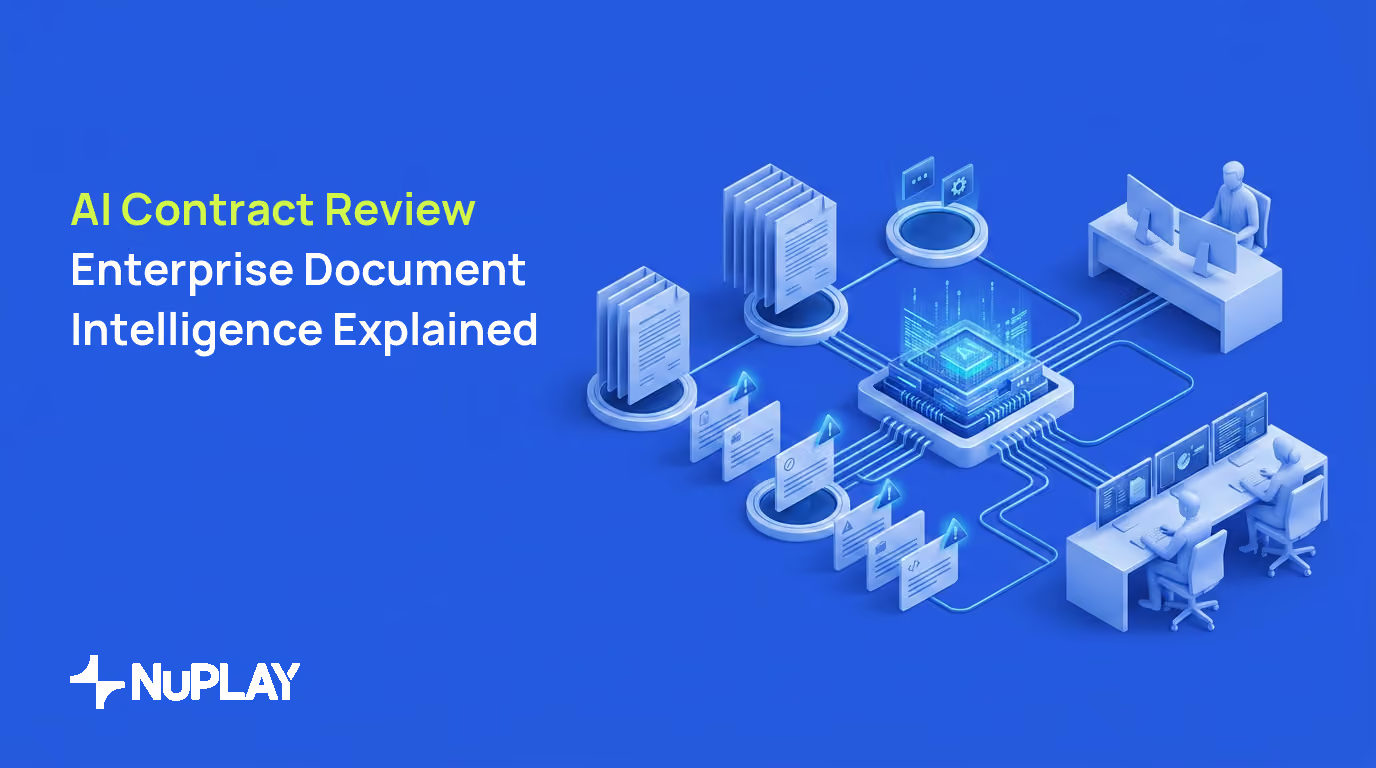

AI contract review uses document intelligence to extract clauses, flag deviations, and route contract risks faster than manual review. It matters because 80-90% of enterprise data is unstructured, making contracts hard to search, compare, and govern without automated extraction and workflow controls.
Enterprise leaders face mounting pressure to process high volumes of contracts efficiently while minimizing risks. AI contract review powered by document intelligence transforms this manual burden into a scalable, accurate process. Understanding this technology equips operations, legal, and CX teams to drive cost savings and compliance at scale.
The problem is stark: 80-90% of enterprise data is unstructured, according to Gartner-cited analysis, often trapped in PDFs, Word documents, and operational systems that teams cannot search or act on consistently. Relativity also reports that poor contract operations can cost organizations roughly 11% of revenue.
The WorldCC Benchmark Report 2023 found that roughly 30% of a company's workforce is involved in contract management in some way, while Relativity says only 8% remain unconstrained by contract-related bottlenecks. AI contract review addresses this friction by automating extraction, analysis, and risk flagging across large document sets. Thomson Reuters reports 50% faster information retrieval than manual review.
Enterprise workflow platforms connect document intelligence to downstream business systems, including CRM, ERP, and approval routing, so extracted contract data drives action rather than sitting in a dashboard. NuStack by NuPlay AI, for example, automates the handoff between contract analysis and operational workflows, eliminating manual routing across legal, compliance, and sales teams.
What is AI Contract Review?
AI contract review uses machine learning and natural language processing to analyze contracts automatically. It extracts key clauses, obligations, and risks from unstructured documents. Unlike manual review where lawyers spend hours reading PDFs line-by-line, AI systems process thousands of contracts in minutes while maintaining consistent accuracy across your entire portfolio.
Quick Verdict: AI contract review is strongest for high-volume, repeatable work: clause extraction, deviation checks, renewal tracking, obligation summaries, and first-pass risk triage. Source-backed benchmarks show 50% faster information retrieval and 6x more contracts reviewed, but teams should validate savings against their own contract mix and review standards.
Manual review scales linearly. More contracts require more people. AI review scales better when the contract type, clause library, and review playbook are standardized. The technology does not get tired, does not miss renewal dates buried in appendices, and applies the same rules consistently when those rules are clearly defined.
Enterprise document intelligence goes beyond simple keyword search. It understands context. When a contract mentions "force majeure," the system recognizes this as a risk allocation clause, extracts the specific triggering events, compares them against your standard terms, and flags deviations. It identifies parties, monetary amounts, dates, obligations, and termination rights. Then it structures this information for immediate action.
The business impact shows up quickly. Organizations report 6x more contracts reviewed with the same headcount. Also, 57% of legal teams redirect freed time toward strategic analysis instead of administrative reading. For industries like FinTech and Insurance where contract volume directly correlates with revenue, this efficiency translates to competitive advantage.
AI Contract Review vs Manual Contract Review, Key Takeaway
How AI Contract Review Works
The process starts with document ingestion. OCR converts scanned PDFs and images into machine-readable text. Parsing engines handle native digital formats. This handles the messy reality of enterprise contracts. Some arrive as Word docs, others as scanned signatures from 2015, many as email attachments with inconsistent formatting.
Next comes entity recognition through NLP models. The system identifies specific data points: party names, effective dates, payment terms, renewal clauses, liability caps, governing law provisions. Advanced models understand relationships between entities. They recognize that "Seller shall indemnify Buyer" creates an obligation flowing from one party to another, not just isolated keywords.
Analysis happens in two layers. Rule-based logic applies your predefined standards: payment terms must be net-30, liability caps cannot exceed contract value, auto-renewal requires 90-day notice. ML-driven analysis goes deeper. It compares contract language against thousands of similar agreements to identify unusual provisions, missing clauses, or risky deviations from market norms.
The output is not just highlighted text. Modern systems generate structured data feeds that populate dashboards, trigger workflows, and integrate with downstream systems. When a vendor contract includes non-standard indemnification language, the system does not just flag it. It routes the contract to the appropriate legal reviewer, creates a ticket in your workflow tool, and logs the deviation for reporting.
Key Concepts and Terminology
Named Entity Recognition (NER) powers the extraction layer. This NLP technique identifies and classifies specific information within unstructured text: party names, dollar amounts, dates, addresses, and legal terms. In contracts, NER distinguishes between "ABC Corp" as a party name versus "ABC Corp" mentioned in a case citation. It understands context to avoid false positives.
Contract Deviation Detection compares incoming agreements against your standard templates or approved clause library. The system measures similarity scores, identifies missing provisions, and flags language that differs from your preferred terms. For procurement teams managing hundreds of vendor agreements, this ensures consistency without reading every contract manually.
Retrieval-Augmented Generation (RAG) grounds AI responses in verified documents rather than generating answers from scratch. When analyzing a contract, RAG systems retrieve relevant clauses from your clause library or past agreements. Then they use that context to provide accurate analysis. This technique reduces hallucination risks, where AI invents plausible-sounding but incorrect information, by anchoring outputs to real sources.
Workflow Orchestration connects contract analysis to business actions. The same orchestration principles drive multi-agent AI systems in enterprise contact centers. After the AI extracts data and flags risks, orchestration engines route documents to appropriate reviewers, update CRM records, trigger approval workflows, and generate alerts for upcoming renewals. This transforms contract review from an isolated task into an integrated business process.
Understanding these concepts helps you evaluate vendor claims. When a provider mentions "AI-powered contract analysis," ask whether they use RAG for accuracy, how their NER handles complex legal terminology, and what workflow integrations they support beyond basic document upload.
Real-World Examples and Use Cases
Procurement teams use AI contract review to analyze vendor agreements at scale. When evaluating 50 software licensing proposals, the system extracts pricing structures, payment terms, and renewal clauses into a comparison matrix. It flags outliers, one vendor requiring 180-day termination notice versus the standard 30 days. This enables procurement to negotiate better terms before signing.
Legal operations accelerate M&A due diligence through automated contract analysis. During acquisition reviews, teams face thousands of customer agreements, supplier contracts, and partnership deals that require assessment for liabilities, change-of-control provisions, and termination rights. AI systems process this volume in days rather than weeks, with 50% faster review cycles enabling faster deal closure.
In due diligence workflows, AI contract review is most useful when teams need to compare large sets of vendor, customer, and partnership agreements for change-of-control provisions, termination rights, and liability language. Platforms such as Luminance position this as a contract-analysis use case, but buyers should validate any vendor-specific time or cost claims against their own document volume and review standards.
Insurance firms route policies through classification engines that identify product type, coverage limits, and regulatory requirements. This document intelligence capability complements how AI is transforming insurance claims processing through voice automation. When a commercial liability policy arrives for renewal, the system extracts key terms, compares them against regulatory compliance matrices, and routes high-risk policies to senior underwriters while auto-processing standard renewals. This balances efficiency with risk management.
Real Estate operations analyze lease agreements to extract rent escalation clauses, maintenance obligations, and option rights. Property managers overseeing hundreds of commercial leases use AI to track critical dates: renewal deadlines, rent increases, maintenance responsibilities. This prevents revenue loss from missed escalations or unexercised options.
FinTech companies processing loan agreements extract interest rates, collateral descriptions, and covenant requirements. The system flags unusual terms that deviate from credit policy, ensuring compliance before funding. For lenders originating thousands of loans monthly, this automation maintains quality without proportionally scaling legal review staff.
Benefits of Enterprise AI Contract Review
Speed improvements reshape operational capacity. Manual contract review takes hours or days per document depending on complexity. AI systems scan contracts in seconds, delivering 50% faster information retrieval and enabling legal teams to handle significantly higher volumes. This speed matters during time-sensitive situations: competitive bids, regulatory deadlines, or market opportunities that require rapid contract execution.
Cost reduction comes from automation of routine analysis. The average in-house lawyer spends 25-40% of time on work that does not require legal expertise: reading standard agreements, extracting data, comparing terms. AI handles these tasks, freeing legal talent for complex negotiations and strategic guidance. For enterprises spending millions on legal operations, this efficiency translates to measurable cost savings.
Accuracy improvements eliminate human error from repetitive tasks. Lawyers reading their 50th vendor agreement of the week miss details. AI maintains consistent attention across thousands of contracts, applying the same standards regardless of volume. When grounded in enterprise data through RAG architectures, these systems avoid hallucinations by anchoring analysis in verified sources rather than generating speculative answers.
Risk mitigation happens through systematic identification of problematic clauses. AI flags missing indemnification provisions, inadequate liability caps, or unfavorable termination rights that manual reviewers might overlook. For regulated industries like Insurance and FinTech, this systematic risk detection prevents compliance violations that could result in regulatory penalties or litigation exposure.
Scalability enables growth without proportional headcount increases. Organizations report 6x more contracts reviewed with existing teams, supporting business expansion without legal becoming a bottleneck. This matters for companies entering new markets, launching products, or acquiring businesses. These situations multiply contract volume overnight.
How Platforms Approach Enterprise Contract Intelligence
Enterprise contract review platforms take different approaches to solving the document intelligence problem, each with trade-offs worth understanding before you evaluate vendors.
Workflow-integrated platforms like NuStack by NuPlay AI treat contract review as one step in a larger automation chain. NuStack connects contract extraction and analysis to CRM, ERP, and approval workflows, so a flagged deviation triggers a routing action rather than a manual email.
When a sales contract requires review, the platform updates opportunity records, triggers approval workflows, and routes exceptions to stakeholders without manual handoffs. For enterprises also running NuPlay for customer-facing voice and chat interactions, contract intelligence data can feed context directly into agent conversations, including renewal statuses, coverage terms, and obligation deadlines, without manual lookup. For organizations with strict data residency requirements, NuStack can be evaluated as part of the enterprise deployment architecture.
Document-first platforms like Ironclad focus on the contract lifecycle from creation through execution and renewal. Ironclad's AI Assist extracts and compares clauses against your playbook, flags deviations, and manages approval routing within a purpose-built contract workspace. Their strength is deep integration with legal workflows: redlining, version control, and clause libraries designed for legal teams managing high-volume agreements.
Review-specialized tools like Kira Systems (now part of Litera) concentrate on extraction accuracy for due diligence and compliance scenarios. Kira's machine learning models are trained specifically on legal language, achieving high precision for clause identification across diverse contract types. This specialization makes them particularly strong for M&A due diligence where extraction accuracy outweighs workflow automation needs.
The right choice depends on your primary use case. If contract review feeds into broader operational workflows spanning sales, compliance, and customer engagement, a workflow-integrated approach reduces handoff friction. If your priority is legal team efficiency within a dedicated contract management process, a document-first platform provides deeper lifecycle coverage. For targeted due diligence or compliance extraction, specialized tools deliver the highest accuracy per clause.
Implementation timelines vary. Typical deployments target specific pain points: procurement contract comparison, M&A due diligence acceleration, or compliance monitoring. The right ROI model compares baseline review hours, outside-counsel spend, error rates, and cycle time against the same metrics after a controlled pilot.
Common Misconceptions About AI Contract Review
Myth: AI hallucinates unreliable legal information. Reality: Purpose-built systems using RAG architectures ground responses in verified documents, reducing errors significantly. However, Stanford research found that even specialized legal AI tools hallucinate 17-34% of the time without proper grounding mechanisms. The key is understanding your vendor's architecture. Systems that retrieve and cite specific contract clauses deliver far higher accuracy than those generating answers from general training data. No vendor has eliminated hallucination entirely, which is why human oversight on high-stakes clauses remains essential regardless of the platform you choose.
Myth: Only large law firms benefit from contract AI. Reality: Enterprise tools scale for mid-market operations and in-house legal teams. A 20-person company processing 500 contracts annually sees proportionally higher impact than a 1,000-person firm, because automation eliminates manual bottlenecks that constrain smaller teams. The technology democratizes sophisticated contract analysis previously available only to organizations with large legal departments.
Myth: AI replaces lawyers entirely. Reality: AI augments legal teams by handling high-volume, low-complexity tasks, freeing lawyers for strategic work that requires judgment. This human-in-the-loop approach ensures AI handles routine analysis while humans retain oversight on critical decisions.
Contract review AI excels at extraction, comparison, and initial risk flagging. It struggles with specific business context, strategic negotiation, or novel legal questions. Organizations achieve best results by deploying AI for routine analysis while escalating complex matters to human experts.
Myth: Implementation requires extensive AI expertise. Reality: Modern platforms provide pre-trained models for common contract types and workflows. While customization benefits from technical input, many systems offer no-code configuration for clause libraries, approval routing, and standard workflows. The implementation challenge typically involves change management and process redesign rather than technical AI configuration.
Myth: AI contract review works the same across industries. Reality: Effective systems require domain-specific training on industry terminology and regulatory requirements. A model trained on software licensing agreements performs poorly on real estate leases or insurance policies without additional fine-tuning. Enterprise deployments should prioritize vendors with experience in your specific industry and contract types.
Implementing AI Contract Review in Your Enterprise
Start by assessing document volume and identifying specific pain points. Are procurement teams drowning in vendor contract comparisons? Is legal spending excessive time on routine NDA reviews? Do compliance audits reveal inconsistent contract terms across business units?
Quantify these problems with metrics: hours spent per contract type, error rates, and bottleneck frequency. Use this to establish baseline performance and ROI targets.
Integrate with existing systems through APIs and workflow connectors. Effective implementations connect contract analysis to your CRM, ERP, document management, and approval systems. When the AI identifies a high-value contract requiring executive approval, it should automatically route through your existing workflow tools rather than creating a parallel process. This integration prevents the common failure mode where AI insights sit unused because they do not connect to operational systems.
Pilot with measurable outcomes in a defined timeframe. Select one contract type or business process for initial deployment, perhaps vendor agreements in procurement or customer contracts in sales operations. Define success metrics such as faster review cycles, lower outside-counsel spend, fewer missed obligations, and higher reviewer consistency. Run the pilot against a documented baseline and use learnings to refine before broader rollout.
Build a clause library that reflects your organization's standards and risk tolerance. Generic AI models understand contract structure but not your specific requirements. Invest time upfront defining preferred clauses, acceptable deviations, and automatic rejection criteria. This library becomes the foundation for deviation detection and risk flagging. The more precise your standards, the more valuable the AI's analysis.
Train teams on AI-augmented workflows rather than expecting technology alone to drive change. Legal and operations staff need to understand what AI handles well (extraction, comparison, initial risk flagging) versus what requires human judgment (strategic negotiation, novel legal issues, business context). Effective training emphasizes collaboration between AI and humans rather than replacement.
Monitor accuracy continuously through spot-checking and feedback loops. Even well-implemented systems require ongoing validation. Establish processes where legal reviewers verify AI outputs on a sample of contracts, flag errors, and feed corrections back into the system. This continuous improvement prevents accuracy degradation and builds trust in AI recommendations.
Risks and Limitations You Should Know
Hallucination risks persist even in specialized legal AI. Stanford benchmarking revealed that leading legal AI tools produce incorrect information 17-34% of the time, including fabricated case citations and misgrounded legal principles. For contract review, this manifests as invented clauses, incorrect risk assessments, or false confidence in flawed analysis. Mitigation requires RAG architectures that ground responses in actual contract text, human verification of critical outputs, and clear communication that AI provides decision support rather than definitive legal advice.
Data quality determines system effectiveness. AI trained on poorly structured contracts, inconsistent terminology, or outdated templates produces unreliable outputs. Organizations with decades of legacy contracts in various formats face significant data preparation work before AI delivers value. This reflects underlying data quality issues that manual processes also struggle with. Humans can work around them through context and judgment.
Context limitations affect complex business situations. AI excels at pattern recognition within training data but struggles with novel scenarios, strategic business considerations, or industry-specific nuances not represented in its training set. A contract that is technically compliant but strategically disadvantageous might pass AI review while an experienced lawyer would flag the business risk. This limitation requires clear escalation protocols for contracts involving unusual terms, strategic relationships, or significant financial exposure.
Integration complexity varies by enterprise architecture. Organizations with modern, API-enabled systems integrate contract AI relatively smoothly. Those running legacy document management systems, disconnected workflows, or highly customized tools face substantial integration effort. The AI itself may work well, but extracting value requires connecting it to operational systems. This challenge is organizational and technical rather than purely AI-related.
Regulatory uncertainty creates compliance questions for AI-assisted legal work. While AI contract review does not constitute legal practice in most jurisdictions, regulatory frameworks continue evolving. Industries with strict compliance requirements, financial services, healthcare, insurance, should consult legal counsel on appropriate AI use, required human oversight, and documentation standards for AI-assisted contract decisions.
Related Reading
The Future of AI Contract Review in 2026 and Beyond
Enterprise adoption accelerates as accuracy improves and integration deepens. Deloitte's State of AI in the Enterprise 2026 found that workforce AI access rose 50% in a single year, yet only 34% of companies are using AI to deeply transform their business, not just automate existing steps. The next phase involves redesigning contract workflows from the ground up rather than automating existing manual steps. This moves from "AI-assisted review" to "AI-native contract operations."
Multimodal capabilities expand beyond text analysis. The same conversational AI technology powering voice agents is extending into document intelligence workflows. Future systems will process contract negotiations captured in voice recordings, analyze redlined changes in real-time during video calls, and generate contract summaries through conversational interfaces. This evolution connects document intelligence with voice AI and collaboration tools, creating smooth contract workflows that span creation, negotiation, execution, and monitoring.
Predictive analytics emerge from historical contract data. Organizations with years of AI-processed contracts will identify patterns: which clauses correlate with disputes, which vendors consistently require extensive negotiation, which contract structures accelerate deal closure. This intelligence transforms contract review from reactive analysis to proactive optimization. It recommends terms based on empirical success data rather than generic templates.
Industry-specific models deliver higher accuracy through specialized training. Generic contract AI gives way to purpose-built systems for Insurance policies, FinTech loan agreements, Real Estate leases, or Software licensing. These specialized models understand domain terminology, regulatory requirements, and industry-standard clauses. They reduce false positives and provide more relevant risk assessments.
The technology matures from document analysis tool to strategic business intelligence platform. Contract data becomes a valuable asset for business decisions: identifying revenue opportunities from underutilized contract rights, detecting vendor concentration risks, or optimizing renewal timing based on usage patterns. Organizations that treat contract intelligence as strategic data rather than operational efficiency gain competitive advantages in negotiation, risk management, and revenue optimization.
Conclusion
AI contract review with enterprise document intelligence delivers measurable value: 50% faster reviews, 6x capacity increases, and systematic risk detection across your entire contract portfolio. It addresses the reality that 80-90% of enterprise data remains unstructured and can cause significant revenue leakage.
Success requires understanding both capabilities and limitations. AI excels at extraction, comparison, and systematic risk flagging but requires human oversight for strategic judgment and complex business context. Organizations achieve best results by deploying AI for high-volume routine tasks while escalating specific situations to legal experts. This hybrid approach maximizes efficiency without sacrificing quality.
For enterprise leaders in Operations, CX, and Sales, the path forward starts with a focused pilot: pick your highest-volume contract type, measure your current review cycle in hours and dollars, and run a 90-day proof of concept against those baselines. The organizations pulling ahead are not waiting for perfect technology. They are building contract intelligence into their workflows now, learning what works for their specific document types, and compounding those gains quarter over quarter.