.gif)
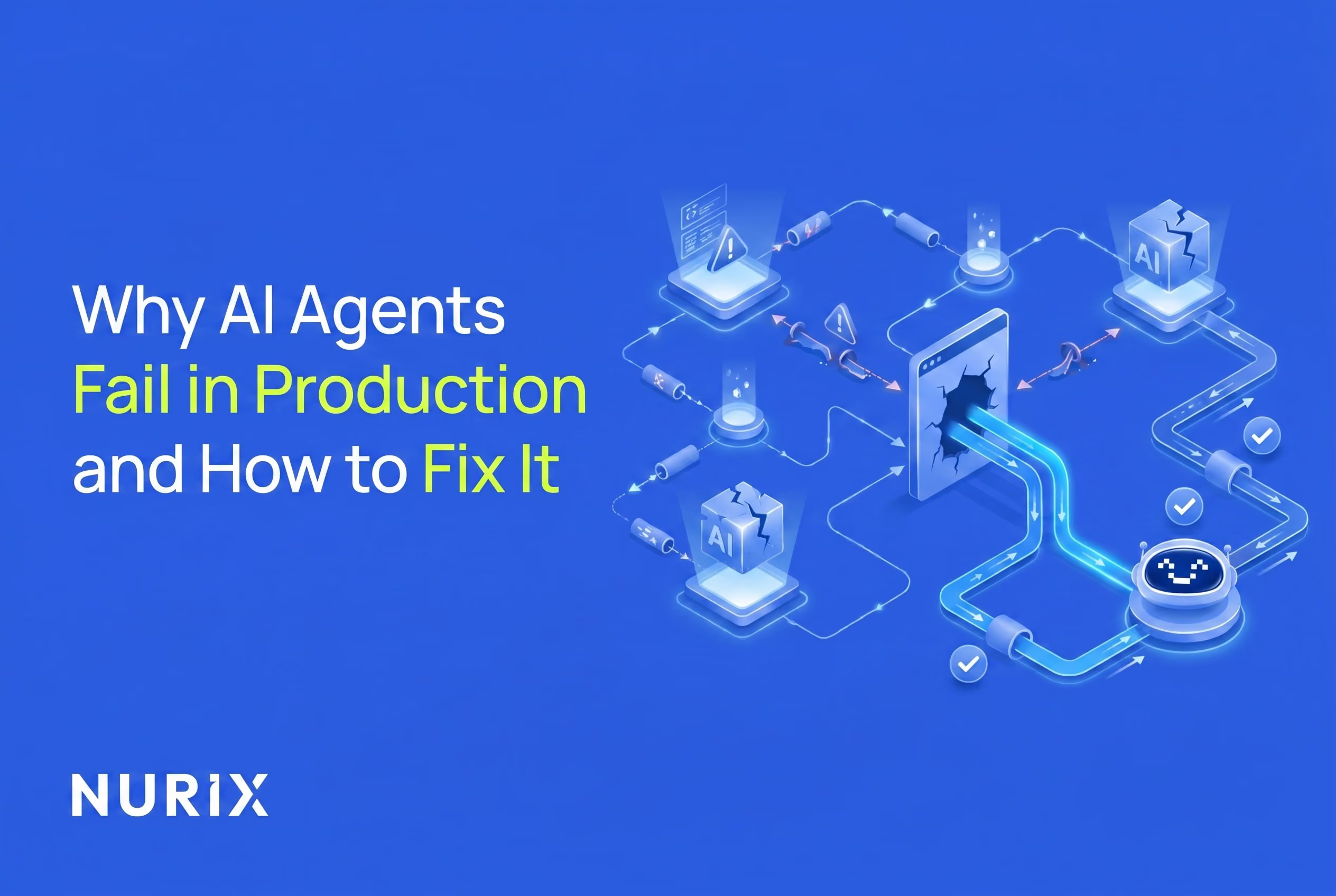

Why ai agents fail production stems from brittle integrations, context fragmentation, and agentic drift. While prototypes succeed in isolated sandboxes, 95% of enterprise AI pilots fail to generate measurable returns. Fixing this requires closing the feedback loop with human-approved diagnostics and governed changes rather than relying on static deployments.
Enterprise teams often deploy software that performs perfectly in a controlled demonstration but breaks under real-world volume and complexity. Understanding these failure points is essential for leaders managing high-stakes workflows in retail, insurance, and financial services. Automation without qualification just industrializes your bad habits. The system amplifies the quality of your inputs instead of fixing them. NuPlay AI approaches this problem by running enterprise workflows in live environments and improving them systematically.
What Is the Main Reason Why AI Agents Fail Production?
Why AI agents fail production is primarily due to agentic drift and brittle legacy integrations. Static deployments degrade as business logic, application programming interfaces (APIs), and data environments evolve away from their original training context.
Common Reasons AI Agents Fail in Production
Enterprise systems break because of brittle integrations with legacy data. Generic software wrappers lack the ability to connect deeply with proprietary organizational knowledge. Research indicates that agents fail on as much as 87% of real-world multi-agent tasks. This traces the largest share of failure to system design rather than model limitations.
Production success requires careful system design, multi-layered evaluation, and human-in-the-loop validation patterns. Without a mechanism for post-run validation and fixes, minor errors compound rapidly. A single broken integration can halt an entire back-office workflow.
The Gap Between Pilot and Production
High-volume repeatable workflows expose edge cases that simple prototypes never encounter. This gap highlights the software customization paradox. Enterprises require deep integration with sensitive, proprietary data that generic wrappers cannot handle.
Without proper orchestration, these isolated deployments suffer from agentic drift. They gradually degrade as business requirements change. Industry data reveals that 94% of these failures follow predictable patterns related to static architecture. Manual monitoring creates severe operational bottlenecks when teams try to fix these breaks, leaving operations leaders blind to underlying system faults.
Why Generic AI Agents Lack Reliability
The industry currently faces a reliability plateau. Model capabilities continue to climb, but the consistency of agents in production remains stagnant. Most platforms ship a static system that degrades as the business changes. Only 38% of production agents run automated evaluations on every prompt change.
This absence of continuous evaluation is the single most diagnostic predictor of long-term failure. Fragmented memory layers prevent agents from accessing historical context. Without human-in-the-loop approval for changes, generic agents act unpredictably.
Here is a side-by-side comparison of static deployments versus self-improving platforms.
| Feature | Static Deployments | Self-Improving Platforms |
|---|---|---|
| Architecture | Fragmented point tools | Unified agent orchestration |
| Adaptability | Degrades as workflows change | Improves run over run |
| Governance | Manual troubleshooting | Human approve-to-promote |
| Context | Isolated memory | Tiered organizational memory |
How NuLoop Enables Continuous Agent Improvement
NuPlay runs enterprise workflows in production and improves them after every run through NuLoop, with agents, the systems they operate, and the context they draw on under one platform. That contrasts with static deployments that degrade as the business changes. This closed feedback loop watches every agent run and ships validated fixes back into the platform.
Improvement happens through a strict sequence of Report, Diagnose, Propose, Try, and Ship. This governed change process increases coverage and resolves workflow friction. By automating the diagnostic phase, operations teams achieve up to 90% time savings in workflow maintenance.
Crucially, this process is never autonomous. NuLoop operates on an approve-to-promote model. A human operator reviews the proposed fix against historical runs and signs off before anything ships to production. This ensures complete enterprise control over every change.
Building Production-Ready Agent Workflows
Without a strong foundation, isolated agents face a 70-95% real-world failure rate. NuStack makes enterprise systems agent-ready by building, wrapping, or rebuilding legacy infrastructure. It orchestrates the entire workflow so that tasks flow logically from one step to the next.
Once the system is ready, NuPro executes the work. These task-specific micro-agents run on proprietary Astra and SEAL models. They draw on tiered memory that organizes information across organizational, agent, and user levels. This unified approach ensures every decision uses the most relevant, up-to-date business logic.
Monitoring Outcomes with NuPulse
Visibility is mandatory for enterprise control. Without it, unmonitored agents can execute destructive actions, such as the catastrophic database deletions seen in early 2025 pilot failures. NuPulse provides a real-time dashboard for status, volume, and outcomes.
This monitoring layer detects drift early. It feeds data directly into the diagnostic loop. Rollback is a cost of ownership, not a failure mode. The most successful enterprises use these dashboards to identify gaps and promote validated fixes systematically.
Conclusion
Generic deployments break because they cannot adapt to enterprise reality. NuPlay AI solves this by keeping agents, the systems they operate, and the context they draw on under one unified architecture. By moving the right work into agent mode and governing change through human approval, leaders can turn predictable failures into scalable, reliable workflows. Book a demo to see how the platform brings stability to your most complex operations.




.avif)