.gif)
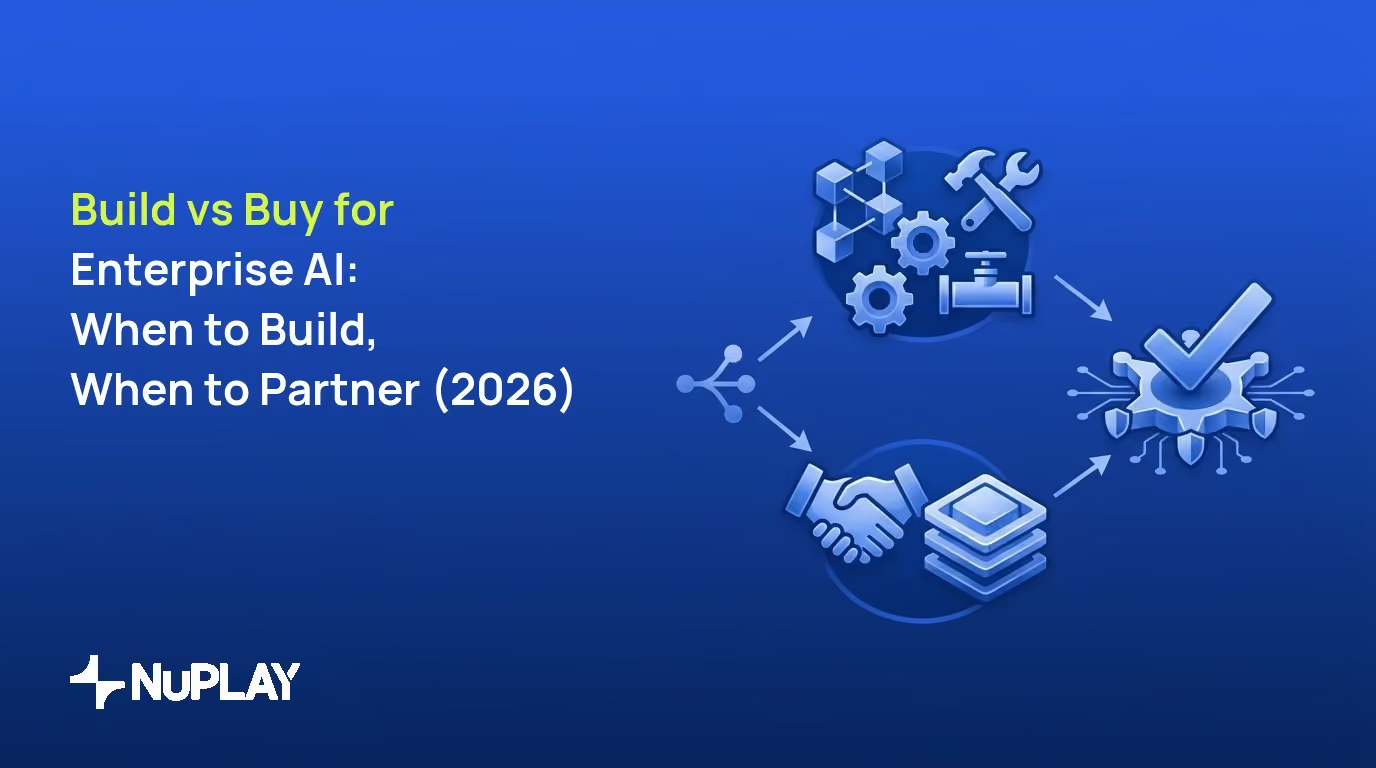

Build vs buy for enterprise AI is a governance and operating-model decision, not just a cost comparison. MIT-linked reporting found 95% of generative AI pilots fail to produce measurable P&L impact, so leaders should decide what to own internally and where a production partner reduces execution risk.
What is Build vs Buy for Enterprise AI?
That definition matters because buyers need to separate a production operating model from a prototype, tool purchase, or isolated model experiment.
Build vs buy for enterprise AI is the decision between creating an AI system internally, licensing an external platform, or working with a partner that combines platform infrastructure with hands-on deployment.
In enterprise AI, the choice is rarely binary. A bank may own its data, policies, and risk model while using a partner for workflow orchestration and production deployment. A retailer may keep strategy and customer experience design in-house while relying on an external system for voice agents, observability, escalation, and integrations.
The useful question is not, should we build or buy everything? The useful question is, which layers create strategic advantage, and which layers create avoidable operational burden?
The Build Path
The build path works only when the enterprise can own the platform disciplines around the model, including reliability, monitoring, governance, and upgrades.
Building in-house gives the enterprise maximum control. Internal teams can design the system around proprietary data, unusual workflows, and long-term platform goals. This is attractive when the AI system is central to the company's competitive advantage.
Build is strongest when the organization has:
- A mature AI engineering team
- Strong data platform ownership
- Security and compliance teams that can review AI systems continuously
- Product managers who understand the workflow deeply
- Budget for maintenance, monitoring, upgrades, and incident response
The hidden cost is not the prototype. The hidden cost is the production system around the prototype. Enterprises must build data pipelines, testing harnesses, model evaluation, access control, audit logs, rollback paths, and support processes. Without that foundation, the system remains a demo.
The Buy or Partner Path
The partner path works when the enterprise wants production delivery without rebuilding repeatable infrastructure that does not create proprietary advantage.
Buying or partnering reduces the operational burden. A strong partner brings reusable architecture, deployment experience, governance patterns, and workflow integration practices that have already been tested in live environments.
For NuStack by NuPlay AI, the partner model is not a generic software license. It combines platform infrastructure with forward-deployed engineers who work through the last mile of production deployment. That matters because enterprise AI usually fails between the model demo and the operating workflow. First Mid Insurance Group automated 100% of covered training workflows and reported a 25% productivity increase, an example of governed workflow operation rather than a standalone demo.
Partnering is strongest when the enterprise needs:
- Faster time to production
- Built-in governance and observability
- Secure workflow integration
- Lower total cost to deploy, run, and upgrade
- A system that operations teams can use without becoming an AI engineering organization
The tradeoff is less control over every component. The benefit is lower execution risk and a clearer path from use case to production.
Build vs Buy Comparison
Here is a practical side-by-side view of how the two paths compare across the factors enterprise buyers weigh most.
When to Build In-House
Build when the AI system is itself the strategic asset. If the workflow depends on proprietary algorithms, deeply differentiated data, or a unique operating model that no partner can support, internal ownership may be justified.
This path also works when the enterprise already has a platform engineering culture. The team should be able to support security reviews, model evaluation, monitoring, incident response, and version upgrades without pulling focus from the core business.
Building is risky when the organization only has a prototype team. A small team can create an impressive demo, but production requires a much broader operating system.
When to Partner
Partner when the business problem is clear but the internal team should not own every technical layer. This is common in workflow automation, customer operations, document processing, compliance operations, and enterprise support.
A partner is especially useful when the system must integrate with existing tools, follow strict governance rules, and keep improving after launch. The buyer still owns the business workflow. The partner owns the delivery discipline required to make the AI system run every day.
NuStack is built for this middle path. It gives enterprises a production-grade AI software platform while keeping implementation close to the actual workflow through forward-deployed engineering.
Governance and Operating Burden
The NIST AI Risk Management Framework defines governance and risk management as operating disciplines, which is why governance belongs inside delivery decisions.
The build-or-buy decision should include the operating model, not just the build plan. Enterprise AI systems need owners for policy changes, model evaluations, access control, incident response, and cost monitoring. If those owners are not named before launch, the system will drift after the first successful release.
Internal builds often underestimate this work because the prototype team is measured on speed. Production teams are measured on reliability. That shift changes the staffing model, the budget, and the technical architecture. A partner can reduce that burden when it brings reusable governance patterns, observability standards, and deployment experience from similar enterprise workflows.
The buyer still needs internal accountability. A platform partner cannot decide which workflow matters most, which data is authoritative, or which exceptions require human review. The strongest model keeps business ownership inside the enterprise while using a partner for the repeatable production layers that do not need to be rebuilt from scratch.
Risk Signals That Point Toward Partnering
Gartner predicts that more than 40% of agentic AI projects will be canceled by the end of 2027 because of escalating costs, unclear business value, or inadequate risk controls. Those failure modes should be part of the build-versus-partner decision.
Several warning signs suggest that a partner path may be safer than a pure internal build. The first is unclear ownership after launch. If no team owns monitoring, model updates, access reviews, and incident response, the system is not ready to become an internal platform. The second is dependency on one prototype team.
A demo can be built by a small group, but production requires security, operations, data, and business owners working together.
The third signal is a high volume of common enterprise work. If the workflow involves document intake, routing, customer operations, compliance operations, or structured back-office processing, the enterprise usually benefits from reusable platform components. Building those components repeatedly inside each business unit creates cost and governance drag.
How to Decide
A practical decision process starts with operating risk and business ownership, not with a blanket preference for internal or external engineering.
Use four questions before choosing a path.
- Is this workflow strategically unique, or is it a common enterprise process that needs better execution?
- Do we have the engineering depth to maintain the system for years, not just launch a pilot?
- How much governance, auditability, and security review will the use case require?
- What happens operationally if the system fails during a live workflow?
If the workflow is unique and the organization can own the full stack, build may be right. If the workflow needs reliable execution, lower total cost, and a faster route to production, partner.
What to do next
For a production partner path, review NuStack by NuPlay AI as a workflow automation and enterprise AI software deployment option.
The wrong build-or-buy decision creates years of drag. Enterprises either overbuild commodity infrastructure or buy tools that never survive contact with real workflows. The better path is to decide what must remain proprietary and partner for the layers where reliability, governance, and production delivery matter most. NuPlay AI uses NuStack to help enterprises take that practical middle path.




.avif)