.gif)
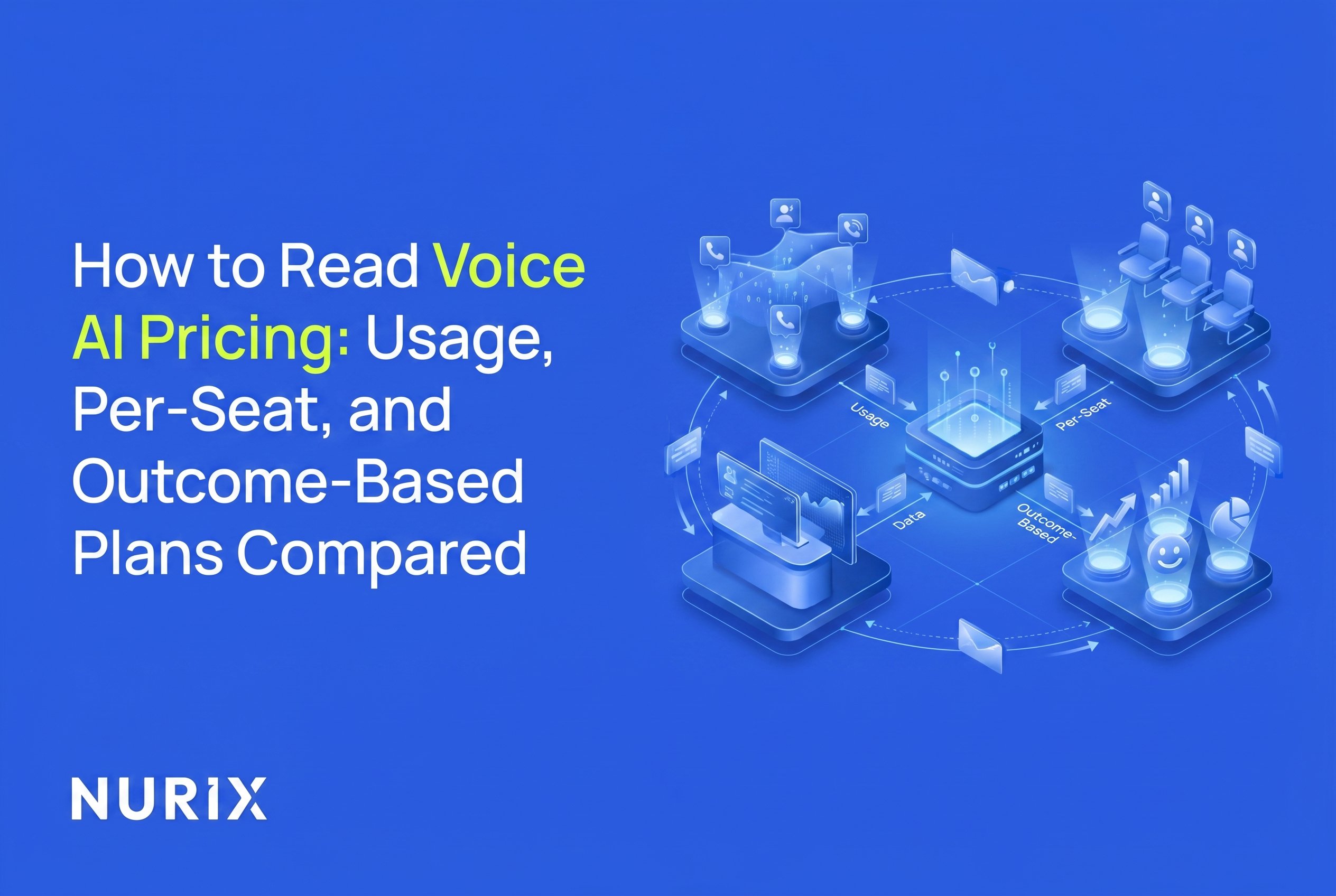

How to Read Voice AI Pricing: Usage, Per-Seat, and Outcome-Based Plans Compared in 2026
Buying enterprise software used to be simple. You counted the number of employees who needed access, multiplied that by a monthly fee, and sent the invoice to finance. Voice AI has changed that purchasing model. When you deploy artificial intelligence to handle customer support or sales calls, you are not only buying software access. You are procuring digital labor that consumes compute, telephony, orchestration, and support resources every time it works.
That shift creates a confusing market for enterprise buyers in 2026. Vendors use different billing structures, so apples-to-apples comparisons are difficult. One vendor may price around usage. Another may price around platform access. A third may connect commercial terms to completed business outcomes. Operations leaders and procurement teams need to understand those models before they compare proposals.
Enterprise-grade platforms like NuPlay (previously Nurix) focus the conversation on measurable business outcomes rather than raw compute. This guide explains the most common voice AI pricing structures, the risks behind each model, and the questions your finance team should ask before contract review.
What Is Voice AI Pricing?
Voice AI pricing is the commercial model used to charge for AI agents that speak with customers, understand intent, trigger workflows, and complete tasks across enterprise systems. A good pricing model should connect usage, reliability, and business value so buyers can forecast cost without losing sight of outcomes.
Unlike traditional software as a service (SaaS), voice AI has meaningful variable cost. Every live call can touch at least five production layers: telephony, speech-to-text, a large language model (LLM), text-to-speech, and infrastructure or workflow orchestration. LiveKit's voice-agent architecture guide describes the core pipeline as speech-to-text (STT), LLM, and text-to-speech (TTS), while AssemblyAI's voice-agent architecture guide adds an orchestration layer that manages data flow, turn detection, interruption handling, and error recovery. Those inputs scale with call volume, complexity, language coverage, and latency requirements.
The right model depends on who should carry volume risk: the buyer, the vendor, or both. That is the core commercial question behind every voice AI proposal.
The 7 Voice AI Pricing Models Explained
1. Usage-Based Pricing
What it is: Usage-based pricing charges according to actual consumption. The billing unit may be call time, interaction count, API usage, or another metered signal.
Key details:
- Billing unit: Active voice interaction, API usage, or model consumption.
- Cost behavior: Spend rises when call volume rises and falls when volume drops.
- Contract shape: Often useful for pilots, seasonal teams, or narrow first deployments.
- Risk profile: The buyer carries more budget risk during demand spikes.
- Control needs: Finance teams need usage caps, alerts, and clear definitions of billable activity.
Why it stands out: This model keeps early adoption flexible. Teams can test voice AI on a focused workflow without committing to a broad enterprise rollout.
What to consider: Forecasting can be difficult when call volume is volatile. Ask how the vendor reports usage, handles abandoned calls, and prevents surprise spend.
2. Per-Seat Pricing
What it is: Per-seat pricing charges for each human user who manages, monitors, or configures the platform.
Key details:
- Billing unit: Human administrator, supervisor, or platform user.
- AI exclusion: The AI agents are not usually counted as seats.
- Budget behavior: Predictable for procurement teams because spend maps to named users.
- Operational fit: Works best when platform governance and human oversight are the primary cost drivers.
- Risk profile: Pricing can become disconnected from the actual work completed by the AI.
Why it stands out: Procurement teams understand this model. It is easy to approve, budget, and renew.
What to consider: A seat-based model can understate or hide usage economics. Confirm whether high call volume, premium voice models, integrations, or analytics are billed separately.
3. Outcome-Based Pricing
What it is: Outcome-based pricing connects payment to verified business results, such as resolved support requests, qualified leads, completed bookings, or processed transactions.
Key details:
- Billing unit: A defined and auditable business outcome.
- Success definition: The contract must specify what counts as completed, partial, failed, or escalated.
- Risk profile: The vendor carries more delivery risk because payment depends on results.
- Measurement needs: Requires integration with CRM, helpdesk, order, or workflow systems.
- Buyer fit: Strong for teams that want the business case tied to cost-to-serve, conversion, or throughput.
Why it stands out: It aligns incentives. Buyers pay for work that gets done, not just time spent in conversation.
What to consider: Poor definitions create disputes. Decide how repeat contacts, abandoned calls, human handoffs, and partially completed workflows are counted before signing.
4. Tiered and Volume Pricing
What it is: Tiered pricing changes commercial terms as usage grows. Higher-volume deployments may receive better economics or additional platform capabilities.
Key details:
- Billing unit: Usually usage, interactions, or a committed volume band.
- Package design: Tiers may bundle support, analytics, voice quality, integrations, or governance controls.
- Budget behavior: More predictable than pure usage pricing when baseline volume is stable.
- Scaling behavior: Larger rollouts can improve unit economics if the deployment performs well.
- Review needs: Buyers should understand what happens when usage crosses a tier boundary.
Why it stands out: It gives enterprises a path from pilot to department rollout to global deployment.
What to consider: Make sure tier changes do not create hidden operational constraints. Ask which capabilities are available at each tier and whether mission-critical controls are optional.
5. Hybrid Pricing Models
What it is: Hybrid pricing combines a fixed platform component with a variable usage component.
Key details:
- Billing unit: Platform access plus metered usage.
- Feature access: The fixed component may cover dashboards, integrations, support, governance, or custom configuration.
- Budget behavior: Gives finance teams a stable baseline with usage variability layered on top.
- Operational fit: Useful for enterprises with predictable baseline demand and periodic spikes.
- Control needs: Buyers need reporting for both fixed and variable components.
Why it stands out: Hybrid pricing is often a practical middle ground. It lets the vendor support enterprise-grade infrastructure while giving the buyer room to scale.
What to consider: Confirm what is included in the platform component. If core governance or support is excluded, the headline model may look cleaner than the actual contract.
6. Minimum Commitment Plans
What it is: A minimum commitment plan sets a guaranteed baseline spend, usage level, or contract term in exchange for more favorable commercial treatment.
Key details:
- Billing unit: A committed baseline rather than only actual usage.
- Buyer fit: Best for mature teams with reliable historical volume and a clear production roadmap.
- Risk profile: The buyer carries underuse risk if demand falls below the committed level.
- Vendor benefit: Predictable revenue supports capacity planning, support staffing, and implementation work.
- Review needs: Contracts should define rollover, overage, underuse, and early termination terms.
Why it stands out: For stable high-volume teams, commitments can make large deployments easier to forecast and operate.
What to consider: Do not commit before the deployment has proven containment, reliability, and integration quality on real workflows.
7. Overage and Burst Fees
What it is: Overage and burst mechanics apply when usage exceeds the limits defined in a hybrid, tiered, or commitment model.
Key details:
- Billing unit: Usage beyond the contracted allowance or concurrency limit.
- Trigger events: Seasonal spikes, outages, campaigns, recalls, or support surges.
- Budget behavior: Low predictability unless alerts and caps are configured.
- Operational value: Prevents customer experience failures when demand suddenly rises.
- Review needs: Buyers should understand the exact trigger, reporting cadence, and escalation process.
Why it stands out: It gives enterprises flexibility without renegotiating the contract every time demand changes.
What to consider: Require automated alerts and a written surge plan. The goal is to protect both customer experience and budget governance.
Quick Comparison of Pricing Models
Here is a side-by-side comparison of the main voice AI pricing models and when each one fits.
Pricing ModelPrimary Billing UnitBest Enterprise Use CaseBudget PredictabilityUsage-BasedMetered usagePilots and seasonal workflowsLow to mediumPer-SeatHuman administratorGovernance-heavy platform accessHighOutcome-BasedVerified resultROI-focused support and sales workflowsVariable but value-linkedTiered / VolumeUsage bandTeams scaling from pilot to enterprise rolloutMediumHybridPlatform access plus usageStable baseline with variable demandMedium to highMinimum CommitmentCommitted baselineMature, high-volume production deploymentsHighOverage / BurstUsage above allowanceDemand spikes and continuity planningLow unless controlled
How to Choose the Right Economic Model for Your Enterprise
Selecting the right pricing model requires a clear view of operational maturity, call volume, and workflow complexity. Do not buy voice AI the same way you buy a CRM or an email client.
If you are early in adoption, start with a usage-based or hybrid model. This lets your team deploy agents for a narrow workflow, such as after-hours calls, lead qualification, or support triage. Use the first production phase to measure containment, escalation quality, latency, and integration effort.
Once baseline demand is proven, a tiered or commitment model can make sense. At that stage, procurement has evidence, operations understands expected volume, and finance can model spend against actual cost-to-serve.
For mature deployments, outcome-based pricing is worth exploring. It works best when both sides can verify results through connected systems, not spreadsheets or manual judgment.
When evaluating vendors, ask how their pricing scales if call volume rises sharply. Ask how incomplete calls, repeat contacts, handoffs, and system outages are counted. The transparency of those answers will tell you how confident the vendor is in its own operating model.
Conclusion
The economics of voice AI in 2026 require a shift in how enterprise leaders think about software procurement. You are no longer buying static tools. You are deploying a digital workforce that consumes infrastructure as it works.
Whether you choose usage-based, hybrid, tiered, commitment, or outcome-based pricing, the right model should make business value measurable. NuPlay is built for that enterprise reality: voice, chat, and workflow agents that complete real work across connected systems.
Enterprise teams evaluating voice AI pricing can request a NuPlay deployment walkthrough to compare commercial models against their specific call volume and workflow requirements.