.gif)

Enterprise buyers are not underwriting a slick demo. They are underwriting voice agents that resolve real customer conversations autonomously, in production, under live call load. That is a much higher bar, and it is where most tools fall down.
The pattern is familiar. A voice agent clears the demo, sounds natural for three scripted turns, then collapses on containment, procedure adherence, and latency once it meets messy real callers at scale. By then the contract is signed and the pilot has stalled.
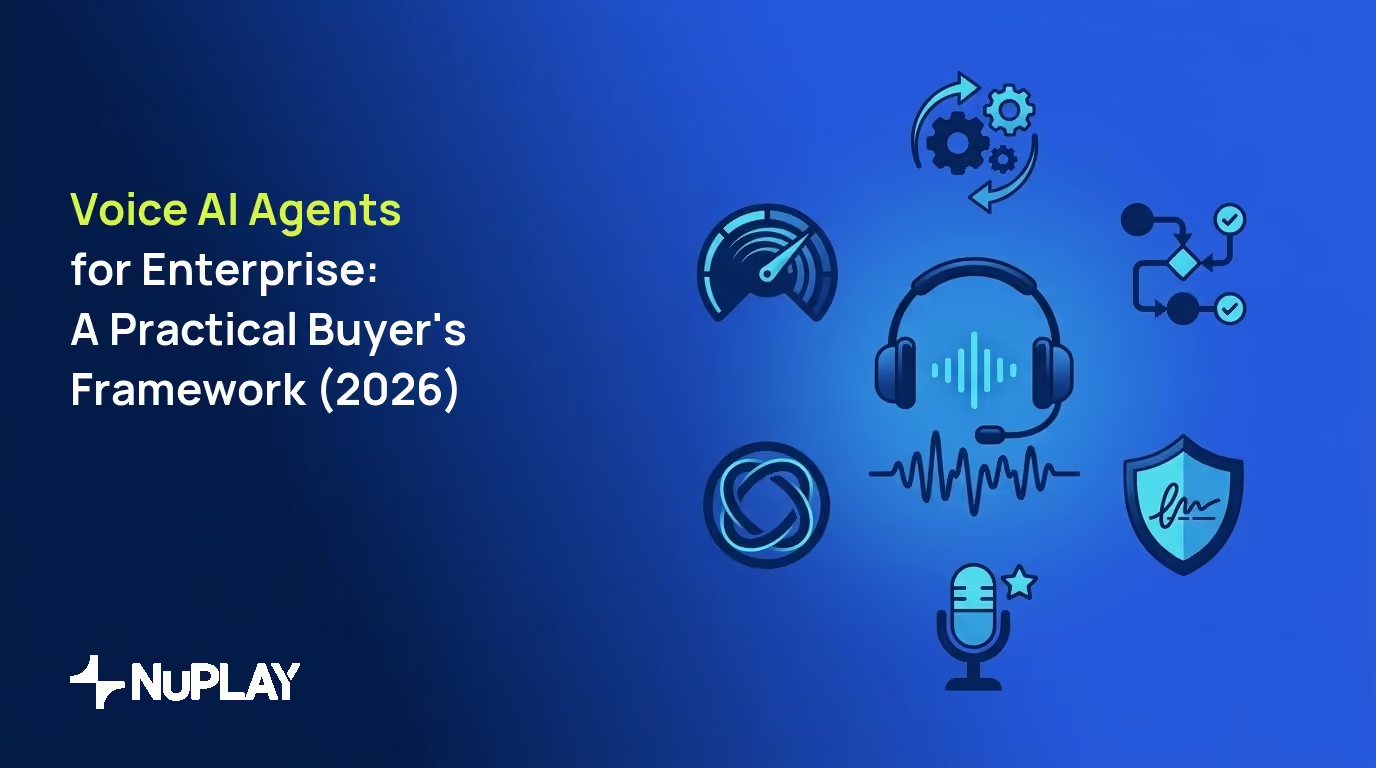
This guide gives you a way to avoid that. It sets out a six-criterion framework for evaluating enterprise voice AI agents, a simple scoring model you can reuse, and an honest side-by-side comparison of the vendors buyers actually shortlist, including NuPlay. Use it to separate what demos well from what runs in production.
What is a voice AI agent?
A voice AI agent is an autonomous software agent that holds real-time spoken conversations with customers, understands intent, and completes tasks end to end by following defined business procedures. Unlike an IVR (interactive voice response) menu or a scripted bot, it reasons over context and orchestrates actions across systems to resolve a request without human handoff.
That distinction matters for enterprise evaluation. Builder toolkits give developers components to assemble a voice app, and the reliability of the result depends on what the team builds. Full-stack agentic platforms manage orchestration, procedure adherence, and containment as part of the product. Both can sound good in a demo. Only one class is engineered to hold up in production.
Why enterprise voice AI evaluations fail
Most evaluations fail because the demo and production are different problems. A demo optimizes for a smooth, happy path on a quiet line. Production means thousands of concurrent calls, interruptions, accents, edge cases, and business rules that must be followed every single time.
The metrics that look impressive in a sales call, response speed on one turn or a clean sample transcript, say little about whether the agent contains conversations without human handoff or follows a standard operating procedure on call 10,000. Buyers who score demos instead of production behavior end up with tools that stall at rollout.
The fix is to evaluate against criteria that predict production performance, then validate them in a short pilot on your own intents. The next sections give you both.
Six criteria for evaluating enterprise voice AI agents
Score every shortlisted vendor against the same six criteria. For each one, measure it the same way, and test it in a pilot rather than trusting a slide.
Latency
Latency is turn-taking response time: how quickly the agent replies after the caller stops speaking. What matters is not a single best-case number but consistent, low latency across a live conversation, so replies do not overlap or stall. Measure it under real call load, not on one quiet test line. Awkward pauses and cut-offs are what make a caller feel they are talking to a machine.
TTS (text-to-speech) quality
TTS quality covers naturalness of the synthesized voice, barge-in handling (letting a caller interrupt), and how gracefully the agent recovers when it is interrupted. Test it by talking over the agent mid-sentence and by throwing it off-script. A natural voice that cannot handle interruption will frustrate callers even if it sounds good reading a prepared line.
Containment
Containment is the share of conversations the agent resolves without human handoff. It is the single clearest signal of production value. Independent voice AI benchmarks put typical containment around 20–40% in early deployments and roughly 40–70% in mature deployments, depending on call mix and industry. Ask each vendor how it defines and measures containment, and confirm resolved outcomes in your pilot on real intents.
SOP (standard operating procedure) adherence
SOP adherence measures whether the agent follows your business process correctly every time, not just usually. For regulated workflows this is non-negotiable. Test it by running the same procedure across many calls and checking for drift. In production, NuPlay reports 99 percent SOP adherence, which is the reliability level enterprise processes require.
Orchestration
Orchestration is the ability to take multi-step actions across systems, tools, and handoffs within one conversation, rather than answering a single question and stopping. An agent that can look up an account, update a record, trigger a downstream workflow, and confirm the outcome is doing agentic work. A single-turn responder is not. Ask to see a multi-step task completed live.
Security and compliance
Confirm the controls your industry requires: SOC 2 Type 2, ISO 27001, HIPAA for healthcare data, and GDPR for personal data. For customer-facing voice, also check regulations that govern outbound calling and consent, including TCPA in the United States and India's DPDP (Digital Personal Data Protection) Act. Verify certifications and data-handling terms before you run a live test, not after.
A scoring model you can reuse
Turn the six criteria into a simple weighted scorecard. Score each vendor 1 to 5 on each criterion, multiply by a weight that reflects your use case, and total the result. The math is criterion times weight times score, summed across all six.
Weights should follow your priorities. A support-led buyer usually weights containment and SOP adherence highest, because those drive cost and risk, then latency and TTS quality for caller experience, with orchestration and security as gating requirements. A developer-led team building a custom application may weight orchestration and latency higher. Set the weights before you see any demos, so the process stays honest.
Here is a side-by-side comparison of leading enterprise voice AI agents against the criteria above.
Figures are as published by each vendor or, for NuPlay, from production deployments. Unpublished cells are marked "not published." Treat any unmarked third-party benchmark as unverified until you see the source.
The table splits into two groups. Builder toolkits such as Vapi, Retell, and Bland give developers the components to assemble a voice application, which suits prototypes and teams that want full control over what they build. Full-stack agentic platforms such as Decagon, Sierra, and NuPlay manage orchestration, procedure adherence, and containment as part of the platform, which suits production at enterprise scale. Neither group is better in the abstract. The right choice depends on whether you are building a custom app or buying production reliability.
Where NuPlay fits
NuPlay's full-stack agentic voice platform is built for the criteria where demo-grade tools tend to fail: production containment and SOP adherence at enterprise scale. It is not a chatbot, an IVR, or a no-code toy, and it is not a set of components you assemble yourself.
The production numbers are what buyers weigh. NuPlay reports 99 percent SOP adherence in production, 75 percent containment at maturity, and up to 90 percent reduction in AHT (average handle time). At Walmart APAC, its agents handle 1.2 million conversations a month with 82 percent autonomous resolution and a 40 percent-plus cut in customer experience cost, the kind of result retail and insurance buyers are underwriting. More than 30 enterprises run its agents in production today.
NuPlay is one option among the platforms above, and the right fit depends on your weighted criteria. For teams that also build custom internal AI workflows, NuStack by NuPlay is a separate product for that job. If your shortlisting is purely head-to-head, comparison pages such as Retell and Vapi alternatives cover that intent directly. To see how the platform performs on your intents, talk to the team and run a pilot.
How to run a 2-week voice AI pilot
A short, structured pilot on your own data will tell you more than any demo. Run it the same way for every shortlisted vendor so the scores are comparable.
- Pick 2 to 3 real intents. Audit your call logs and choose the highest-volume, most repetitive reasons customers call, not edge cases.
- Define the SOPs. Write down the exact business procedure the agent must follow for each intent, including required disclosures and escalation rules.
- Set targets. Agree on containment and latency targets up front, for example a containment floor and a maximum acceptable response time.
- Run in parallel against a human baseline. Route a controlled share of traffic to the agent and compare its handling directly with your human team on the same intents.
- Score with the model above. Rate each vendor 1 to 5 on the six criteria, apply your weights, and monitor transcripts daily to see how the agent handles interruptions, difficult callers, and unusual requests.
- Decide on production behavior, not the demo. Shortlist on the framework, then commit only to the vendor that holds its containment and SOP adherence across the full pilot.