.gif)
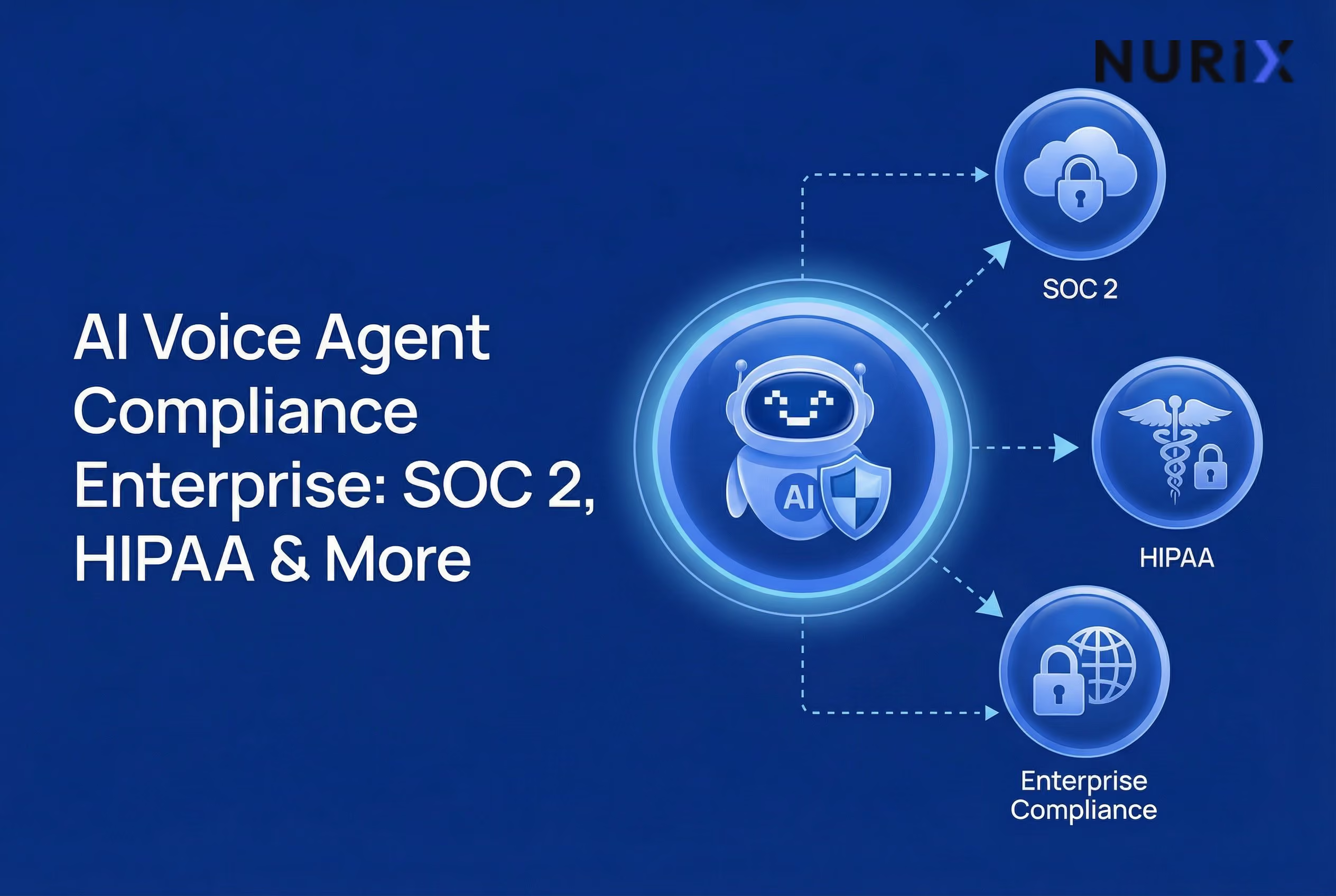

Enterprise AI voice agent compliance means designing each voice workflow around the rules that apply to its data and calls: validated security controls, healthcare safeguards where protected health information is involved, documented consent for regulated outreach, and privacy rights for personal data. The practical test is whether the enterprise can prove those controls work in production.
Gartner predicts that 40% of enterprise applications will feature task-specific AI agents by the end of 2026, up from less than 5% in 2025. Enterprises evaluating agents should request relevant vendor security evidence, including a SOC 2 Type II report, as part of their security and procurement review. Gartner
What is enterprise AI voice agent compliance?
Enterprise AI voice agent compliance is the set of technical, contractual, operational, and governance controls that let an enterprise use voice agents while meeting applicable security, privacy, healthcare, calling, and artificial intelligence requirements.
Compliance is not a vendor checkbox. It is a workflow-level exercise. The same platform may support a low-risk inbound order-status call and a tightly controlled healthcare or outbound telemarketing workflow, but the data, audience, jurisdiction, call purpose, and required controls can differ.
Before selecting a vendor, answer four questions:
- What data will the agent collect, infer, store, or send to another system?
- Who is being called, where are they located, and is the call inbound or outbound?
- What decision or action can the agent take, and can a person review or override it?
- What evidence must the enterprise retain to demonstrate consent, access control, configuration, and incident response?
Use this map to identify the primary compliance lane before selecting controls.
This framework prevents a common procurement error: treating a general security report or a vendor statement as proof that every workflow is compliant.
SOC 2 Type II: use it as assurance evidence, not a shortcut
The American Institute of Certified Public Accountants (AICPA) describes System and Organization Controls reports as assurance reports that help users assess and address risks associated with outsourced services. SOC 2 reporting can cover controls relevant to security, availability, processing integrity, confidentiality, or privacy. AICPA, System and Organization Controls: SOC Suite of Services
SOC 2 is not a certification. The AICPA describes SOC reports as assurance reports that provide users with information needed to assess and address risks associated with outsourcing services. Review the report’s scope carefully. It does not prove that a customer configured its own workflow correctly, or that the report covers every service used in a voice deployment.
Use this vendor-review method:
- Request the actual Type II report. Obtain it through the vendor’s established security-review process rather than relying on a badge or marketing statement.
- Check the report scope. Confirm that it covers the voice, transcription, model-serving, storage, identity, and integration services in the proposed architecture.
- Review exceptions. Read the auditor’s opinion, listed exceptions, and management’s explanation or remediation response.
- Identify subservice organizations. Review cloud, telephony, transcription, identity, and other providers that support the service.
- Map customer-owned controls. Determine which controls remain with your team, including retention settings, access roles, consent workflows, and incident response.
- Match the report to the workflow. A report covering a vendor’s web application does not automatically cover its voice infrastructure or every connected system.
The key question is not whether a vendor has SOC 2. It is whether the report’s scope matches the architecture you plan to deploy and whether your team can operate the customer-owned controls.
HIPAA: begin with the role of the data and parties
The Health Insurance Portability and Accountability Act (HIPAA) becomes relevant when a covered entity or business associate handles protected health information (PHI). The United States Department of Health and Human Services (HHS) explains that business associates perform functions or provide services involving the use or disclosure of PHI on behalf of covered entities. A covered entity may disclose PHI to a business associate when it obtains the required assurances through a contract or other written arrangement, commonly called a Business Associate Agreement (BAA). HHS, Business Associates
Start with the data and the parties, not with the vendor’s product label. For a voice workflow, determine whether the following contain PHI:
- Voice recordings and transcripts
- Caller identity and account information
- Prompts and conversation context
- Agent summaries
- Customer relationship management (CRM) records
- Escalation notes and downstream case records
If a vendor acts as a business associate for the proposed workflow, establish the required contractual relationship, including a BAA where applicable, before sending PHI to the vendor. Review whether the agreement addresses permitted uses, safeguards, incident handling, and relevant subcontractors.
Technical and operational controls should include:
- Least-privilege access and strong authentication
- Audit logs for PHI access and administrative actions
- Retention and deletion rules for recordings, transcripts, prompts, and summaries
- An incident escalation and response process
- Clear separation between approved administrative tasks and decisions requiring human review
For example, an agent may collect information for appointment scheduling or a claims inquiry while escalating clinical judgment, diagnosis, or high-risk triage to an appropriately authorized person. Encryption, a BAA, or a “HIPAA-ready” product statement alone does not make a deployment compliant. The entity’s use case, policies, configuration, and vendor relationship all matter.
TCPA and telemarketing: separate consent from recording notice
The Telephone Consumer Protection Act (TCPA) and the Telemarketing Sales Rule (TSR) apply based on the call, audience, purpose, technology, and jurisdiction. They are customer obligations and evaluation criteria, not certifications that a voice agent vendor can simply claim.
In February 2024, the Federal Communications Commission (FCC) ruled that the TCPA restrictions on “artificial or prerecorded voice” cover current artificial intelligence technologies that generate human voices. The FCC states that calls using those technologies require the called party’s prior express consent. FCC Declaratory Ruling FCC-24-17
That does not mean every AI voice call requires prior express written consent. Your compliance team should assess:
- Whether the call is inbound or outbound
- Whether it is informational, transactional, or telemarketing
- The type of number being called
- The consent basis and how it was collected
- Federal, state, and internal do-not-call requirements
- The disclosure and opt-out language used in the call
- Whether recording creates a separate notice or consent requirement
A recording notice is not a substitute for the consent required for a regulated outbound campaign. Treat the two questions separately and obtain current legal guidance for the jurisdictions in scope.
The FTC’s TSR includes disclosure requirements, restrictions on telemarketing conduct, do-not-call provisions, and recordkeeping requirements. The FTC states that particular business records must be kept for two years. It also describes requirements for prerecorded telemarketing messages, including a written agreement and an automated interactive opt-out mechanism in relevant circumstances. FTC, Complying with the Telemarketing Sales Rule
Use this outbound-call control sequence:
- Verify the permitted audience and consent basis before dialing.
- Check federal, state, and internal suppression lists.
- Deliver required disclosures and provide a usable opt-out.
- Write opt-outs immediately to the suppression system.
- Retain consent, call, disclosure, and opt-out evidence in a searchable audit trail.
- Prevent script or workflow changes from bypassing those controls.
The agent should not be able to proceed merely because a campaign record exists. Consent and suppression checks should be preconditions to dialing, with a human-approved process for material campaign changes.
GDPR and EU AI Act: distinguish personal-data rules from AI-specific rules
The General Data Protection Regulation (GDPR) can apply to a United States-based provider. Article 3 covers processing in the context of an establishment in the European Union, regardless of where processing occurs. It can also apply to a non-EU organization that offers goods or services to people in the Union or monitors their behavior there. GDPR, Article 3
A call recording, transcript, caller identifier, account detail, or inferred preference can be personal data when it relates to an identified or identifiable person. Your review should address:
- The purpose of each processing activity
- The lawful basis for processing
- Transparent notices for callers
- Data minimization
- Retention and deletion periods
- Data-subject rights and the route for handling requests
- Processor contracts
- International data transfers and the applicable transfer mechanism
- Access controls for recordings, transcripts, summaries, and connected records
Consent is not always the lawful basis under GDPR. The correct basis depends on the processing purpose and the organization’s role. A single voice interaction may involve several purposes, such as fulfilling a service request, recording quality information, creating a case summary, and using data for analytics. Document each purpose rather than treating the whole call as one undifferentiated activity.
The EU Artificial Intelligence Act adds AI-specific obligations. In 2026, its transparency requirements include informing people when they interact with certain AI systems, such as chatbots. The European Commission also states that high-risk AI obligations are scheduled to apply from 2 December 2027. European Commission, AI Act
Do not assume that every customer-service voice agent is high-risk. Assess the system’s use, role, decision, affected person, and applicable AI Act category. If the workflow can affect access to important services or make decisions with legal or similarly significant effects, involve legal and compliance specialists before deployment.
Worked example: build controls around one workflow
The following is a hypothetical example.
Hypothetical: an insurer launches an inbound policy-service agent and an outbound renewal campaign
The insurer should assess the two workflows separately even though they use the same organization, platform, and customer records.
Inbound policy servicing
Map every data element the agent touches:
- Caller identification
- Policy details
- Voice recording and transcript
- CRM updates
- Agent summary
- Escalation records
Then validate access roles, retention settings, authentication before account disclosure, and escalation for coverage disputes. If the workflow handles PHI for a covered entity or business associate, add the applicable HIPAA and BAA review rather than assuming that the insurance context alone determines the answer.
Outbound renewal campaign
Treat consent and suppression as preconditions to dialing. Preserve:
- Consent source
- Consent date
- Campaign identifier
- Disclosure version
- Call record
- Opt-out event
- Suppression status
The campaign should not rely on a current customer relationship alone. The compliance team should confirm the permitted calling basis for the campaign, the number type, the message purpose, and the relevant federal and state requirements.
European Union residents
If people in the European Union are in scope, document the GDPR processing purpose, lawful basis, notice, retention period, processor terms, transfer mechanism, and rights-request route. If the voice interaction falls within an AI Act transparency requirement, include the required disclosure in the call experience.
Workflow changes
If the insurer changes a prompt, call script, authentication step, or integration logic, test the revised workflow against recorded edge cases before production release. A change that appears operationally small can alter what data the agent reveals, which action it takes, or whether the consent and suppression controls still run.
Success checks
A reviewer should be able to:
- Retrieve the consent record for a sampled outbound call
- Reconstruct who accessed a transcript
- Identify the active script and disclosure versions
- Show the outcome of an escalation
- Confirm that an opt-out prevents later campaign enrollment
- Identify the workflow configuration in effect when the call occurred
These checks turn compliance from a policy document into evidence that the enterprise can retrieve and review.
Enterprise implementation checklist
Use this checklist before moving an AI voice workflow from evaluation into production:
- Inventory the data. List recordings, transcripts, identifiers, inferred information, prompts, summaries, and downstream records.
- Map jurisdictions. Identify where callers are located, where processing occurs, and which markets the workflow serves.
- Classify the workflow. Record whether it is inbound or outbound, informational or telemarketing, healthcare-related, and capable of affecting a person’s rights or access.
- Request vendor evidence. Obtain the relevant SOC 2 Type II report, scope statement, exceptions, subservice list, contractual terms, and BAA where applicable.
- Configure controls. Set access roles, authentication, retention, deletion, consent, suppression, notice, escalation, and logging rules.
- Test edge cases. Include consent withdrawal, opt-out handling, failed authentication, deletion requests, transcript access, risky responses, and integration failures.
- Train supervisors. Define when a person must intervene, how incidents are escalated, and who approves production changes.
- Review evidence periodically. Check that logs, consent records, configurations, and vendor reports remain available and match the live workflow.
- Approve material changes before release. Route prompt, script, model, integration, and data-retention changes through the same governance process as the initial deployment.
NuPlay AI runs enterprise workflows in production and improves them after every run through NuLoop, with agents, the systems they operate, and the context they draw on under one platform. NuPlay platform NuLoop’s governed change process follows Report, Diagnose, Propose, Try, and Ship. Changes are tested against real past runs with rollback, and a human approves them before they ship. SOC 2 Type 2, ISO 27001, HIPAA, and GDPR compliant.