.gif)
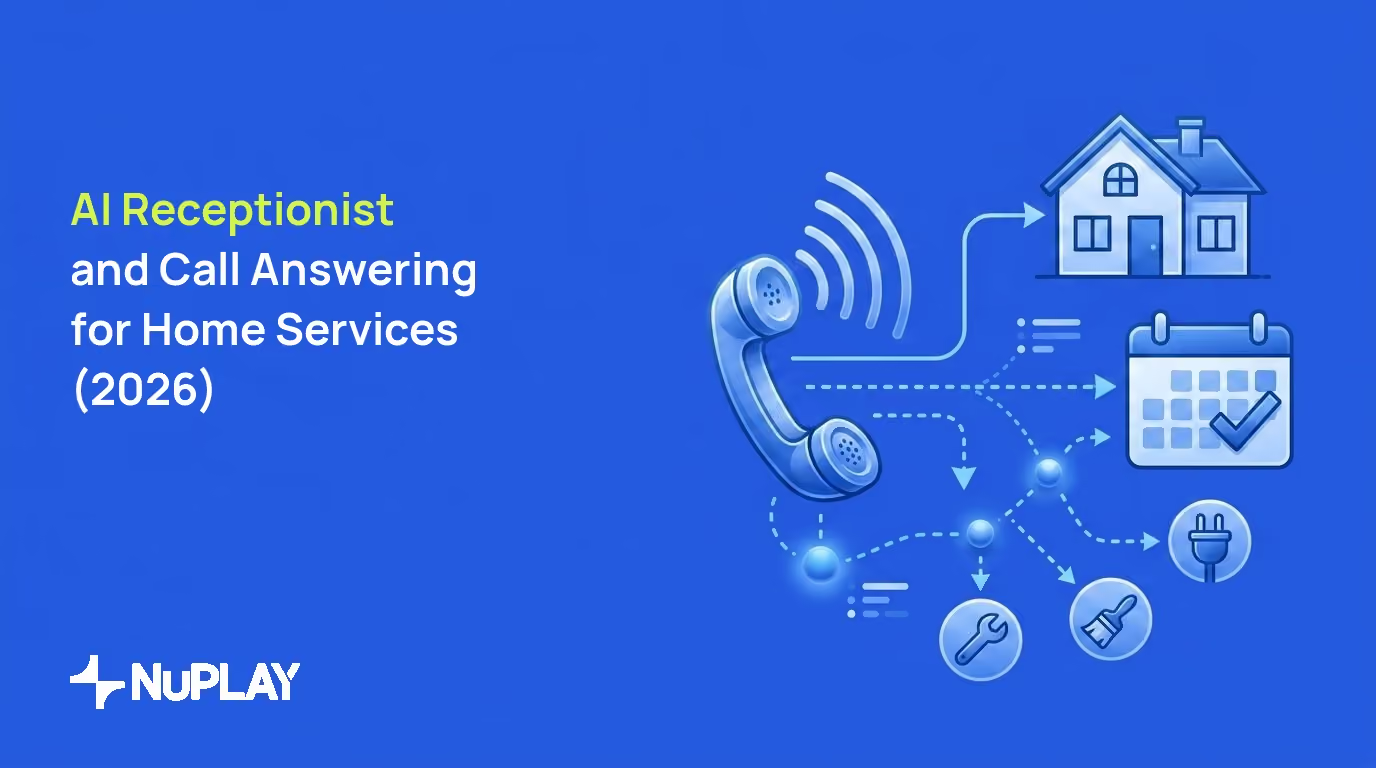

An AI receptionist is a production-grade system that answers inbound calls, interprets intent, and executes business workflows like scheduling or lead qualification. In home services, missing calls results in lost revenue, as 71% of homeowners will call the next company immediately if they reach a voicemail greeting.
Home service businesses face high call volumes that demand reliable, scalable handling. Understanding AI receptionists helps leaders evaluate tools that manage scheduling, inquiries, and follow-ups without constant human oversight. This guide breaks down the technology and its fit for the industry. Rather than relying on static call answering systems that break when business rules change, enterprises are shifting to self-improving platforms. NuPlay AI runs enterprise workflows in production and improves them after every run. This keeps operations running smoothly even during peak seasonal demand.
What is an AI Receptionist
An AI receptionist is a system that answers inbound calls, routes requests, and completes routine tasks using voice agents. In home services, it manages appointment booking, service quotes, and customer follow-ups across high-volume operations. The 2026 version integrates directly with existing customer relationship management (CRM) and scheduling tools to maintain context across conversations.
Standard platforms often fail because home services require deep, bespoke integration with sensitive dispatch data that generic bots cannot handle. This creates a software customization paradox. Currently, 72% of deployments focus on handling these exact scheduling and routing tasks. NuPro task-specific micro-agents execute these interactions, providing the execution layer for voice and chat agents that handle the actual customer conversation.
How AI Receptionists Work
Calls are received and processed through voice agents that interpret intent and pull relevant customer data. Workflows then execute tasks such as confirming availability or dispatching technicians while logging outcomes. Agentic AI dramatically increases the number of operations, orchestrating dozens of real-time data lookups and model inferences before deciding in milliseconds whether to approve, decline, or flag a transaction. This ensures customers get immediate answers about service windows.
Continuous monitoring tracks volume, resolution rates, and exceptions for later review and adjustment. Without this tracking, home service companies face 37% missed opportunities on inbound calls. NuPulse provides the real-time status and outcome dashboard needed to feed data into the improvement loop. This guarantees that every missed intent or failed workflow is captured for diagnosis.
Key Concepts and Terminology
Enterprise deployments rely on specific architectural concepts to function reliably. Agent mode refers to tasks handled by software with human approve-to-promote checkpoints for changes. Context layers store organizational, agent, and user information to keep responses consistent across multiple interactions. Generative AI usage for observability has reached 85% among enterprise teams, highlighting the need for deep system visibility.
Closed feedback loops diagnose issues, propose fixes, test changes, and ship validated updates. NuLoop is the core differentiator that ensures the AI receptionist improves after every run by diagnosing and fixing workflow failures. It uses a governed Report, Diagnose, Propose, Try, Ship cycle. This governed change process ensures the system adapts to new business rules without requiring manual rewrites.
Examples and Use Cases
Heating, ventilation, and air conditioning (HVAC) companies use AI receptionists to book emergency repairs and send technician details automatically. With 76% smart tech adoption among homeowners, customers expect immediate, digital-first responses. Plumbing firms route after-hours calls, qualify leads, and schedule next-day visits without staff intervention. This keeps the dispatch board full even when the main office is closed.
Electrical service providers handle recurring maintenance requests and update customer records in real time. In each case, the system executes a complete workflow rather than just taking a message. The modern enterprise runs on a federation of systems, each holding governed, context-rich data that the receptionist accesses instantly.
Here is a side-by-side comparison of traditional answering services versus a self-improving AI receptionist.
| Feature | Traditional Answering Service | AI Receptionist |
|---|---|---|
| Execution | Takes messages and passes notes | Executes full scheduling workflows |
| Context | Limited to caller ID | Accesses full CRM and user history |
| Improvement | Requires retraining staff | Diagnoses failures and proposes code fixes |
| Integration | Manual data entry | Direct API connection to dispatch systems |
Benefits and Importance
Deploying this technology reduces missed calls and improves response times during peak demand periods. A missed home service call results in a $285 average revenue loss. Automating the front desk frees staff to focus on complex issues while routine work runs in agent mode. This reallocation of labor improves employee satisfaction and reduces burnout.
Enterprise platforms deliver governed improvements through structured report, diagnose, propose, try, ship cycles. High-performing organizations often see a 5.1 months median payback period for specific agent deployments. By using NuLoop, companies ensure their workflows improve continuously, extending coverage to new edge cases as they arise.
Common Misconceptions
The technology does not replace people but shifts repeatable tasks into agent mode with oversight. Only 10% of the effort is the model itself, while 70% involves the redesign of human workflows and operational processes. Another misconception is that these systems operate entirely on their own. In reality, 95% of enterprise AI pilots fail to deliver returns when they lack human-in-the-loop governance.
Improvement comes from diagnosis and coverage updates rather than generic accuracy claims. Voice handling serves as proof of capability, not the sole identity of enterprise platforms. The goal is executing the enterprise workflow, whether that happens over voice, chat, or backend data processing.
Implementation Considerations for 2026
Assess current call workflows to identify which tasks suit automated or agent modes. The technology is only as good as the operator behind it, and leaders must teach their teams to think clearly about when to reach for AI. Select platforms that combine execution, context, and improvement layers under one system.
NuStack workflow orchestration is required to make legacy scheduling systems agent-ready and orchestrate the complex dispatching workflows. Establish human sign-off processes to maintain control over changes and outcomes. With a 52% adoption rate in home services, moving quickly requires moving safely. NuPlay AI maintains SOC 2 Type 2 and ISO 27001 certifications and supports HIPAA and GDPR compliance requirements.
Conclusion
An AI receptionist becomes a production-grade asset for home services when paired with structured improvement loops that keep workflows current. Static deployments degrade as the business changes, but a self-improving platform adapts to new edge cases and scheduling rules. By running workflows in production and improving them after every run, enterprises can scale their operations reliably. Book a demo to see how NuPlay AI can transform your call answering and dispatch workflows.