.gif)
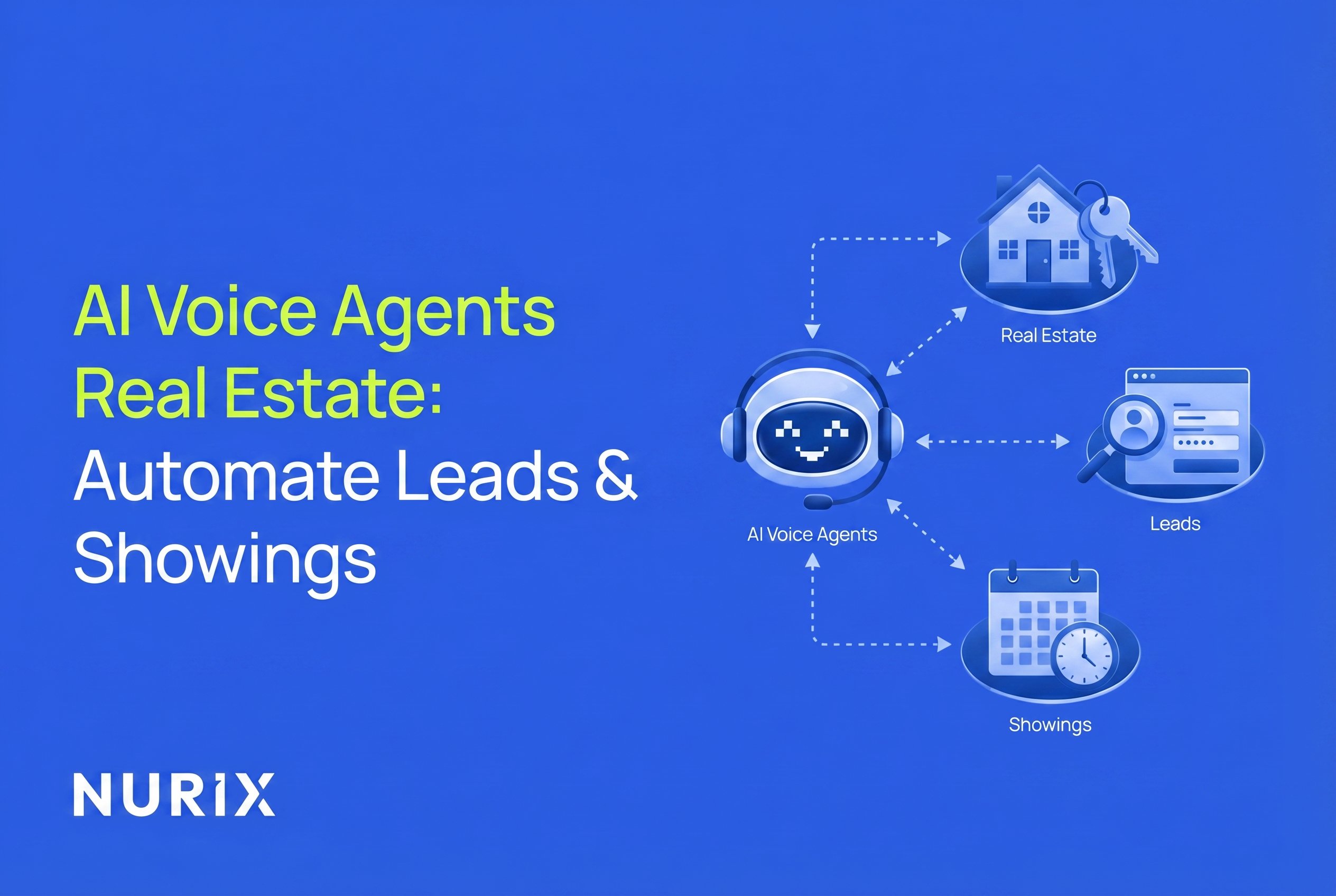

AI voice agents for real estate can answer routine inbound questions, collect buyer or renter requirements, propose showing times, and update a customer relationship management (CRM) system. Strong deployments start with narrow, supervised workflows, keep licensed professionals responsible for advice and decisions, and use reliable listing and calendar data rather than treating automation as a replacement for professional judgment. NAR NuPlay AI
Meta description: AI voice agents for real estate can qualify inbound leads and coordinate showings. Learn which workflows to automate and where human review stays essential.
Artificial intelligence (AI) use is already part of many real estate professionals’ daily work. In the Realtors Property Resource (RPR) 2026 AI Adoption Survey of 225 U.S. real estate professionals who are National Association of REALTORS® members, 82% reported using AI, 68% said they used it daily or several times per week, and 63% identified output accuracy as their leading concern. These are self-reported findings about AI generally, not evidence of voice-agent adoption or performance. RPR
That combination of use and concern makes governance part of the deployment decision. A brokerage needs to decide which tasks a voice agent may perform, which data it may use, what it must record, and when a person must take over.
What is AI voice agents real estate?
AI voice agents for real estate are software systems that conduct spoken conversations and execute bounded workflows through connected systems. A real estate workflow might include answering an inbound enquiry, collecting structured requirements, checking permitted calendar availability, requesting or scheduling a showing, recording the interaction in a CRM, and escalating requests outside the agent’s approved scope.
The central distinction is between coordination and judgment. A voice agent can gather facts and coordinate approved actions, but it should not independently provide property, legal, financing, valuation, fair-housing-sensitive, or other licensed advice.
The Fair Housing Act prohibits housing discrimination because of race, color, national origin, religion, sex, familial status, or disability. Automated questions, recommendations, and responses therefore need review against the brokerage’s fair-housing requirements. U.S. Department of Housing and Urban Development
A voice agent also cannot assume that it may freely change topics, retrieve any live information, or take any action requested by a caller. Its permitted behavior depends on:
- Approved listing, CRM, and calendar data
- Defined permissions and workflow rules
- Current content and source records
- Permitted actions in each workflow
- Escalation paths for uncertainty, exceptions, and advice requests
- Human review of changes to the workflow
What changed in 2026: controlled deployment matters more than AI awareness
The question for brokerage leaders is no longer simply whether agents are using AI. It is where the technology can operate safely and how the brokerage will supervise it.
The National Association of REALTORS® warned on June 16, 2026, that workflows able to take action may rely on stale, incomplete, or non-compliant multiple listing service (MLS) data. It also identified fair-housing exposure, unsupported marketing claims, and the risk that an automated workflow could take on activities requiring a license. Its recommendations include vetting tools, mandatory human review, an enforcement plan, and a formal AI policy. NAR, June 16, 2026
That does not mean every interaction requires manual handling. It means the brokerage should start with workflows where the inputs, permitted actions, and handoffs are clear. More capable automation increases the need for approved data, accountable ownership, and tested failure paths.
The workflow decision framework: automate coordination, escalate judgment
Use this framework to decide whether a workflow is ready for an initial voice-agent release.
The strongest first candidates are high-volume, repeatable tasks with:
- Clear inputs
- An authoritative system of record
- A limited set of allowed actions
- A defined success condition
- An obvious human handoff
Professional judgment remains a human task. NAR states that AI cannot make agency decisions, provide legal advice, or independently determine property value without human oversight. NAR
Worked example: a controlled showing workflow
Consider this hypothetical example.
A prospective buyer calls about a specific listing. The voice agent identifies itself, asks whether the caller needs approved property facts or wants to request a showing, verifies the listing record, and collects a preferred day, time window, and contact details. It offers only slots made available by the brokerage. When the caller selects a slot, it creates the appointment, sends confirmation, writes a transcript summary and the requested criteria to the CRM, and routes financing, neighborhood, pricing, or missing-data questions to a licensed team member.
This workflow is narrow because the agent does not decide whether the property is suitable, interpret the neighborhood, advise on financing, or promise that an appointment exists before the calendar confirms it.
The workflow should also define what happens when conditions are not normal:
- Stale listing or calendar data: Do not state availability as fact. Pause booking and create a human task.
- Advice request or protected-class-related question: Use an approved neutral response and transfer to a person.
- Opt-out or withdrawal of contact permission: Record the preference and enforce it in later outreach.
- Integration failure: Never claim that booking succeeded. Tell the caller that a team member will confirm.
- Conflicting records: Do not choose one record silently. Route the discrepancy for review.
A successful interaction is not just a pleasant conversation. It is a correct record, a permitted action, a clear audit trail, and an appropriate handoff when the workflow reaches its boundary.
Compliance and operating controls for voice workflows
A voice agent does not make a brokerage compliant by itself. The brokerage remains responsible for the use case, messaging, data, consent practices, professional standards, and applicable rules. NAR recommends a formal AI policy covering approved tools, data protection, human oversight, fair-housing and advertising compliance, client communications, training, supervision, incident reporting, and enforcement. NAR
Two federal communication references should be part of the review. On February 8, 2024, the Federal Communications Commission ruled that calls made with AI-generated voices are “artificial” under the Telephone Consumer Protection Act (TCPA). FCC
The Federal Trade Commission’s Telemarketing Sales Rule requires material disclosures, prohibits misrepresentations, limits calling times, and prohibits calls to consumers who have asked not to be called again. FTC
For an outbound or follow-up workflow, the operating checklist should include:
- Obtain legal and compliance approval before launch.
- Define how consent is obtained, stored, and applied.
- Preserve opt-out and do-not-contact records.
- Restrict the agent to approved content and data.
- Identify when a conversation must transfer to a licensed professional.
- Retain interaction records for review according to the brokerage’s policy.
- Test transfers, unavailable calendars, conflicting data, and integration failures.
- Review exceptions and failed interactions regularly.
- Assign a responsible owner to approve workflow changes.
- Review fair-housing, licensing, privacy, MLS, state, and local requirements with the appropriate advisers.
Federal communication rules are not a complete legal checklist. The brokerage should review each planned workflow with its legal and compliance owners before launch.
Evaluate the operating system, not only the voice demo
A natural-sounding conversation is only one part of a real estate voice workflow. Buyers should test whether the system can use authoritative listing, CRM, and calendar data with the right permissions and whether the brokerage can see what happened when the workflow succeeds, fails, or hands off to a person.
During evaluation, ask:
- Which source is authoritative for listing facts?
- What happens when the listing record is missing or stale?
- Which calendar slots may be offered?
- Can the workflow distinguish a request from a confirmed appointment?
- How are exceptions and transfers recorded?
- Can managers review interaction records and summaries?
- Who may change the workflow, prompts, content, or permissions?
- How are opt-outs recorded and enforced?
- Which measures show whether the workflow is operating correctly?
Useful measures include completed CRM fields, correct listing references, correctly confirmed appointments, transfer reasons, recorded opt-outs, failed integrations, and rework required by staff. These measures describe operational quality without assuming a universal conversion rate or return on investment.
A practical pilot is one inbound workflow operated for four to six weeks. During that period, operations and compliance owners should review a representative sample of completed, escalated, and failed interactions each week. Expand only after those owners agree that the workflow is performing its permitted actions and handling exceptions correctly.
NuPlay AI runs enterprise workflows in production and improves them after every run through NuLoop, with agents, the systems they operate, and the context they draw on under one platform. NuPlay AI
For showing workflows, NuPro is the task-specific agent layer. NuContext provides organizational, agent, and user context. NuPulse monitors status, volume, and outcomes. Together, these components provide a way to treat voice as one part of a governed workflow rather than as the platform’s entire identity.