.gif)
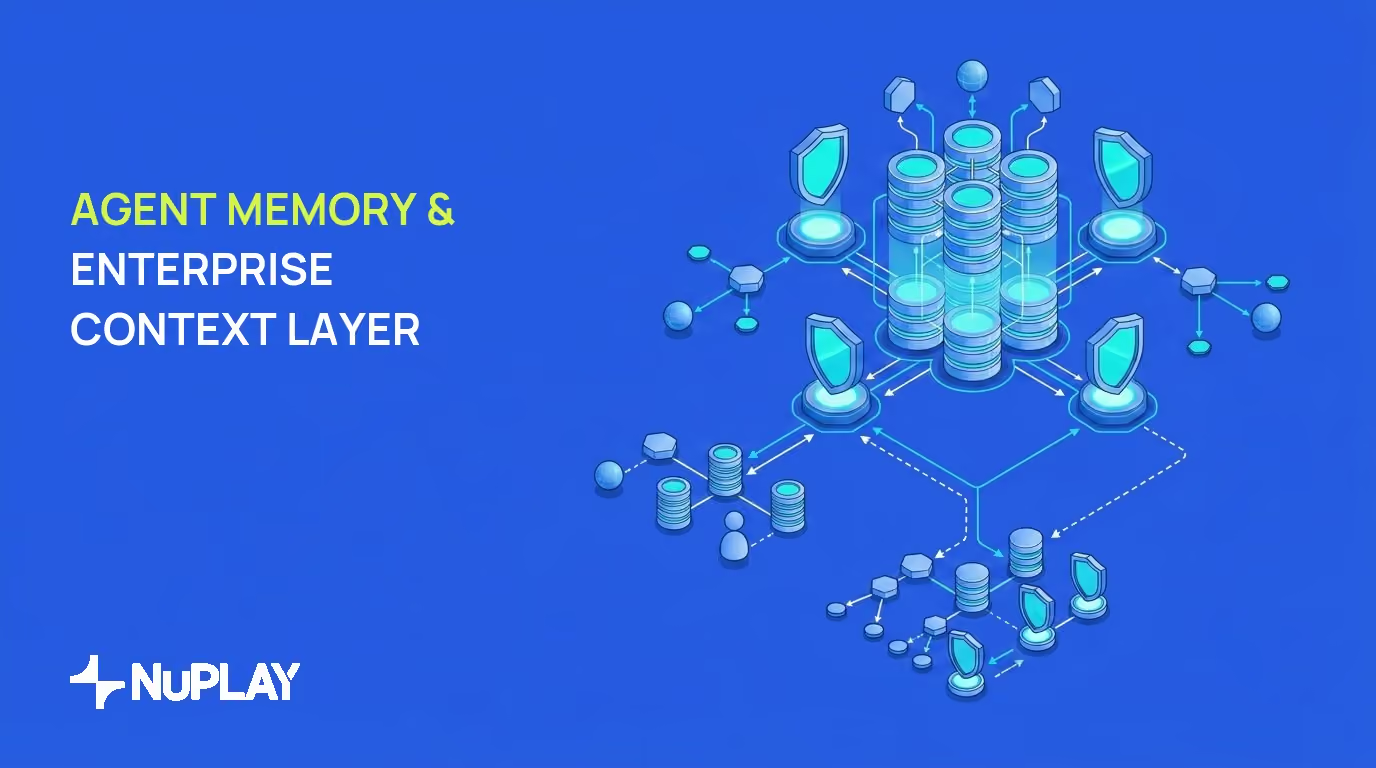

Agent memory and the enterprise context layer together enable reliable AI agent workflows. Agent memory provides session continuity through persistent recall, while the enterprise context layer supplies governed organizational truth across systems. Enterprises need both because memory alone cannot enforce policies, resolve entities, or maintain lineage at scale.
Heads of AI, CTOs, and operations leaders face repeated production failures when agents operate without this combined foundation. A VentureBeat June 2026 Pulse survey of 101 enterprises, as republished by Rama on Healthcare, found that 57% traced a confident but wrong AI agent answer to missing or inconsistent business context. A July 2026 follow-up wave from the same VB Pulse tracker found the figure had climbed to 68%. The challenge appears most clearly in high-volume repeatable workflows common in retail, insurance, financial services, collections and mortgage, and home services. This article examines the distinction, the evidence of failure rates, and the architectural decisions that determine whether agentic workflows reach production reliability.
What is the agent memory and enterprise context layer?
The combined concept refers to two distinct but related capabilities that support agentic workflows. Agent memory stores episodic and semantic recall so agents can reference prior interactions and facts. The enterprise context layer supplies the single source of governed truth that defines metrics, entities, policies, and lineage across the organization.
Memory systems often begin as extensions of the context window inside a large language model (LLM). These windows remain ephemeral. Persistent external stores hold data across sessions, yet they still require an outer governance structure to remain trustworthy at enterprise scale. Three generations of memory evolution illustrate the progression: basic session memory that resets on each call, retrieval-augmented generation (RAG) that pulls documents on demand, and dedicated read-write memory layers that support both episodic and semantic recall.
The term context layer emerged in late 2025 as buyers recognized that memory alone could not enforce organizational rules. Readiness gaps reinforce that shift. A March 2026 Cloudera and Harvard Business Review Analytic Services report found that only 7% of enterprises say their data is fully ready for AI. NuPlay AI (formerly Nurix) builds NuContext, which implements the memory and context separation through three tiers: Organizational, Agent, and User. The organizational tier holds enterprise definitions and policies. The agent tier manages workflow-specific context. The user tier tracks individual interaction history. This structure keeps memory inside a governed boundary rather than treating it as an independent system.
Why agent memory alone fails in enterprise settings
Large language models reset between sessions by design. They retain no state unless an external system supplies it. When that external system lacks enterprise governance, agents produce answers that appear confident yet rest on incomplete or outdated business rules.
A VentureBeat June 2026 Pulse survey of 101 enterprises, as republished by Rama on Healthcare, found that 57% traced a confident but wrong AI agent answer to missing or inconsistent business context. The same survey reported that only 25% of enterprises run a governed context layer in production. These figures point to a maturity gap that directly affects deployment outcomes.
The pattern is consistent across buyer roles. Memory systems improve recall, yet they cannot substitute for governed definitions of metrics, entity resolution rules, or policy constraints that apply across systems. Agents that handle customer interactions or back-office tasks must draw on accurate business definitions every time. Without a governed context layer, even well-designed memory systems produce inconsistent results that require manual correction.
For heads of operations and customer experience leaders, the cost appears in repeated manual reviews and customer escalations. For CTOs and VPs of engineering, the cost appears in architecture reviews that reveal stateless agents operating on stale data. Both groups encounter the same root cause: memory without an enclosing context layer.
Memory layer vs. enterprise context layer: key differences
Five architectural dimensions separate the two layers and guide procurement decisions. The same VentureBeat Pulse survey found that only 25% of enterprises run a governed context layer in production, which shows how few organizations have closed this gap today.
A memory layer stores conversation history and recalled facts from prior runs. An enterprise context layer stores governed definitions, data lineage, and machine-readable policies that apply organization-wide. Governance follows the same split: memory systems emphasize compliance posture for stored interactions, while context layers enforce enterprise policy at query time.
Freshness requirements also differ. Memory updates are interaction-driven and accumulate from each agent run. Context updates are estate-driven and reflect changes in source systems, organizational structure, or regulatory requirements. Entity resolution scope expands from user-level or session-level matching in memory systems to cross-system resolution that spans the entire enterprise in a context layer. Ownership follows the scope: data science or AI teams often manage memory layers, while data governance, compliance, and operations teams share ownership of the context layer.
A memory layer suffices for narrow pilots or single-domain agents where business rules remain simple and stable. An enterprise context layer becomes necessary when workflows span multiple systems, require audit trails, or operate under regulatory constraints. The decision framework therefore begins with workflow scope and regulatory exposure rather than model size or memory capacity.
The table below compares the two layers across the five dimensions buyers should evaluate.
Dimension Memory Layer Enterprise Context Layer What it stores Conversation history, episodic facts Governed definitions, lineage, policies Governance model Compliance posture for interactions Machine-readable enterprise policy Freshness Interaction-driven Estate-driven Entity resolution Session or user scope Cross-system organizational scope Ownership AI or data science teams Governance, compliance, and operations
Core components of an enterprise context layer
Five elements together make agents trustworthy at production scale. Semantic definitions for metrics ensure every agent references the same calculation for revenue, risk, or resolution time. Entity resolution across systems prevents duplicate customer records or mismatched account identifiers from producing conflicting answers.
Governance and access policies determine which agents can read or write specific data categories. Lineage for answer provenance records the source systems and transformation steps that produced each fact an agent uses. Persistent memory of prior decisions captures outcomes from earlier workflow runs so subsequent agents can apply consistent logic.
These components operate as a single layer rather than separate tools. When any element is missing, agents either refuse tasks or produce answers that require human correction. Retail operations teams see the effect when pricing rules differ across channels. Insurance and financial services teams see it when compliance policies are not machine-readable. Collections and mortgage teams see it when entity resolution fails across legacy servicing systems. Home services teams see it when scheduling policies stored in one system contradict availability data in another.
Buyers should treat the five elements as a checklist during architecture reviews. Ask which system owns metric definitions, how entity keys resolve across source systems, who approves policy changes, whether lineage is queryable at answer time, and how prior decisions feed the next run. Gaps on any item usually surface later as manual exception queues.
How the context layer integrates with agent memory
The memory layer functions as the read-write substrate for episodic and semantic recall. Agents query it to retrieve prior interactions or learned facts. The context layer serves as the single source of truth that memory systems query before returning results.
This ordering matters for multi-agent coordination. When several agents operate on the same workflow, each must reference the same definitions and policies. The context layer supplies those definitions. Memory systems then record the specific decisions each agent made within that shared frame.
Cross-domain consistency requirements increase the importance of this stack. An agent handling customer inquiries must align with an agent managing back-office fulfillment. Without a shared context layer, each memory system can drift toward its own local definitions. The result is conflicting outputs that surface only after customer impact occurs.
In practice, the stack reads top-down and writes bottom-up under control. Organizational definitions stay authoritative. Agent and user tiers adapt to specific workflows and people. Write-back from memory into shared context should remain governed, tested against prior runs, and shipped only after human approval. That approve-to-promote path increases coverage of business rules over successive runs while keeping change control intact.
NuContext implements the three-tier model so that organizational definitions remain authoritative while agent and user tiers adapt to specific workflows. Write-back from memory to context remains governed by NuLoop and ships only after human approval, which increases coverage of business rules over successive runs.
Common misconceptions about agent memory and context
Four misconceptions frequently lead to failed deployments. The first holds that larger context windows inside models can replace external memory. Windows remain bounded and stateless between calls. External memory is required for any workflow that spans multiple turns or days.
The second assumes retrieval-augmented generation alone solves enterprise answer quality. RAG improves document access yet still depends on the quality and governance of the underlying data. Without entity resolution and policy enforcement, retrieved passages can still produce inconsistent answers.
The third equates the context layer with a data catalog or semantic layer. Catalogs describe data assets. Semantic layers standardize queries. Neither enforces machine-readable policy or maintains decision lineage across agent runs.
The fourth assumes any vector store provides governed enterprise context. Vector stores supply similarity search. They do not enforce access policies, track lineage, or resolve entities across source systems. Only a purpose-built context layer supplies these controls at the scale required for production workflows.
Clearing these misconceptions early shortens procurement cycles. Evaluate vendors on governance, lineage, entity resolution, and policy enforcement, not only on memory capacity or embedding performance. Pilots that skip those controls often look strong in demos and fail under multi-system load.
Conclusion
The enterprise context layer, not raw model capability, determines whether agentic workflows reach production reliability. Memory systems improve recall within sessions, yet they require the surrounding governance of definitions, lineage, and policy to remain consistent across systems and over time. Organizations that evaluate platforms on this combined capability reduce manual correction cycles and support higher volumes without added headcount. Corrections and resolved cases are written back into the context layer, but that write-back is governed by NuLoop and ships only after a human approves, following Report, Diagnose, Propose, Try, and Ship. The result is broader coverage and richer context, so later deployments start better informed. Request a demo to see how NuContext and NuLoop work together on one of your workflows.





.jpeg)