.gif)
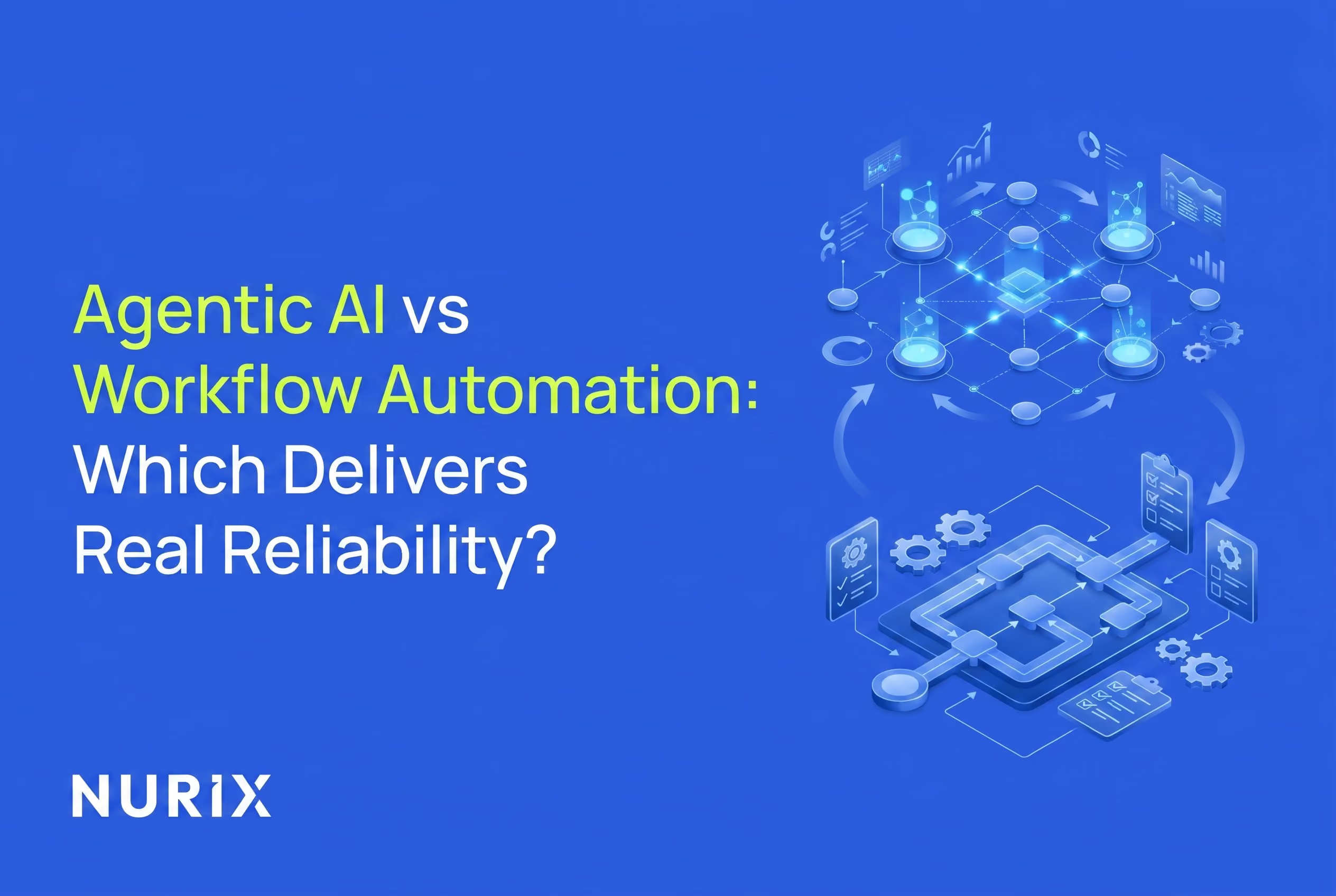

When evaluating agentic AI vs workflow automation, the decision hinges on handling data variability. Workflow automation maintenance costs drive agentic adoption, with 60% of RPA vendors pivoting to computer-use models to prevent bot breakage. Agentic systems provide the adaptability required for reliable enterprise scale.
Enterprise leaders face a critical choice between rigid workflow automation and adaptive agentic AI when scaling reliable operations. Traditional tools often fail under variability, while agentic systems promise continuous improvement. This comparison examines which approach delivers production-grade reliability across complex business environments.
What is Agentic AI vs Workflow Automation?
Agentic AI vs workflow automation contrasts two fundamentally different software architectures. Workflow automation uses deterministic, rule-based scripts to execute repetitive tasks, while agentic AI uses software equipped with large language models to interpret goals, reason about next steps, and interact with systems dynamically.
Quick Verdict
Agentic AI with self-improving loops outperforms static automation for any process involving variable data. In 2026, agentic automation will redraw the enterprise map, but the focus must be on governance rather than just capability, as industry experts note. Workflow automation suits only low-variability tasks where inputs never change.
For everything else, enterprises need systems that close the loop on their own performance. NuLoop enables this by generating validated fixes after every run. This ensures the workflow adapts to the business rather than breaking when conditions shift.
Defining Agentic AI and Workflow Automation
Workflow automation relies on deterministic, rule-based systems that follow fixed scripts. If X happens, then do Y. These systems execute repetitive tasks efficiently in highly stable environments. However, they lack the capacity to handle exceptions or unstructured inputs.
Agentic AI takes a different approach. It uses NuPro task-specific micro-agents that interpret goals, reason about next steps, and interact with systems dynamically. These agents adapt via feedback rather than waiting for a developer to rewrite their underlying code.
Can agentic AI completely replace traditional workflow engines? Not entirely. Deterministic, high-volume pipelines with zero variability still favor traditional automation. Most enterprises use a hybrid stack where fixed rules handle basic steps and agentic AI provides the reasoning for judgment-heavy exceptions. Real reliability stems from execution combined with post-run improvement.
Reliability Criteria for Enterprise Workflows
Enterprise workflows demand strict evaluation criteria for production environments. First, systems must maintain consistency under high volume and edge cases. Second, they need the ability to self-diagnose and apply fixes when data drift occurs. Third, deep integration with legacy systems is required. Finally, auditability and human oversight controls must remain absolute.
The main risks include unmanaged agent sprawl, model drift, and control failures. To mitigate this, organizations need grounded context layers like NuContext to maintain memory across sessions. Compliance is also non-negotiable. NuPlay AI maintains SOC 2 Type 2 and ISO 27001 certifications and supports HIPAA and GDPR compliance requirements.
For regulated sectors like finance, ISO 42001 is becoming the baseline for responsible AI governance, requiring human-in-the-loop accountability. Human oversight, done well, is the difference between a human who is merely present and a human who is accountable for the system's outcomes.
Side-by-Side Breakdown
Here is a side-by-side comparison of how these two approaches handle enterprise production requirements.
| Feature | Workflow Automation | Agentic AI |
|---|---|---|
| Exception Handling | Brittle; fails when inputs change | Dynamic handling through reasoning |
| Maintenance | High manual update burden | Adapts via feedback loops |
| Integration | Basic API triggers | Deep reasoning across systems |
| Improvement | Static until rewritten | Diagnoses and proposes fixes |
Workflow automation remains brittle on exceptions and carries high maintenance debt. Agentic AI provides dynamic handling but requires strong feedback loops to prevent degradation. NuStack builds and orchestrates the end-to-end workflow, ensuring systems are agent-ready. From there, a closed feedback loop ensures continuous reliability through a strict cycle: Report, Diagnose, Propose, Try, Ship.
When Workflow Automation Falls Short
Standard software automation fails to handle deep enterprise data integration without forward-deployed engineering. Performance typically degrades 20 to 40% when moving from pilot to real production traffic due to dirty data and integration friction.
Collections and mortgage workflows experience frequent policy changes that break static scripts instantly. Retail operations require voice and chat micro-agents to handle customer urgency, which rigid decision trees cannot process. Insurance claims involve variable data inputs from medical records and adjuster notes. In these scenarios, workflow automation requires constant manual rewriting, driving up technical debt and delaying customer resolutions.
How NuPlay Delivers Measurable Reliability
NuPlay runs enterprise workflows in production and improves them after every run through NuLoop, with agents, the systems they operate, and the context they draw on under one platform. That contrasts with static deployments that degrade as the business changes.
Standard monitoring tools like NuPulse provide the outcome dashboard for volume and status, but monitoring alone does not fix broken processes. NuLoop actively improves the workflow run over run through Report, Diagnose, Propose, Try, Ship. It identifies coverage gaps and applies governed change.
Every fix requires human approve-to-promote sign-off before shipping to production. NuPro executes these tasks using proprietary Astra and SEAL models, ensuring high-volume repeatable workflows execute flawlessly.
Final Recommendation
By the end of 2026, 40% of enterprise applications will feature task-specific AI agents. Heads of AI, CTOs, and Operations leaders must choose platforms built for scale and continuous adaptation. While 71% of firms have pilots, only 11% reach production because most platforms lack a governed feedback loop.
Prioritize NuLoop-style feedback over static point solutions. Start with high-volume repeatable workflows in US markets where the cost of manual execution is highest. Move the right work into agent mode rather than attempting to replace people entirely.
Conclusion
Enterprise reliability favors agentic systems equipped with continuous, validated improvement mechanisms over static workflow automation. Rigid scripts create technical debt, while adaptive agents diagnose their own gaps and propose governed changes. To see how this architecture scales in production, enterprise teams can request a demo to review the platform's capabilities firsthand.




.avif)