.gif)
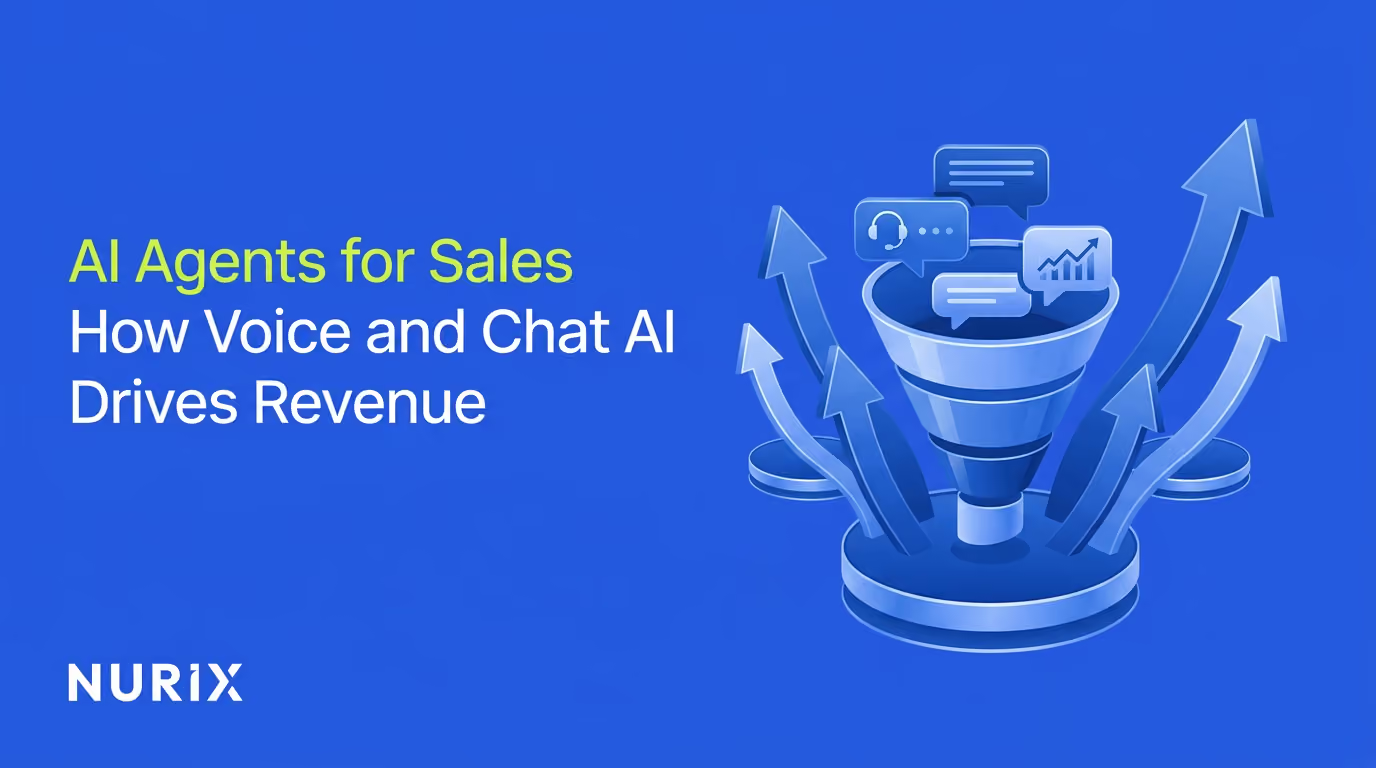

AI agents for sales are task-specific micro-agents that execute complex enterprise workflows like lead qualification and outreach. Unlike static chatbots, these production-grade systems reason through decisions and improve run-over-run. Retailers deploying these agents see annual revenue surge by 7% to 25% through automated, high-volume lead engagement.
Enterprise sales organizations face a massive operational bottleneck when attempting to scale customer interactions. Human bandwidth limits revenue potential during peak periods. AI agents for sales are transforming how enterprises handle this volume. Voice and chat capabilities enable consistent execution of sales workflows while adapting based on real outcomes. This article explains the mechanics and business impact for decision-makers evaluating production-grade platforms. NuPlay AI runs enterprise workflows in production and improves them after every run through a closed feedback loop. That contrasts directly with static deployments that degrade as the business changes.
What Are AI Agents for Sales
AI agents for sales are task-specific micro-agents that execute sales processes end-to-end. They reason through decisions rather than following static, pre-programmed scripts. These systems are built specifically for repeatable enterprise workflows in retail, insurance, and financial services. They combine voice and chat interfaces with deep memory and orchestration layers.
A major market trend to avoid is agentwashing. This occurs when vendors rebrand legacy chatbots as agents without providing autonomous task-execution capabilities. Traditional chatbots follow static decision trees to answer simple questions. True AI agents execute processes from start to finish. NuPro executes these sales processes end-to-end using proprietary Astra and SEAL models. This ensures high-volume sales execution without relying on generic, third-party wrappers.
How Voice and Chat AI Drive Revenue
Voice and chat AI drive revenue by providing 24/7 lead qualification and follow-up without human bandwidth limits. Consistent messaging improves conversion rates across all channels. While 94% of sales leaders call this technology critical, organizations must focus on execution rather than just capability. Real-time adaptation through closed-loop improvement systems ensures that the sales messaging stays relevant as market conditions shift.
The enterprise market is experiencing a massive 327% growth in agent deployments. However, a significant gap exists between intention and reality. Roughly 78% of teams have pilots, but only 14% reach production scale. The primary bottleneck is not the model itself. The bottleneck is the orchestration layer that makes enterprise systems agent-ready.
By 2028, AI agents will outnumber human sellers heavily. Yet fewer than 40% of sellers will say the technology improved productivity unless organizations overhaul their data and automation strategies. Proper deployment requires moving the right work into agent mode, rather than attempting to replace human relationship building entirely.
Key Enterprise Requirements
Production-grade systems demand strict architecture. Integration with existing customer relationship management, telephony, and backend systems is mandatory. Since 76% of CRM data is unstructured, agents must parse complex information dynamically. NuStack handles this integration and workflow orchestration. It makes enterprise systems agent-ready by wrapping or rebuilding legacy infrastructure to support complex sales workflows securely.
Memory layers must maintain context across organizational and user tiers. If a prospect chats on the website and calls the next day, the system must remember the entire context. Monitoring dashboards for volume, outcomes, and compliance are equally critical for production environments. NuPulse provides these monitoring dashboards for volume and outcomes.
Scaling enterprise AI without breaking the bank requires a focus on unit economics. The cost of the agent must be measured against the recovery of manual hours and actual revenue growth. Leaders need clear visibility into these metrics to justify ongoing investment.
Industry Use Cases
Practical applications in target verticals demonstrate clear financial impact. Insurance quote generation and policy renewal outreach require absolute precision and strict compliance. Agents handle the initial data collection, verify policy details, and route qualified prospects directly to licensed brokers for final signature. This reduces friction and accelerates the sales cycle significantly.
Retail order support and upsell workflows prevent abandoned carts during high-volume holiday periods. The system can proactively contact customers regarding pending orders and offer relevant upgrades. Collections and mortgage servicing rely on compliant voice interactions to manage payment schedules. Moving the right work into agent mode yields an 83% reduction in manual research cycles for financial institutions. This frees human staff to handle complex negotiations.
Platform Capabilities for Production Deployment
Most sales AI agents are deployed as static scripts that lose relevance as product catalogs and market conditions shift. This static degradation trap means systems fail quickly in production. Self-improving AI solves this by routing execution outputs back into the system as improvements to skills and context.
NuLoop provides this closed feedback system. It watches every agent run and ships validated fixes back into the other layers through a strict sequence. This sequence is Report, Diagnose, Propose, Try, Ship. Improvement is stated as diagnosis, coverage, and governed change, never as a generic accuracy gain. NuContext supports this entire process by acting as the memory and context layer across Organizational, Agent, and User tiers.
Here is a side-by-side comparison of static chatbots versus production-grade sales agents.
| Feature | Static Chatbots | Production-Grade Sales Agents |
|---|---|---|
| Execution | Follows fixed decision trees | Reasons through complex workflows |
| Improvement | Degrades as business changes | Diagnoses and ships governed fixes |
| Integration | Basic API data syncing | Wraps and rebuilds legacy systems |
| Governance | Manual spot checks | Human approve-to-promote sign-off |
Implementation Considerations
Buyers must evaluate criteria beyond impressive demonstrations. Focus on measurable workflow outcomes rather than generic AI features. The practical implication for enterprise sales leaders in 2026 is not whether to deploy sales AI agents. The real question is in which order, at what scope, and with which governance framework in place.
Require human-in-the-loop approval for production changes. In regulated sales environments like Insurance and Finance, governance is an infrastructure layer. Approve-to-promote is not just a feature but a strict requirement to prevent massive value loss. Every system change must receive human sign-off before shipping to live environments.
Finally, prioritize platforms proven in US English-speaking enterprise environments. NuPlay AI maintains SOC 2 Type 2 and ISO 27001 certifications and supports HIPAA and GDPR compliance requirements. This ensures sensitive customer data remains secure throughout the entire sales lifecycle.
Conclusion
Enterprise buyers achieve sustainable revenue growth when AI agents for sales are deployed on platforms with built-in improvement loops. Static tools degrade over time, but self-improving systems adapt to changing business conditions through governed change. By moving the right work into agent mode and enforcing strict approve-to-promote governance, organizations can scale their sales operations securely. Book a demo of the NuPlay platform to see how governed agentic workflows drive real enterprise value.




.jpeg)