.gif)

AI claims processing uses governed agents to classify documents, validate data, prepare adjudication files, identify subrogation opportunities, and route exceptions to human specialists. In adjacent insurance workflow evidence, First Mid Insurance Group automated 100% of covered training workflows, showing that governed document workflows can reach production without removing human accountability.
Claims, subrogation, and underwriting are document-heavy and audit-sensitive. Point tools can automate individual steps, but the operating challenge is connecting intake, validation, review, and escalation as one traceable workflow.
Independent evidence supports this end-to-end approach. McKinsey reports that domain-wide AI transformations improved claims accuracy by 3–5%. In Aviva's claims operation, more than 80 AI models cut complex liability-assessment time by 23 days, improved routing accuracy by 30%, and helped save more than £60 million in 2024. These are Aviva results, not NuStack guarantees, but they show why connecting the full claims workflow matters more than automating one step.
This article explains the end-to-end design. NuStack by NuPlay AI is the back-office workflow and enterprise AI software platform discussed here; NuPlay remains the separate conversational AI product for customer-facing voice and chat.
What is AI claims processing?
AI claims processing is the use of AI agents to run the insurance claims workflow, reading and classifying claim documents, extracting and validating data, and routing each claim for adjudication, with humans kept in the loop where regulation or risk requires. Unlike single-step automation, an agentic approach handles the end-to-end workflow from first notice of loss (FNOL) through resolution while staying auditable.
This differs from standalone optical character recognition (OCR), which only converts an image to text and stops there. It differs from a rules engine, which applies fixed logic but cannot read and interpret unstructured documents. And it differs from a manual review queue, where every document waits for a person before anything moves. An agentic workflow reads, decides, and routes across the whole lifecycle, escalating to a person only where it should.
The end-to-end agentic claims workflow
Agentic AI is distinct from robotic process automation (RPA). RPA replays fixed clicks and breaks when a form changes. An agent has a defined job, a confidence threshold, and a human-in-the-loop checkpoint where required. The claims lifecycle runs as one workflow, with each stage handled by an agent that knows when to act and when to escalate.
Intake and first notice of loss (FNOL)
The intake agent captures the claim from any channel, phone, email, portal, or document upload, and structures it into a clean record. Low-confidence intake routes to a person to confirm scope before the claim moves downstream.
Document classification
Each incoming document is identified and sorted by type: policy, estimate, medical record, or police report. Ambiguous or novel document types route to a reviewer rather than being forced into the wrong bucket.
Data extraction and validation
The extraction agent pulls the fields that matter and validates them against the policy and systems of record. Gaps and mismatches are flagged for an adjuster instead of flowing through as silent errors.
Adjudication support
The agent assembles a decision-ready package and surfaces coverage and policy checks for the adjuster. The coverage and payment decision stays with the adjuster, who now works from a complete file rather than a pile of raw documents.
Subrogation identification
As the claim is processed, the agent reads the facts and detects recovery opportunities. Because subrogation runs on the same workflow, no separate document pass is needed. Detected opportunities route to the recovery team to confirm and pursue.
Underwriting assist
The same document and workflow agents apply to risk documents in underwriting. They extract and validate risk data and assemble decision-ready packages, so the underwriter reaches the risk decision with less manual prep and more consistency.
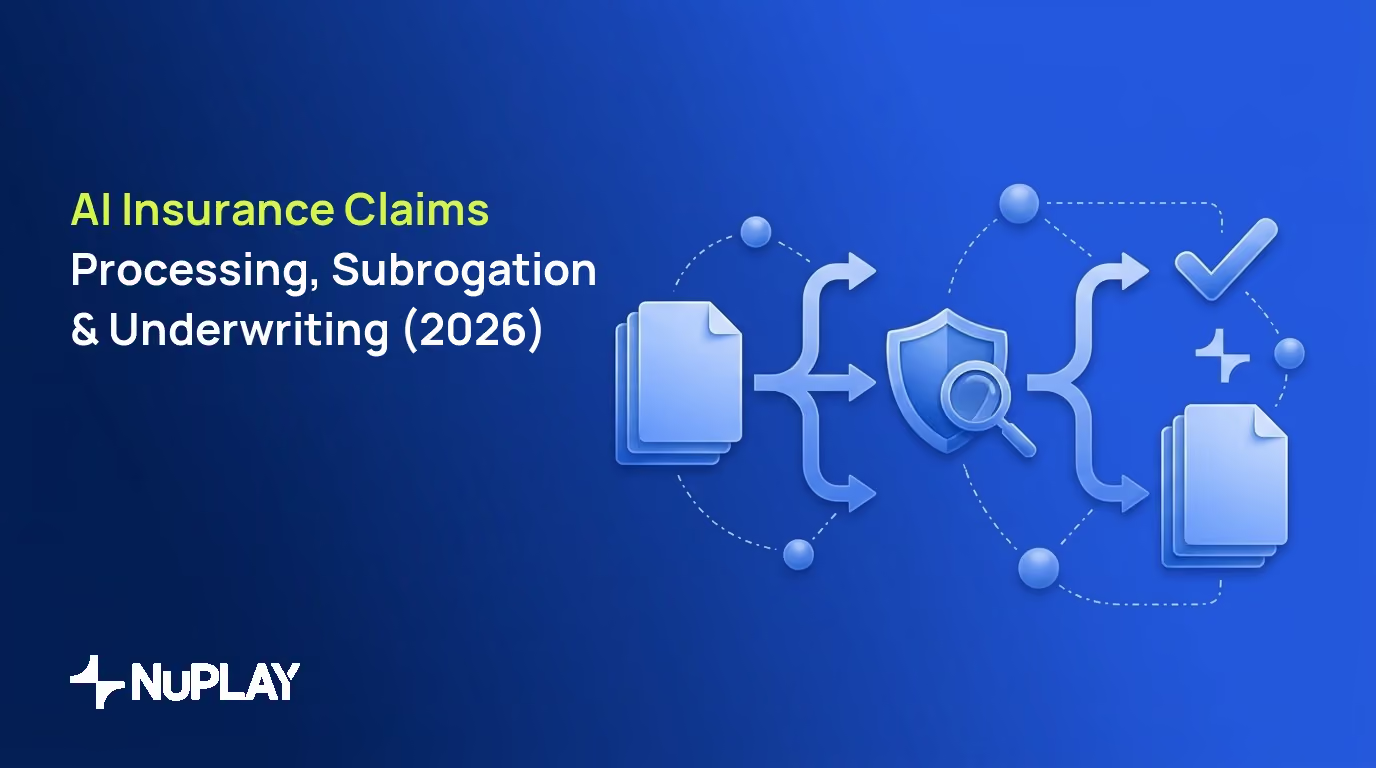
Here is how the agentic claims workflow breaks down stage by stage.
For the underlying detail on how agents read, classify, and extract from documents, see the document intelligence approach on NuStack.
Reliable by design: governance built into the workflow
The difference between a pilot and a production system is governance. On NuStack, governance is part of the workflow design, not a patch added after the fact.
Human-in-the-loop by rule
Agents act autonomously within confidence thresholds and escalate to a person where regulation or risk requires. The checkpoint is defined in the workflow, so escalation is consistent rather than dependent on who happens to be reviewing.
Auditability
Every classification, extraction, and routing decision is logged and traceable. When a claim is disputed or an auditor asks how a decision was reached, the record is already there.
Accuracy and validation
Extracted data is validated against policy and systems of record before it moves downstream. Bad data is caught at the point of extraction, not discovered three steps later in adjudication.
Enterprise readiness
NuPlay AI maintains SOC 2 Type 2 and ISO 27001 certifications and supports HIPAA and GDPR compliance requirements. Buyers should validate access controls, retention, audit records, and human approval rules against the specific claims workflow and jurisdiction.
Lower total cost: build and run vs assemble point tools
Buyers often compare AI claims tools on a single feature. The real comparison is total cost across both building the solution and running it. Assembling point tools means one license for OCR, another for a rules engine, and integration, governance, and the last mile left to the buyer to own and maintain.
Here is a side-by-side comparison of assembling point tools and running one agentic workflow on NuStack.
NuStack presents 60% faster operations and 10x lower total cost as aggregate platform outcomes. They are not claims-specific guarantees. A buyer should compare the two approaches using its own intake volume, exception rate, integration burden, review time, and audit requirements.
What production evidence is relevant to claims buyers
NuPlay AI's named insurance evidence is adjacent to claims rather than a direct claims-processing case study. First Mid Insurance Group automated 100% of covered training workflows and reported a 25% increase in team productivity.
That result supports the feasibility of governed document and knowledge workflows in insurance. Read it alongside the independent domain-wide claims evidence above, while keeping the sources distinct. Neither establishes a universal claims-processing time or loss-adjustment result. Claims buyers should require a pilot on one claim type and measure extraction quality, exception routing, adjuster review time, audit completeness, and total operating cost against the current baseline.
How to deploy AI across the claims workflow
Deploying agents across claims is a staged path, not a single switch. This sequence gets one claim type into production before extending across the book.
- Pick one document-heavy claim type where volume and manual effort are highest.
- Map the stages, and set confidence thresholds and human-in-the-loop checkpoints for each.
- Connect claims systems of record so agents validate against real policy and payment data.
- Run the workflow in production on that claim type, and measure processing time and cost against your baseline.
- Extend the same agents to subrogation and underwriting, which reuse the same document and workflow foundation.
For teams that also handle policyholder conversations, voice and chat servicing is a separate story covered by the NuPlay conversational platform. This article stays on the workflow and documents side.
You can read more about how insurers put these workflows into production on the AI for insurance hub.