.gif)

AI customer service agents resolve customer requests end to end by understanding intent, acting in connected systems, following governed procedures, and escalating exceptions with context. Cult.fit reported a 95% issue-resolution rate and an 80% reduction in frontline-support load with NuPlay.
The central measurement is containment, the share of conversations resolved without a human. It is stricter than deflection, which can count a contact as diverted even when the customer's problem remains unresolved.
This guide explains how autonomous resolution works, how to separate containment from vanity metrics, and how to expand customer-service automation without removing human judgment from exceptions.
What are AI customer service agents?
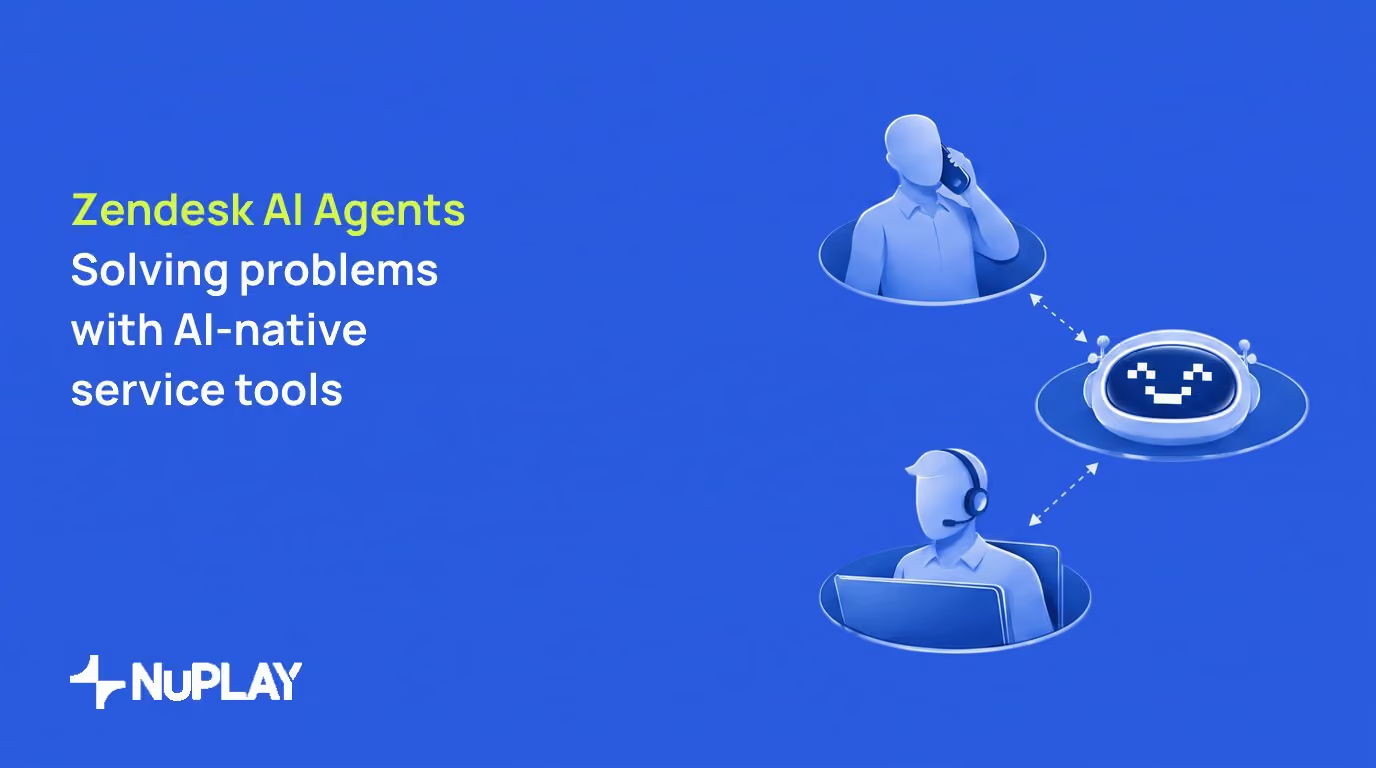
AI customer service agents are autonomous software agents that understand a customer's intent, take actions across connected systems, and resolve support requests end to end without human involvement. Unlike a chatbot that returns scripted replies, an agent completes the task, issuing the refund, updating the order, closing the ticket, and escalates cleanly only when a case falls outside its defined scope.
This is a different category from the tools most teams already run. Interactive Voice Response (IVR) routes callers through fixed menus. Rule-based bots match keywords to canned answers.
Both hand the customer back to a queue the moment a request leaves their script. An agent reasons about the request, decides which systems to touch, and carries the task to completion. Agentic AI is also distinct from Robotic Process Automation (RPA), which replays fixed sequences of clicks and breaks the moment a screen or field changes.
What is containment?
Containment is the share of customer conversations an AI agent resolves end to end without a human. It is not the same as deflection, which only measures conversations kept out of the human queue. A deflected ticket can still leave the customer unresolved.
The distinction matters to a CX leader because deflection can look good on a dashboard while Customer Satisfaction (CSAT) falls. A bot that answers a question and closes the chat counts as a deflection even if the customer never got what they needed and simply gave up. Containment ties directly to resolution and cost: a contained conversation is one where the customer's problem is actually solved, so it maps to lower reopen rates, higher CSAT, and fewer downstream contacts.
How autonomous resolution actually works
Containment is the visible result. Underneath it sits a four-part mechanism that runs on every conversation.
Intent detection
The agent parses what the customer actually wants, not the keywords they happened to use. A message like "I never got the thing I ordered last week" resolves to a shipping-status intent tied to a specific order, even though it contains none of the obvious trigger words. Accurate intent detection is what lets the agent choose the right action instead of returning a generic article.
Orchestration
Once intent is clear, the agent calls the systems that hold the answer and the levers that change the outcome. It queries the order management system, reads and writes to the Customer Relationship Management (CRM) platform, pulls from knowledge sources, and triggers downstream actions such as a refund or a replacement. Orchestration across these systems is the difference between an agent that talks about a resolution and one that performs it.
SOP adherence
Every action runs inside a governed standard operating procedure (SOP). The agent follows the same policy rules a trained human would, checking eligibility before issuing a refund, applying the right exception logic, and staying within approval limits. NuPlay agents operate at 99% SOP adherence in production, which is what makes autonomous action safe to trust at volume. Governance is not a constraint bolted on afterward; it is the layer that lets an enterprise let an agent act without supervision.
Escalation
When a case falls outside defined scope, the agent hands off to a human with the full conversation and context attached. Escalation is a clean transfer, not a dead-end loop that drops the customer back at the start. Because scope is governed by SOPs, the agent knows its own boundaries and escalates before the customer has to fight through a menu to reach a person.
Deflection vs containment
The fastest way to see why the two metrics diverge is to compare them side by side across what each one measures and what it means for the customer.
Read the table top to bottom and the trap becomes obvious. A team can drive deflection up by making the bot harder to escape, and the number will climb while the actual customer experience gets worse. Containment cannot be gamed the same way, because the metric only counts conversations where the problem was solved.
How to measure containment without hiding failure
Containment needs a written counting rule. Define the point at which a conversation is considered resolved, how reopened contacts are attributed, and whether abandoned contacts or forced closures are excluded. Without that definition, two vendors can report different containment rates for the same customer outcome.
Track containment with three companion measures:
- Reopen rate: whether the customer returns with the same issue after an apparent resolution.
- Escalation quality: whether the human receives intent, account data, attempted actions, and the full conversation context.
- Customer outcome: whether satisfaction, resolution quality, and repeat-contact volume improve as containment rises.
Break the results down by intent and deployment phase. A mature password-reset workflow should not be averaged with a new, high-risk refund workflow, because the two have different scope, approval rules, and expected human involvement.
What containment looks like in production
The strongest production results pair customer-resolution outcomes with operational impact.
Cult.fit reported a 95% issue-resolution rate and an 80% reduction in frontline-support load while providing 24/7 support.
Myntra reported 75%+ routine queries resolved end to end, a 50% reduction in average handle time, and 3x support scale without adding headcount.
NuPlay AI separately presents 75% containment at maturity and 99% AI SOP adherence in production as platform outcomes. These figures are not universal guarantees. Buyers should define which intents count as resolved, track reopen rates and customer satisfaction, and measure performance by workflow and deployment phase.
How to move from first-level support automation to full containment
Containment is a progression, not a switch you flip. A practical arc for a CX leader looks like this.
Start with first-level support automation: the high-volume, repetitive requests where intent is clear and the resolution path is well defined. Instrument containment from day one, not just deflection, so you can see whether customers are actually resolved rather than merely diverted. Watch CSAT alongside containment to catch any vanity deflection early.
From there, expand SOP coverage so the agent can act on a wider set of cases, and widen scope as SOP adherence proves out in live traffic. Each expansion is gated by evidence: you extend the agent's authority only where its behavior is already governed and measured.
For customer-facing support, NuPlay is the relevant product from NuPlay AI. NuStack is the separate platform for back-office workflow automation and enterprise AI software deployment; it should not be presented as an alternative way to build NuPlay customer-service agents.
To see the mechanism running on your own support data, book a demo or talk to the NuPlay AI team.