.gif)
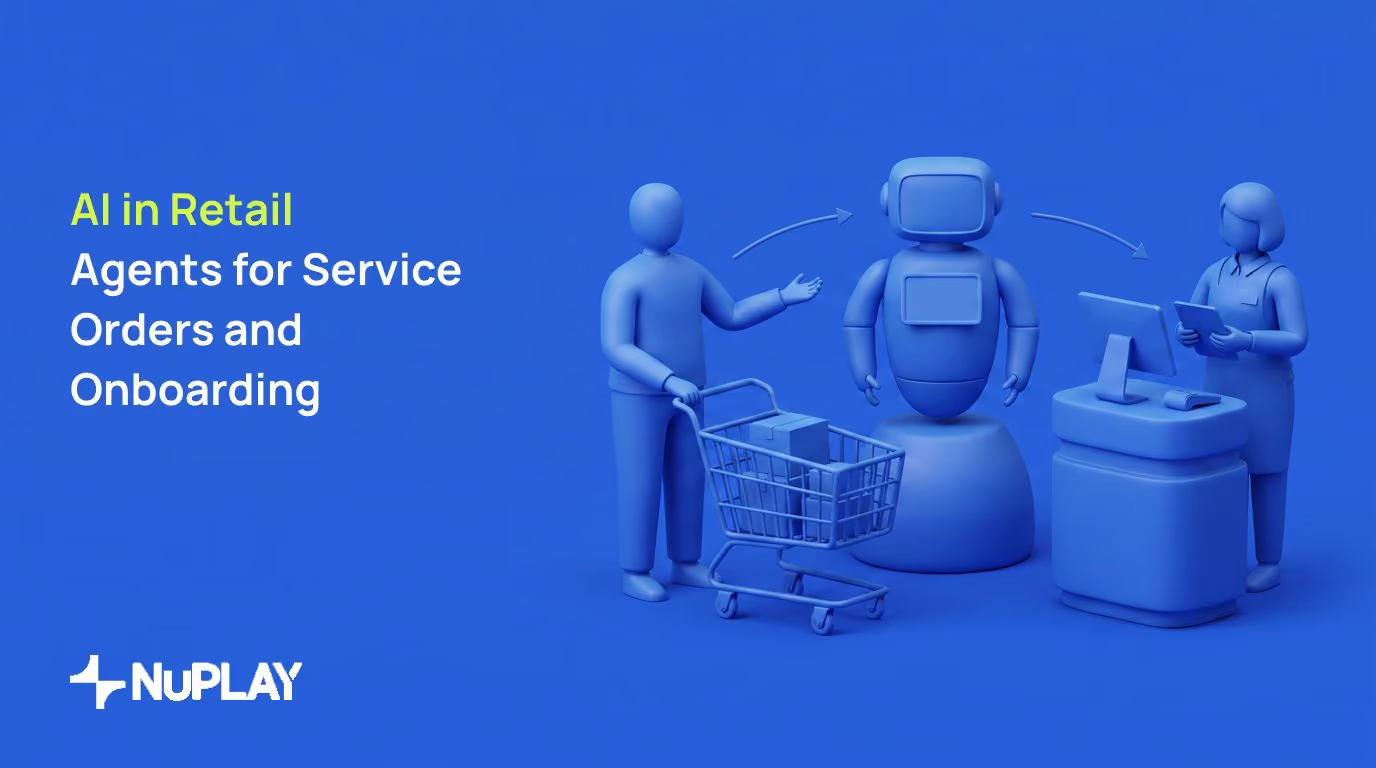

AI in retail deploys task-specific agents to execute high-volume workflows like customer service, order management, and vendor onboarding. Rather than relying on static scripts, production-grade retail platforms use closed feedback loops to diagnose failures and improve operations continuously under strict human approve-to-promote oversight.
Retail enterprises are deploying AI agents to handle high-volume workflows in service, orders, and vendor management. These agents operate in production environments and adapt through structured feedback loops. The shift moves repeatable tasks into agent mode while keeping human oversight on approvals. For operations leaders, the goal is not replacing people. The goal is executing massive transaction volumes reliably while freeing human staff to handle complex exceptions.
What is AI in Retail?
AI in retail refers to the deployment of agentic systems where artificial intelligence executes end-to-end business workflows such as product discovery, customer support, and supply chain management on behalf of consumers or enterprises.
Current State of AI in Retail
High-volume service and order workflows are moving rapidly to agent execution. The era of simple prompts is over. Retail is in the middle of the agent leap, where AI orchestrates complex, end-to-end workflows. For enterprises struggling with speed-to-value, this is the defining opportunity of 2026. Traffic from AI sources has jumped 1,200% for retailers, signaling a total collapse of the traditional shopping funnel.
Yet, a massive execution gap exists. While 8 out of 10 employees report some operational impact from AI, reaching production scale remains difficult. Only a fraction of pilots survive because retail data is fragmented. Vendor onboarding remains largely manual with severe integration gaps. Enterprise buyers are actively seeking platforms over point solutions to solve this friction.
Developments in Customer Service Agents
Retailers use voice and chat micro-agents to handle routine inquiries at massive scale. These are not basic conversational bots. They are task-specific agents that execute actual business processes.
NuPro executes these high-volume retail service workflows using voice and chat agents built on proprietary Astra and SEAL models. Context layers pull directly from order and customer databases. If a buyer calls about a refund, the agent already knows the purchase history, the shipping status, and the applicable return policy.
These deployments yield a 95% issue resolution rate when properly integrated. However, human approve-to-promote gates remain critical. Complex resolutions and policy exceptions route to human managers automatically. This ensures customers receive immediate answers for repeatable tasks while human agents handle high-empathy escalations.
Developments in Order Management Agents
Order processing and fulfillment require deep backend connections. Retailers process millions of transactions daily, and static automation breaks when edge cases appear.
NuStack makes legacy retail systems agent-ready, orchestrating order workflows across ERP and CRM systems. Task-specific agents execute order updates, manage inventory routing, and track shipments autonomously. They interpret order triggers, validate them against business rules, and update backend databases instantly.
Run-time monitoring of volume and outcome metrics is crucial for these operations. NuPulse provides real-time visibility into retail order volumes and outcome metrics. Without closed feedback loops, systems suffer from static degradation. Traditional models fail during high-variability events like Black Friday because they cannot diagnose their own failures. Only systems with active feedback loops sustain performance through these volume spikes, because they can diagnose what went wrong and correct it before the next peak.
Developments in Vendor Onboarding Agents
While 95% of retailers use AI for marketing, the supply side remains a manual risk minefield. Automating this through a chain of agents is the next frontier for margin protection. Manual vendor onboarding consumes weeks of coordinator time per supplier, most of it spent chasing documents rather than assessing risk.
Automated document intake and validation steps replace weeks of email threads. Agents verify credentials against global databases and cross-reference data in legacy ERPs. The manual process is notoriously insecure, responsible for nearly 30% of data breaches in supply chains.
NuContext maintains the organizational and vendor context required to automate these complex onboarding documents. This approach drives a 97% reduction in cycle time, cutting onboarding from five days to under four hours. It also results in a 28% faster ramp-up for new suppliers to reach full operational capacity. Governed change cycles follow each onboarding run to handle exceptions safely.
What This Means for Retail Operations
The immediate impact is a sharp reduction in manual handoffs across service, orders, and onboarding. NuPlay runs enterprise workflows in production and improves them after every run through NuLoop, with agents, the systems they operate, and the context they draw on under one platform. That contrasts with static deployments that degrade as the business changes.
The differentiator is NuLoop, the closed feedback loop, not AI agents generically, since every competitor claims those. Improvement happens through continuous diagnosis, coverage, and governed change via a strict Report, Diagnose, Propose, Try, Ship sequence.
Failure to implement this governance carries a 40% project cancellation risk due to inadequate risk controls. Operations must maintain a clear separation of human, automated, and agent modes.
Here is a side-by-side comparison of static retail bots versus agentic retail platforms.
What's Next for AI in Retail
The near-term evolution requires deeper integration of memory and workflow layers. Retailers used to compete for human attention. Soon they will compete for agent attention. If a customer's AI agent does the shopping, your website, pricing, and product data need to be readable by machines, not just attractive to people.
Currently, 58% of consumers prefer AI tools for discovery. To capture this traffic, retailers must provide invisible efficiencies like structured data that agents can parse instantly. As this shift accelerates, 68% of executives expect operational deployment of agentic commerce to fundamentally alter their supply chain models.
This means expanding self-improving loops across more retail processes. The focus remains entirely on production-grade reliability over generic agents. Procurement teams are standardizing around ISO/IEC 42001:2023 to ensure AI management systems meet strict regulatory baselines.
Conclusion
The future of AI in retail relies on moving complex workflows into governed agent mode with platforms that improve through structured feedback. Static deployments cannot survive the seasonal volume spikes and constant catalog changes inherent to the industry. By deploying task-specific micro-agents and orchestrating them through a self-improving platform, retailers can scale their operations securely. To see how these systems execute high-volume repeatable workflows in production, book a demo with the NuPlay AI team today.




.jpeg)