.gif)
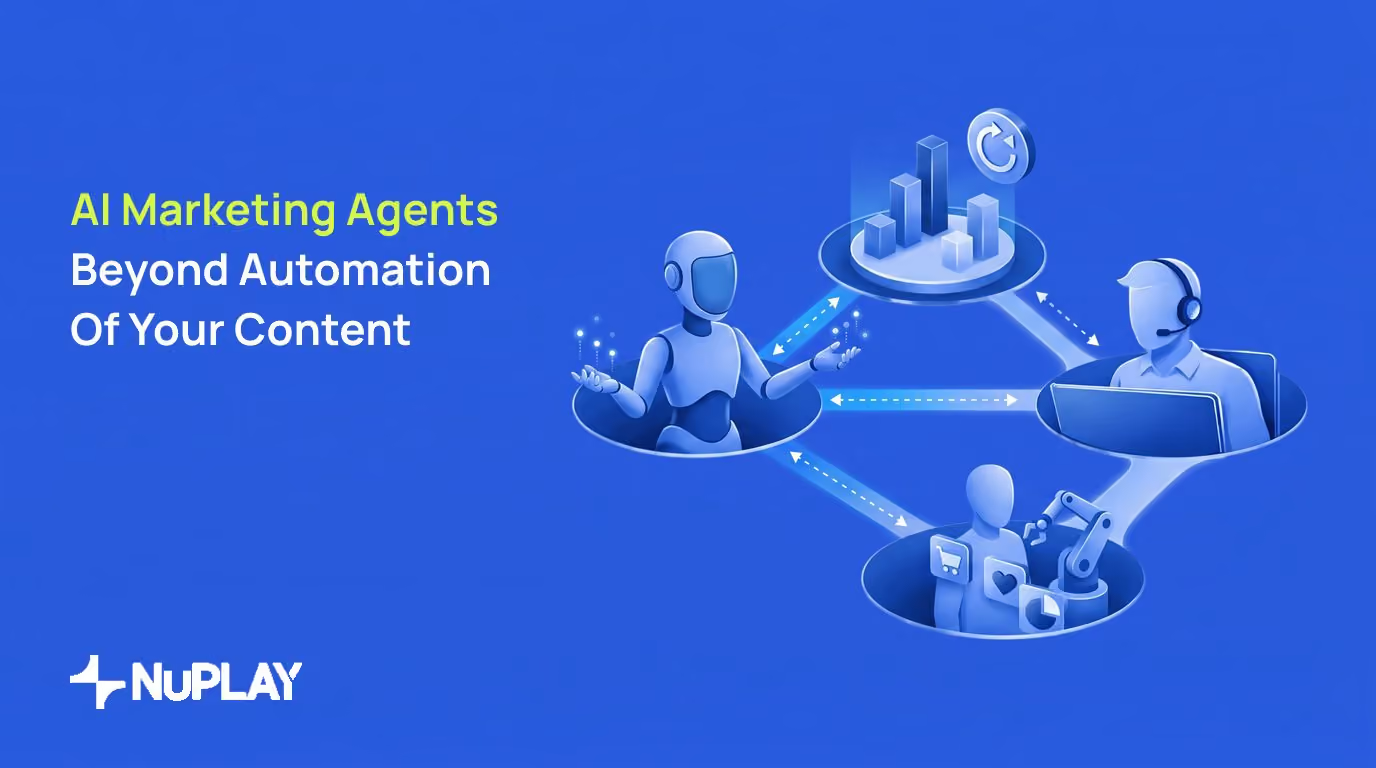

AI marketing automation uses autonomous agents to execute and refine marketing workflows like lead scoring and journey orchestration at scale. By 2026, 40% of enterprise applications will feature task-specific AI agents. Production-grade systems distinguish themselves from static tools by diagnosing failures and improving operations after every run.
Understanding ai marketing automation helps enterprise leaders see the full scope of what agents can manage. Marketing departments historically viewed artificial intelligence as a tool for generating blog posts or drafting emails. That narrow view ignores the operational reality of modern enterprise systems. This guide explains core mechanisms, terminology, and real applications so decision-makers can evaluate platforms effectively. You will learn how shifting from content factories to agent workforces drives measurable business value.
What is AI Marketing Automation
AI marketing automation is the use of autonomous agents capable of reasoning, goal-setting, and multi-step execution across platforms to manage marketing workflows like lead scoring and journey orchestration without human instruction for every step.
This discipline covers the use of intelligent agents to execute and refine marketing processes at scale. It focuses strictly on production-grade systems that handle high-volume repeatable tasks. Rather than acting as simple assistants, these agents operate as digital workers within a governed framework. The industry faces a massive execution gap between testing and deployment. While many firms pilot agents, few have mature governance frameworks in place to scale them safely.
Enterprise leaders must distinguish between static tools and platforms that improve after each run. A static tool executes a fixed script and breaks when application programming interfaces change. A self-improving enterprise AI platform runs enterprise workflows in production and improves them after every run. This continuous adaptation separates true automation from fragile scripts.
How AI Marketing Automation Works
Agents operate in Human, Automated, or Agent modes with approve-to-promote governance. Every task or decision routes to the appropriate mode based on complexity and risk. Workflows run through execute, build, inform, improve, and monitor layers to ensure consistent performance.
Standard software models fail in this environment because enterprises require deep integration with sensitive data. Generic platforms cannot handle this without elite engineering support, a challenge often called the SaaS customization paradox. To solve this, NuStack makes systems agent-ready by building, wrapping, or rebuilding legacy marketing infrastructure. It orchestrates the entire workflow securely.
Once deployed, closed feedback loops diagnose issues, propose changes, and ship validated updates. NuLoop provides this core intellectual property. It watches every agent run and ships validated fixes back into the other layers through a strict sequence: Report, Diagnose, Propose, Try, Ship. A human operator must sign off before any change ships, ensuring complete enterprise control.
Key Concepts and Terminology
Clear terminology prevents costly procurement mistakes. Task-specific micro-agents manage voice and chat interactions natively. Instead of relying on one massive, unpredictable model, these micro-agents execute narrow, well-defined marketing tasks.
Memory and context layers span organizational, agent, and user tiers. NuContext serves as this memory layer, keeping responses consistent across channels. If a customer interacts with a chat agent on a website and later speaks to a voice agent, the system remembers the entire journey. This shared memory is non-negotiable for enterprise operations.
Another critical concept is Answer Engine Optimization (AEO). Traditional search engine optimization is losing relevance. As 48% of consumers rely on AI suggestions, AI citation frequency replaces traditional backlink counts. Governed change processes emphasize diagnosis, coverage, and controlled updates to keep marketing data perfectly aligned with these new search algorithms.
What Agents Automate Beyond Content
Marketing agents handle complex operational workflows that extend far beyond generating text. Lead scoring, qualification, and routing happen based on real-time signals. When a prospect interacts with a campaign, the agent analyzes their behavior, updates the CRM, and routes high-value leads directly to sales teams instantly.
Dynamic personalization, segmentation, and journey orchestration run continuously in the background. Agents adjust email cadences and website experiences based on live engagement data. Furthermore, they execute Answer Engine Optimization as an automated workflow. Ranking number one is less important than being the primary citation in Perplexity or Gemini. Agents must now automate the generation of data specifically for AI search bots.
Campaign performance monitoring includes governed optimization steps. NuPro task-specific micro-agents execute these complex tasks natively on proprietary Astra and SEAL models. They handle the execution layer securely, ensuring that sensitive marketing data never leaks to public models.
Examples and Use Cases
Retail and home services teams use agents for customer follow-up and retention workflows. When a service appointment concludes, an agent automatically initiates a feedback sequence. It updates the customer profile and triggers a re-engagement campaign if the sentiment is positive. Slazenger reported a 49x return on investment within eight weeks after using automated, cross-channel marketing workflows.
Insurance and financial services organizations manage high-volume inquiry handling securely. Agents qualify policy inquiries, verify identity details, and route structured data to licensed brokers. This eliminates the manual data entry that typically slows down financial marketing campaigns.
Collections and mortgage operations streamline repetitive outreach and compliance checks. Voice agents handle the initial contact, proving that the system can execute live, multi-turn interactions successfully. This voice capability serves as proof of the platform's underlying workflow orchestration power.
Benefits and Importance
This approach moves the right work into agent mode while preserving human oversight. It enables consistent execution across changing business conditions. AI experimentation has become table stakes for marketing executives. As Kristina LaRocca-Cerrone notes, a widening gap is emerging between leaders who are still testing use cases and those who use AI to create real brand differentiation.
The industry suffers from an accuracy-reliability gap. Benchmark scores diverge from how agents behave in production, where consistency, predictable failure, and bounded error severity matter more than a single success metric, as argued in Towards a Science of AI Agent Reliability. Self-improving platforms solve this by treating every execution as a diagnostic event.
This supports scalable operations in Retail, Insurance, and Financial Services. By focusing on diagnosis, coverage, and governed change, enterprises ensure their marketing workflows never degrade. The system actively adapts to new market signals while keeping humans firmly in control of the final output.
Common Misconceptions
A frequent misunderstanding is that agents replace people entirely. They do not. They shift appropriate tasks into agent mode, freeing human marketers to focus on strategy and creative direction. The goal is human-agent collaboration, not wholesale replacement.
Another dangerous myth involves how these systems get better. Improvement comes from structured diagnosis and governed change rather than automatic accuracy gains. Agentic drift causes a projected 42% reduction in task success rates within months of deployment. If a system cannot diagnose its own failures and propose fixes for human approval, it will break.
Finally, many buyers confuse the interface with the platform. NuPlay supports enterprise workflows end to end. Voice and chat are interfaces within the platform, and they provide one proof point that the underlying orchestration can handle real-time, high-stakes execution.
Evaluating Enterprise Platforms
Enterprise buyers must demand a unified platform that runs workflows and improves them after every execution. Dan Gottlieb explains that the practical implication for 2026 planning is clear. Teams should audit integration quality before evaluating new platforms and treat agent capability as a primary selection criterion.
Support for high-volume repeatable processes requires strict human sign-off controls. Integration across execution, context, and monitoring layers guarantees sustained performance. NuPulse provides the status, volume, and outcome dashboard required for this level of observability.
Here is a side-by-side comparison of static marketing tools versus self-improving platforms.
Arthur Villa points out that sustainable maturity depends on whether enterprises can monitor, trace, and optimize AI agents for performance and cost, rather than just speed of deployment.
Conclusion
Readers now understand the expanded role of agents in ai marketing automation. Self-improving platforms deliver ongoing value in enterprise environments by managing complex workflows beyond simple content creation. By utilizing a closed feedback loop that diagnoses issues and proposes governed changes, organizations prevent system degradation. NuPlay AI provides the execution, build, context, improvement, and monitoring layers required to scale these operations securely. To see how these agents can transform your high-volume marketing workflows, book a demo with the NuPlay AI team.