.gif)
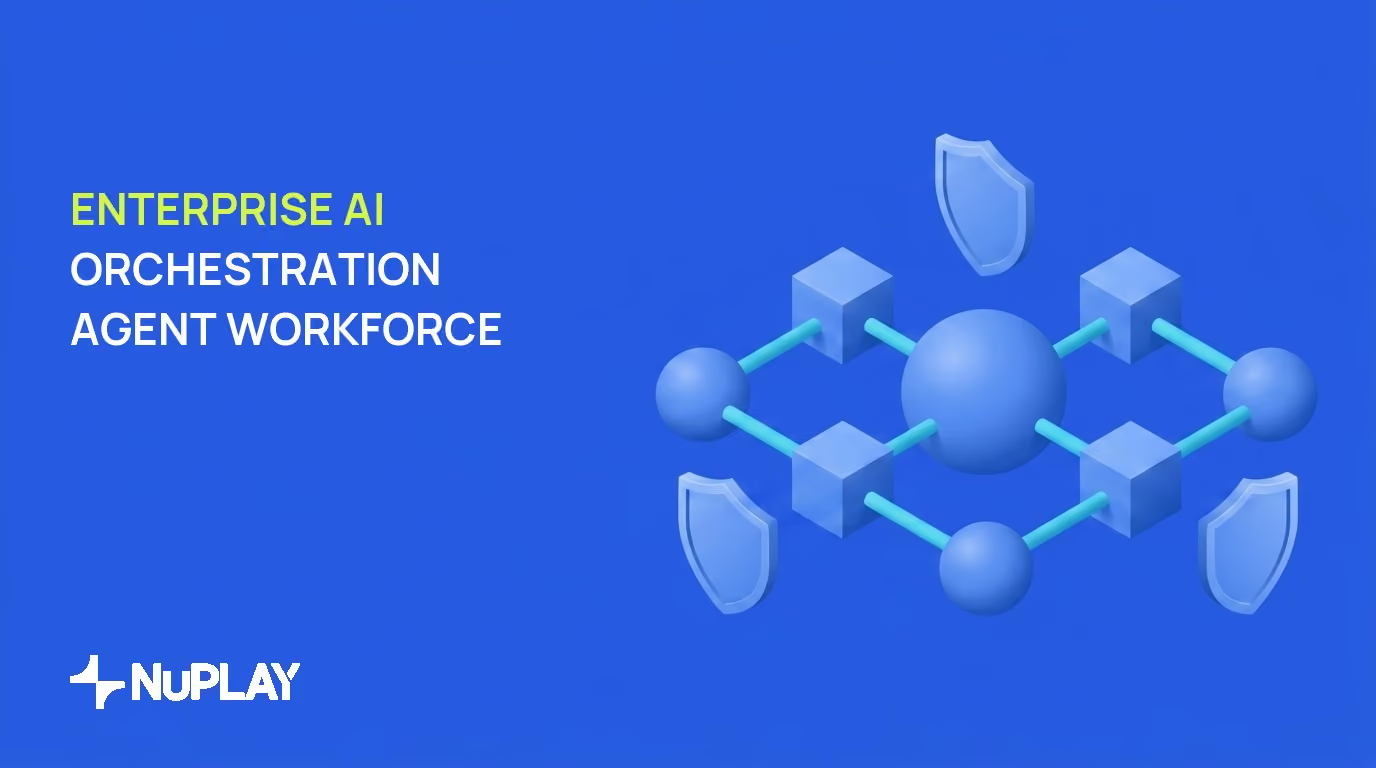

Enterprise AI orchestration is the coordination layer that manages how multiple models, data sources, and workflows operate together. It addresses the execution gap where 88% of agent pilots fail to reach production. Orchestration replaces isolated bots with a unified, governed workforce that executes repeatable business processes reliably.
Enterprises moving beyond pilot agents need structured ways to coordinate multiple agents across complex workflows. Many organizations manage agentic systems that do not share state or context. Without a shared control layer, teams lose visibility into handoffs, context, and ownership.
This guide explains how organizations achieve reliable operations at scale. Readers will understand the mechanisms, terminology, and practical steps for building an orchestrated agent workforce. You will learn how to move from static deployments to systems that diagnose issues and propose fixes after every run.
What Is Enterprise AI Orchestration
Enterprise AI orchestration is the coordination layer that manages how AI models, agents, data sources, and workflows operate together across an enterprise environment to support reliability and governance.
It moves operations from isolated single-agent deployments to a unified workforce. Organizations face a massive execution gap in this transition. While many enterprises pilot multi-agent systems, only a fraction scale them to organization-wide production use due to governance and integration friction. The typical enterprise runs three orchestration platforms at once, selecting them for flexibility across models rather than affinity to any single one. Managing this complexity requires a centralized approach.
This coordination is critical for high-volume repeatable workflows in regulated industries. NuPro task-specific micro-agents provide the execution layer for these orchestrated workforces. They chain together across complex sub-workflows to complete defined business tasks. Assigning bounded tasks to specific micro-agents supports clear permissions and data-access controls.
How Enterprise AI Orchestration Works
Agent execution, system integration, and context layers must connect through defined interfaces. Orchestration acts as a control plane that manages state, identity, and shared memory. This helps prevent agents from duplicating work or overwriting critical data in legacy systems. Orchestration efficiency measures the ratio of successful multi-agent tasks completed against total compute cost. High efficiency means agents complete coordinated work within cost and policy constraints.
NuStack makes legacy systems agent-ready and orchestrates the end-to-end workflow. It solves the integration friction that stalls so many projects. Once deployed, the system requires a closed feedback loop to maintain performance against shifting business rules.
This requires human approve-to-promote governance across human, automated, and agent modes. Every AI-proposed fix must be validated by a human operator before shipping to production. This oversight keeps the workforce aligned with business goals while limiting risks from agent actions.
Key Concepts and Terminology
Understanding the vocabulary of an agent workforce prevents costly architectural mistakes. By the end of 2026, 40% of enterprise applications will feature task-specific AI agents. This shift sets new standards for human-agent teamwork, demanding clear definitions for procurement and engineering teams.
Context layers span organizational, agent, and user tiers to prevent fragmentation. NuContext manages this memory across all tiers. It supplies approved context for each micro-agent's defined task. Without shared memory, agents may ask customers to repeat information and create avoidable friction.
Production-grade execution demands continuous diagnosis and governed change. ISO/IEC 42001:2023 defines requirements for an AI management system and reinforces organizational accountability. An approve-to-promote pattern ensures that every system update receives explicit human sign-off. This creates an audit trail for each production change.
Real-World Examples and Use Cases
Retail and home services depend heavily on workflow coordination. When a customer requests a return, one agent handles the chat interaction while another updates the inventory system. This coordination drives a 78% positive workforce impact in financial services by removing tedious manual data entry. Human workers focus on complex exceptions while agents handle the predictable volume.
Insurance and financial services rely on these systems for claims and servicing processes. Multiple agents collaborate to extract data from medical records, verify policy limits, and generate settlement proposals. The system then routes the packaged data to a human adjuster for final approval. This drastically reduces the time required to process a claim.
Collections and mortgage operations require consistent outcomes at scale. Orchestrated workforces handle payment scheduling and document verification across thousands of accounts daily. Voice capabilities often execute these tasks, proving the system can handle live, multi-turn interactions securely.
Benefits of Enterprise AI Orchestration
Reliable production performance that improves after every run is the primary benefit. Organizations that scale these systems effectively achieve 15% higher operating margins. They replace fragile manual processes with a unified platform covering execution, build, context, improvement, and monitoring.
By 2026, the divide in enterprise AI is between organizations that ship static pilots and those that build infrastructure for continuous, governed improvement. If a system cannot diagnose its own failures, it is a liability. Static deployments degrade rapidly, forcing engineering teams to spend their time fixing broken scripts rather than building new capabilities.
NuPulse provides a real-time view of status, volume, and outcomes. It shows operations leaders where workflows are succeeding, escalating, or creating repeat work. NuLoop owns the governed changes that address those signals.
Common Misconceptions About Scaling Agents
A major misconception is that orchestration replaces people. It shifts appropriate work to agent mode while keeping humans in control. Another error is measuring improvement only through model accuracy. Production success depends on workflow reliability, coverage, and governed change.
Improvement comes from diagnosis, coverage, and governed change. Static agents can drift as business rules, data, and user behavior change. Without a closed feedback loop, that degradation can go unnoticed until workflows fail. Teams cannot fix what they do not measure.
Finally, voice capabilities serve as proof of capability, not the primary identity of the platform. If a system can handle complex voice negotiations, it proves the underlying orchestration is sound. The actual value lies in the backend workflow execution.
How NuPlay Supports Orchestrated Agent Workforces
NuPlay runs enterprise workflows in production and improves them after every run through NuLoop, with agents, the systems they operate, and the context they draw on under one platform. This contrasts with static deployments that degrade as the business changes. NuLoop is the closed feedback loop that ships validated improvements with human sign-off. It follows a strict sequence: Report, Diagnose, Propose, Try, Ship.
Here is a side-by-side comparison of static bots versus an orchestrated agent workforce.
This architecture brings agents, the systems they operate, and the context they draw on under one platform. Buyers should evaluate whether it completes defined workflows, escalates exceptions correctly, and produces the records required for investigation and change control.
Conclusion
Enterprise AI orchestration enables organizations to scale agents into governed workforces that improve through validated changes. Static deployments break when business rules change, but a governed platform can diagnose failures and propose tested fixes. NuPlay AI provides the execution, orchestration, context, improvement, and monitoring layers required to run these workflows. Book a demo to review an orchestrated agent workflow against your systems and controls.




.jpeg)