.gif)
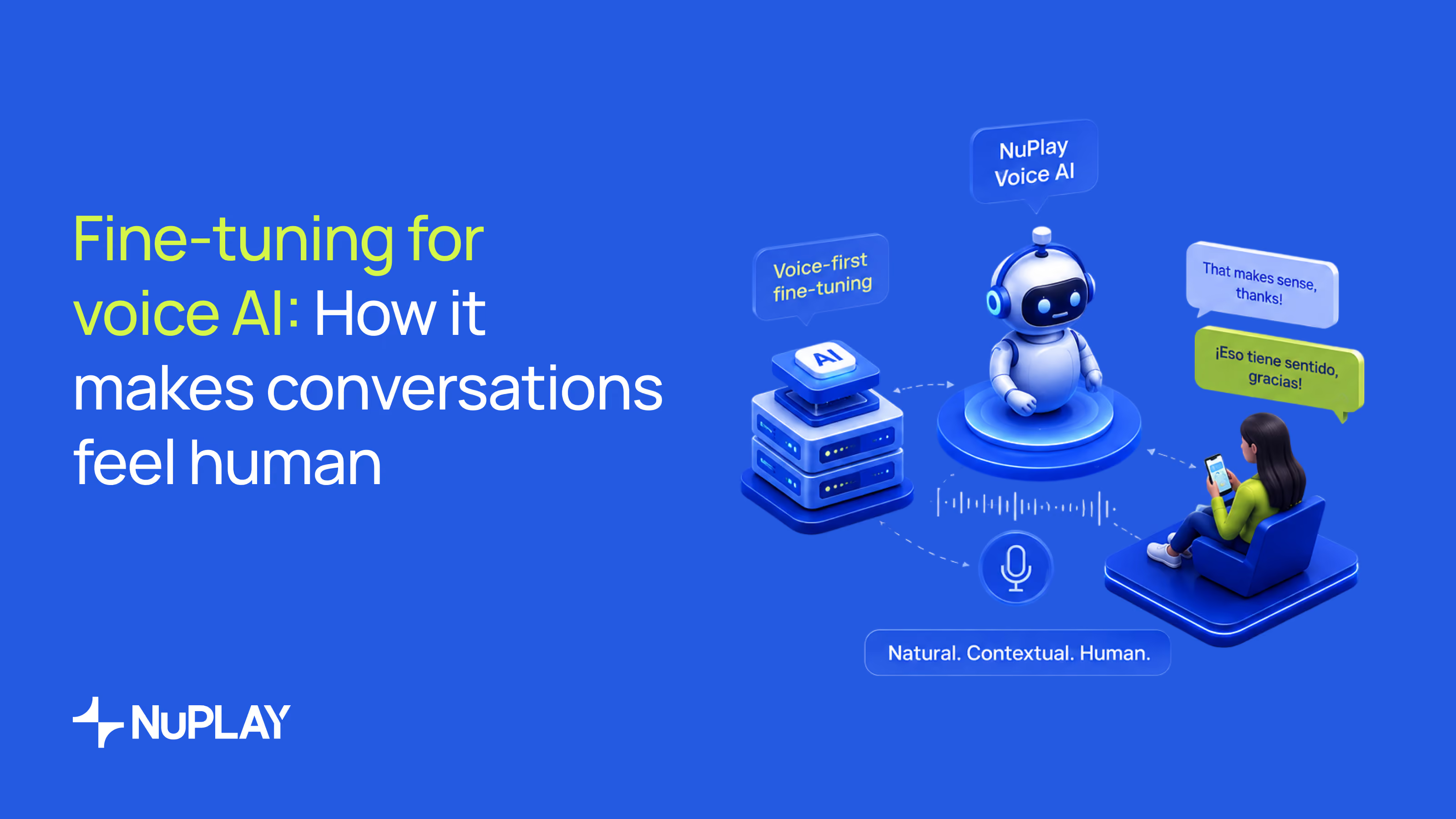

Every enterprise buying a voice AI agent hears some version of the same promise: it's trained for human-like communication. It's worth being precise about what fine-tuning actually does - because the honest version of the claim is different, and arguably more useful, than the version most vendors lead with.
What fine-tuning actually is
A language model can be adapted to a task in two different ways.
Prompting gives a general-purpose model instructions - tone, boundaries, what to say in common situations. It's fast to set up. The model itself hasn't changed. It's the same system, given better notes.
Fine-tuning actually adjusts the model using real data. For a voice AI model, that means training on real voice conversations - how people actually talk on a call, the rhythm of turn-taking, the phrasing that sounds natural out loud versus stiff or written. This is different from training a model on a single business's specific data. It's training a model on what real conversation actually sounds like, so it stops sounding like a text system reading answers aloud.
That's the honest scope of what fine-tuning does. It doesn't mean the model has learned any one business's specific customers, policies, or history. It means the model has learned how humans actually talk, so it can hold up its end of a conversation instead of just answering questions correctly.
Why this matters more than it sounds like it should
Most AI voice agents can answer a question correctly and still feel wrong on a call. The gap isn't accuracy - it's whether the response sounds like something a person would actually say, at the pace and rhythm a real conversation moves at.
A model that hasn't been fine-tuned for voice tends to produce the same kind of language it would use in a chat interface: complete, correct, and slightly stiff. Read aloud, that reads as robotic - not because the information is wrong, but because real spoken conversation doesn't work like written text. People trail off, use contractions, respond in fragments, and pick up on conversational cues that a text-trained model was never taught to reproduce.
That gap shows up in ways that matter to a business: customers who sense they're talking to something artificial disengage faster, trust the answer less, and are quicker to ask for a human. None of that is about whether the AI got the facts right. It's about whether the conversation felt like one.
What we're doing with Astra
Astra is NuPlay AI's own LLM, built in-house and fine-tuned specifically for enterprise-to-customer voice conversations. The fine-tuning is trained on real conversational voice data - not a single business's private records, but the patterns of how real voice conversations actually happen between businesses and their customers. The goal is a model that sounds human, natural, and fluent by default, because it has actually learned what spoken conversation sounds like, rather than being prompted to approximate it.
Being built in-house is what makes this possible. A model accessed only through someone else's API can be prompted, but a business can't retrain the underlying model itself. Owning the model is what makes this kind of fine-tuning - training on conversation itself, not just configuring behavior on top of a fixed model - something we can actually do.
What Astra can help with
Natural, fluent conversation is what fine-tuning specifically delivers, but it's one part of a broader picture. Because Astra is NuPlay AI's own model, built and run in-house, it also helps with three other things that matter just as much in production:
- Low latency. Because Astra runs on our own infrastructure, a response never has to leave, reach another company's servers, and come back. That's what keeps a conversation feeling immediate instead of laggy.
- Data security. Because inference happens on infrastructure we control, customer conversations aren't routed out to a separate AI provider to generate a response.
- Predictable cost. A fixed-cost model means running Astra doesn't get more expensive every time call volume goes up.
Together with natural, fluent conversation, these are the four things that actually determine whether a voice AI agent holds up in production - not just in a demo.
This applies broadly, across every industry we work with: retail customer service and sales agents, insurance claims and policy servicing, financial services collections and lead engagement, home services scheduling and dispatch, and education admissions and student support. In each case, the starting point is the same - an agent that sounds like a person having a conversation, responds instantly, keeps data secure, and doesn't get more expensive as it scales.
What to ask before you believe a customization claim
If a vendor says their voice AI is "trained for your business," ask specifically what that means: is the underlying model fine-tuned to sound natural in conversation, is it trained on that business's own historical data, or is it a general-purpose model with a business-specific prompt on top? These are three different things, and knowing which one you're actually being sold matters more than the phrase on the landing page.