.gif)
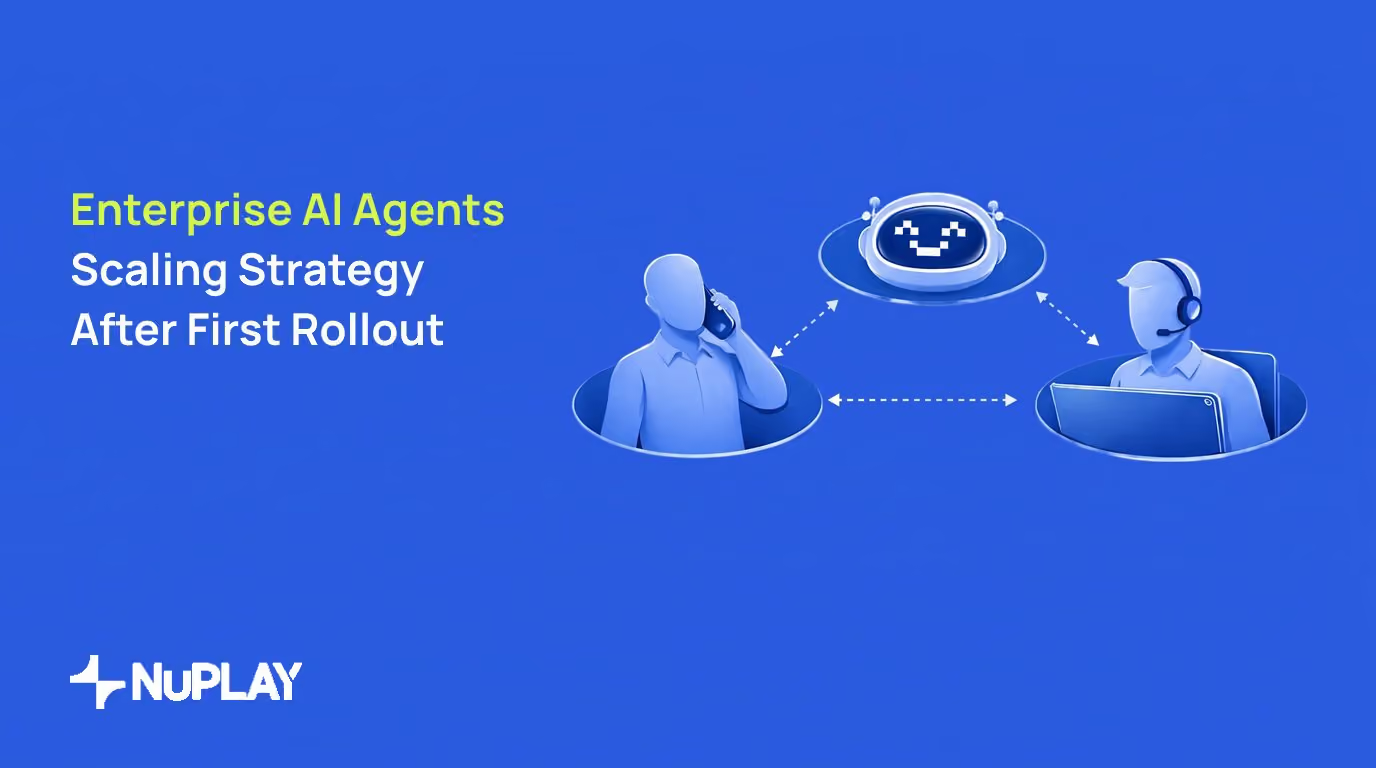

Enterprise AI agents expand after their first rollout by moving from isolated pilots into orchestrated, self-improving workforces. While agent features now ship inside most enterprise applications, successful expansion requires governed feedback loops to prevent performance degradation. Scaling effectively demands moving the right tasks into agent mode with strict human oversight.
Enterprise AI agents are moving rapidly from pilot projects to production at scale in 2026. Organizations in retail, insurance, and financial services are seeing initial deployments expand into adjacent workflows. This growth depends entirely on platforms that support continuous improvement rather than static performance. Many early adopters treat agent rollout as a fire-and-forget software installation, which leads to immediate operational friction. True scaling requires a fundamental shift in architecture. NuPlay AI runs enterprise workflows in production and improves them after every run through NuLoop, keeping agents, the systems they operate, and the context they draw on under one platform. This guide explores how successful deployments grow beyond initial rollouts through orchestration, feedback loops, and governed expansion.
What Are Enterprise AI Agents
Enterprise AI agents are autonomous software systems capable of interpreting goals, reasoning across multi-step workflows, and interacting with enterprise data layers to execute business tasks reliably and securely.
Current State of Enterprise AI Agent Deployments
The canonical AI agent benchmark often presents a lie of omission. It answers how good the agent is today while ignoring if it will be as good next week, as longitudinal evaluation work has shown. Production agents exist in a world of constant background change. Currently, high-volume repeatable workflows in retail and financial services dominate the initial focus. Teams deploy agents to handle customer experience and back-office operations, seeking immediate efficiency gains.
However, a massive execution gap exists in the market. Most agent pilots never reach organization-wide production, and the blockers are governance friction and reliability rather than model quality. Organizations are realizing that disconnected point tools cannot handle enterprise complexity. They are shifting toward unified platforms that treat voice, chat, and backend execution as cohesive workflows. This shift sets the baseline for adoption patterns after the first successful rollout.
Workflow Orchestration and System Integration
Expanding beyond a single rollout requires deep connectivity. Agent-ready infrastructure is built by wrapping or rebuilding legacy systems to support automated execution. Without this orchestration, organizations suffer from agent sprawl. This uncontrolled proliferation of independent bots acts as the new shadow IT, which multiplies operational risk because no single owner can see what the fleet is doing.
Where expansion stalls is most often the integration layer. Legacy systems need to be wrapped or rebuilt before agents can act on them, and that work needs a single owner rather than a patchwork of pilot-specific tools. On the NuPlay platform, NuStack is that owner: it makes systems agent-ready and orchestrates the workflow end to end. Once a system is ready, NuPro deploys task-specific micro-agents to handle execution across every channel the workflow touches.
Shared context is the third requirement for expansion. Multi-step workflows reach across systems and long conversations, so memory must follow the work instead of living inside a single bot. NuContext provides the platform's memory tiers across organizational, agent, and user data, keeping every interaction coherent with the ones before it. With execution, integration, and context unified, staff can focus on high-value exceptions rather than managing disconnected point tools.
Closed-Loop Improvement Mechanisms
Post-run enhancement processes separate successful expansions from failed pilots. Static agents suffer from agentic drift, a behavioral degradation in production over time. This drift causes a projected 42% reduction in task success rates and a massive increase in human intervention requirements within months of deployment.
NuLoop acts as a closed feedback loop that watches every agent run to prevent this decay. Improvement is executed through a strict cycle: Report, Diagnose, Propose, Try, Ship. The system identifies coverage gaps and proposes governed changes. This process relies on diagnosis and coverage improvements applied to production agents rather than generic accuracy curves. Benchmark scores diverge from how agents behave in production, where consistency, predictable failure, and bounded error severity matter more than a single success metric, as argued in Towards a Science of AI Agent Reliability.
Governance and Monitoring Expansion
Scaling operations demands absolute oversight. Governance and monitoring must expand alongside the agent workforce. NuPulse monitors status, volume, and outcomes in real time, providing the exact data needed for the diagnostic phase. Risk controls for regulated industries require strict human accountability.
The approve-to-promote workflow ensures that human operators sign off on every proposed fix before it ships to production. This model applies across human, automated, and agent modes. Compliance standards now mandate this level of control. Enterprise buyers increasingly screen for ISO/IEC 42001:2023 alignment before the first procurement round. Organizations are building alignment plans to meet these AI management system requirements.
What This Means for Enterprise Buyers
For enterprise buyers, the shift toward orchestrated systems translates directly to financial performance. Returns concentrate where the platform is measured on outcomes rather than on activity. Margin gains follow from moving the right work into agent mode, not from moving the most work.
By 2026, the divide in enterprise AI is between organizations that ship static pilots and those that build infrastructure for continuous, governed improvement. If a system cannot diagnose its own failures, it is a liability, not an asset. Buyers benefit from reduced degradation of agent performance over time. They experience faster extension into new workflows without full system rebuilds. A platform approach outpaces disconnected point solutions by keeping context and execution unified.
What's Next for Enterprise AI Agents
The near-term trajectory through 2027 points toward broader adoption in collections, mortgage, and home services. Deeper integration of memory and feedback layers will separate the leaders from the laggards. Continued emphasis on production-grade governance will force companies to abandon ungoverned tools.
Deployments that lack these controls are the ones most often cancelled. Conversely, Gartner expects 40% of enterprise applications to feature task-specific AI agents by the end of 2026, setting new standards for human-agent teamwork.
Here is a side-by-side comparison of static deployments versus orchestrated agent platforms.
Conclusion
Expansion looks concrete in production. Working with Myntra, agent-led support cut average handle time by 50% and scaled support three times over without added headcount.
Enterprise AI agents expand successfully only when supported by platforms designed for continuous improvement and strict governance. Moving from a single rollout to a full agent workforce requires orchestrating execution, memory, and feedback into one cohesive system. NuPlay AI provides the infrastructure to run enterprise workflows in production and improve them after every run. By focusing on diagnosis, coverage, and governed change through human approve-to-promote sign-offs, organizations can scale their agentic operations securely. To see how these systems perform in high-volume environments, book a demo with the NuPlay AI team.




.jpeg)