.gif)

How to Ground AI Agents in Proprietary Enterprise Knowledge
Grounding AI agents means anchoring model outputs to an enterprise’s own controlled data sources rather than relying on training data alone. This practice produces traceable responses that support high-volume workflows and allows updates through source edits instead of retraining. Enterprises in retail, insurance, and financial services use it to maintain reliability as business conditions change.
Without grounding, agents answer from parametric memory that goes stale the moment policies, prices, or product rules shift. With grounding, you treat proprietary knowledge as a living control surface: curate it, retrieve it under access rules, constrain generation to that material, and govern every change before it ships. The rest of this guide shows how to design that system for production workflows.
What is grounding ai agents?
Grounding anchors an AI model’s responses to verified, retrievable source material rather than training data alone. The outcome is a production-grade agent whose claims can be inspected against the passages it used.
Three components make grounding work in practice.
- Source of truth. Proprietary documents, policies, product catalogs, case notes, and structured records that your organization owns and can version.
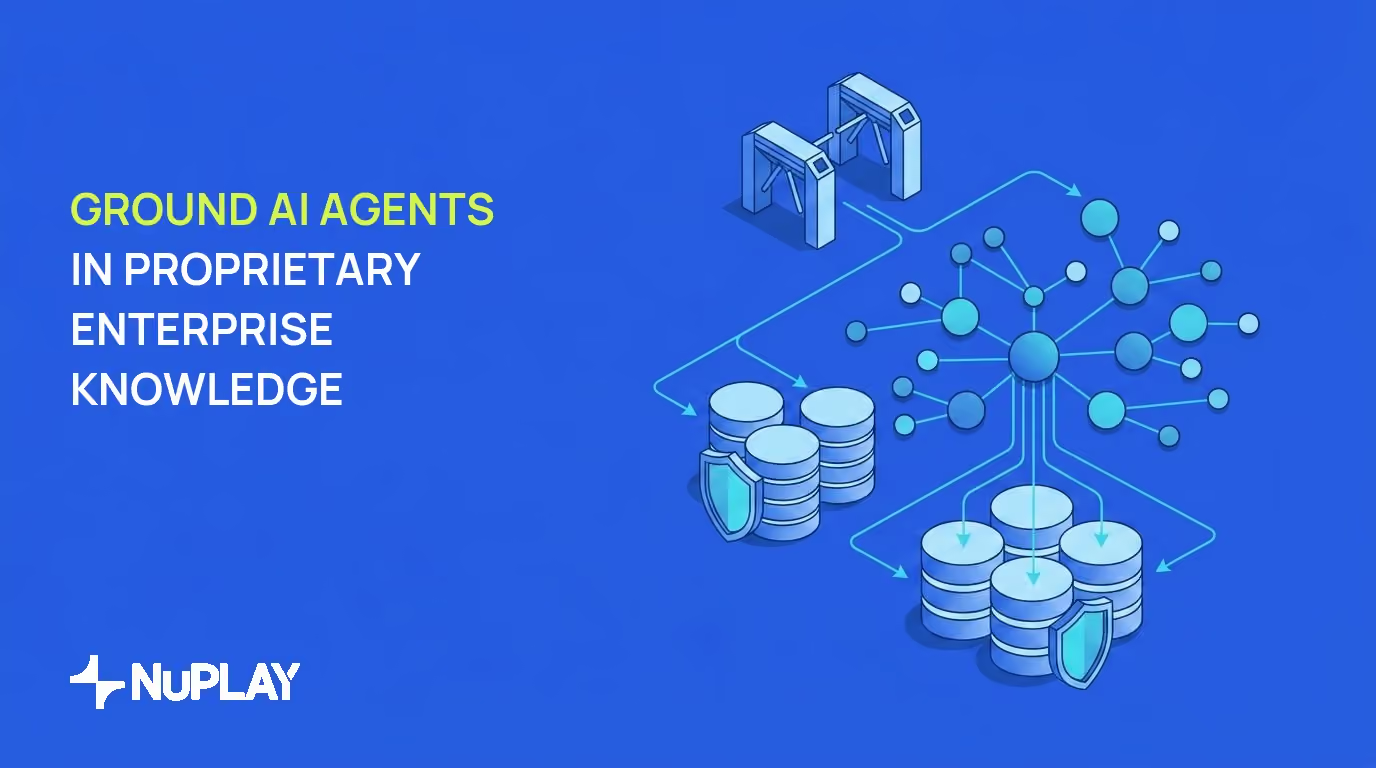
- Retrieval layer. The system that selects the passages most relevant to a query, typically through semantic search over vector embeddings plus filters for access, freshness, and scope.
- Constrained generation. Explicit instructions that limit the model to the retrieved material, require citations, and refuse to invent facts when context is missing.
Grounding differs from retrieval-augmented generation (RAG). RAG is one architectural pattern that supports grounding by fetching external context at inference time. Grounding itself is the broader outcome: outputs stay tethered to authoritative material even when the underlying model has no knowledge of events after its training cutoff. You can achieve grounding with RAG, tool calls, structured lookups, or a mix of all three. What matters is that every customer-facing or regulated claim maps back to a controlled source.
The risk of skipping this discipline is well documented in high-stakes domains. Stanford HAI’s analysis of legal large language model (LLM) use found that models hallucinated between 69% and 88% of the time on specific legal queries, which is exactly the class of untraceable error grounding is designed to prevent in enterprise settings.
The NuPlay platform supplies the full stack that includes context and improvement layers for this approach, so agents, the systems they operate, and the knowledge they draw on sit under one operating model.
Why grounding matters for enterprise workflows
Enterprise workflows in retail, insurance, financial services, collections, mortgage, and home services share a pattern: high volume, repeatable decisions, and material cost when an answer is wrong or untraceable. Grounding reduces hallucinations that create liability in customer-facing or regulated steps. Remaining errors become diagnosable because you can see which passage the agent used, which source was missing, and which instruction failed.
Behavior updates no longer require a full retrain. When a rate card changes, a claims policy is revised, or a collections script is updated, you edit the source of truth and re-index. The agent picks up the new material on the next retrieval cycle. That is how teams keep agents current without freezing the business around a static model snapshot.
Audit trails follow naturally. Every response can reference the exact passages used, which supports compliance reviews, dispute handling, and root-cause analysis when an output needs examination. Traceability also scales across context tiers. Organizational policies, agent-specific playbooks, and user or session data can each contribute to an answer while remaining separable for access control and investigation.
Adoption pressure makes this discipline non-optional. Gartner’s forecast projects that 40% of enterprise applications will feature task-specific AI agents by the end of 2026, up from less than 5% in 2025. As agents move from pilots into line workflows, ungrounded generation becomes a production risk rather than a demo quirk.
For Heads of AI, CTOs, and operations leaders, the business case is straightforward. Grounding turns agents from generic text generators into participants in controlled workflows: fewer untraceable errors, faster policy updates, and a clear path from a bad run to a governed fix.
How grounding ai agents works in practice
Effective grounding is a pipeline, not a single feature. Teams that succeed treat each stage as an owned control point with clear owners, tests, and failure modes.
Curate and chunk. Start with the proprietary knowledge that actually drives decisions: policy manuals, product matrices, exception tables, approved scripts, and system-of-record extracts. Break those assets into self-contained passages so each chunk answers a coherent question without depending on hidden surrounding text. Attach metadata for origin, version, effective dates, business unit, and access rules. Contradictory or expired documents should never enter the index unmarked.
Retrieve by meaning. Semantic retrieval over vector embeddings matches query intent rather than exact keywords. A customer who asks about “early payoff fees” should still surface the prepayment penalty policy even if the document never uses those words. Combine dense retrieval with filters so the agent never sees content outside the caller’s entitlements or outside the active policy window.
Constrain generation. Instruct the model to answer only from retrieved context, to cite sources inline, and to say when evidence is insufficient. For numerical or policy-bound answers, prefer tool calls and structured lookups over free-form generation. Citations are not decoration; they are the audit link between claim and source.
Monitor continuously. Track retrieval misses, empty-context answers, citation failures, and drift between source updates and agent behavior. A miss rate that rises after a content migration is a signal to fix chunking or connectors, not a reason to retrain the base model.
In short, strong implementations separate curation, retrieval, generation, and monitoring so each can improve independently. Weak implementations bolt a vector store onto a chatbot prompt and call the job done.
Key concepts and terminology
Shared vocabulary keeps architecture, operations, and compliance aligned when agents enter production.
A workflow consists of tasks and decisions that achieve a business outcome. A task is one unit of work. A decision is a choice point that routes the workflow. Sub-workflows nest two or three levels deep inside a parent workflow, which is how complex journeys such as claims intake or mortgage fulfillment stay manageable.
An agent is software that uses a large language model to produce an output or decision. Agentic describes the act of moving a task or decision into an agent. Neither term implies unsupervised autonomy. Production design still decides which steps stay human, which stay rule-based, and which earn agent mode.
Every task or decision runs in one of three modes:
- Human, where a person performs the work or makes the call
- Automated, where fixed rules execute without reasoning
- Agent, where the model reasons over grounded context to produce an output or decision
The operating goal is to move the right work into agent mode, not to displace people from tasks that still require judgment, exception handling, or relationship care.
Memory and context sit in three tiers. The organizational tier holds company-wide policies, product facts, and shared records. The agent tier stores workflow-specific instructions, tools, and run history. The user tier captures individual preferences, entitlements, and session data. Retrieval must respect those boundaries so a collections agent never pulls another customer’s file, and a retail agent never applies a retired promotion. NuContext supplies the three-tier memory layer for proprietary knowledge.
A closed feedback loop improves the system through five stages: Report, Diagnose, Propose, Try, and Ship. Human approve-to-promote sign-off governs every change before it reaches production. That loop is how grounding stays current: failed retrievals and weak coverage become diagnosed fixes to sources, instructions, or tools rather than silent degradation.
Practical techniques for grounding in proprietary data
Enterprise grounding succeeds when data exposure, retrieval design, hybrid tools, and change control work together.
Expose clean, versioned sources. Build or wrap systems so agents read from controlled interfaces rather than scraped screenshots or stale exports. Version every policy and product document. Record effective dates. Retire superseded content from the active index instead of leaving contradictory passages side by side. When legacy systems cannot emit clean APIs, wrap them so the agent still sees a stable contract.
Implement tiered context retrieval. Query organizational, agent, and user tiers with explicit access controls and freshness rules. Organizational content may be broad but tightly versioned. Agent content may be dense and workflow-specific. User content should be narrow, time-bounded, and never mixed across identities. Rank and filter before generation so the model never sees material it is not allowed to use.
Combine retrieval with tools. Free-text RAG is a poor fit for balances, due dates, eligibility matrices, and fee schedules. Pair semantic retrieval for narrative policy with structured lookups and tool calls for numbers and status. The model should explain a rule from a grounded passage and fetch the customer’s actual balance from the system of record, not invent either.
Test against historical runs and require human sign-off. Before any prompt, chunking, or source change ships, replay it against past cases with known outcomes. Compare citations, refusals, and routing decisions. Only promote after a human reviews the trial results. NuLoop supplies the closed feedback loop that governs run-over-run improvement through Report, Diagnose, Propose, Try, Ship.
NuPlay runs enterprise workflows in production and improves them after every run through NuLoop, with agents, the systems they operate, and the context they draw on under one platform. This contrasts with static deployments that degrade as the business changes.
Common pitfalls and how to avoid them
Most grounding failures are operational, not model failures. The patterns below show up repeatedly in enterprise rollouts.
Stale or contradictory source content. If two active documents disagree on a fee or eligibility rule, the agent will eventually surface both. Prevent this with version control, effective dating, and a single owner for each policy domain. Freshness checks should flag documents that have not been reviewed within a defined window, and retired content should leave the retrieval index rather than linger with a soft warning.
Over-reliance on keyword search. Lexical matching misses paraphrases, regional wording, and customer phrasing. Semantic retrieval over vector embeddings captures intent when wording varies, and hybrid search (dense plus sparse) often outperforms either alone. Test retrieval with real customer language, not only with the vocabulary used inside policy PDFs.
Lack of citation enforcement. Without hard instructions and evaluation checks, models summarize without pointing to sources. That hides coverage gaps and blocks audit. Require citations in the generation contract, fail runs that omit them when a claim is made, and review citation quality in the same way you review answer quality.
One-time setup thinking. Grounding is not a launch checklist item. Business rules change weekly. Connectors break. New products appear. Treat grounding as an ongoing governed process: monitor retrieval health, diagnose misses, propose source or instruction fixes, trial them on historical runs, and ship only after approve-to-promote. Teams that skip the loop watch carefully grounded pilots drift into unreliable production systems.
Ignoring access and tenancy boundaries. A technically correct answer drawn from the wrong customer’s file or the wrong legal entity is still a failure. Encode entitlements in retrieval filters, not only in the prompt, so restricted material never enters the context window.
Avoiding these pitfalls keeps grounding aligned with how the business actually operates, which is the only standard that matters once agents touch real customers and regulated decisions.
Conclusion
Grounding AI agents in proprietary enterprise knowledge turns generic models into reliable workflow participants. Anchoring generation to curated sources, tiered context, and constrained citations gives you traceability and a path to update behavior when the business changes. Pair that foundation with a closed feedback loop that reports, diagnoses, proposes, tries, and ships fixes only after human approval, and agents improve through structured diagnosis, coverage, and governed change rather than degrading over time. Enterprises ready to move repeatable workflows into agent mode can request a demo to see how the approach fits their environment.




.jpeg)