.gif)
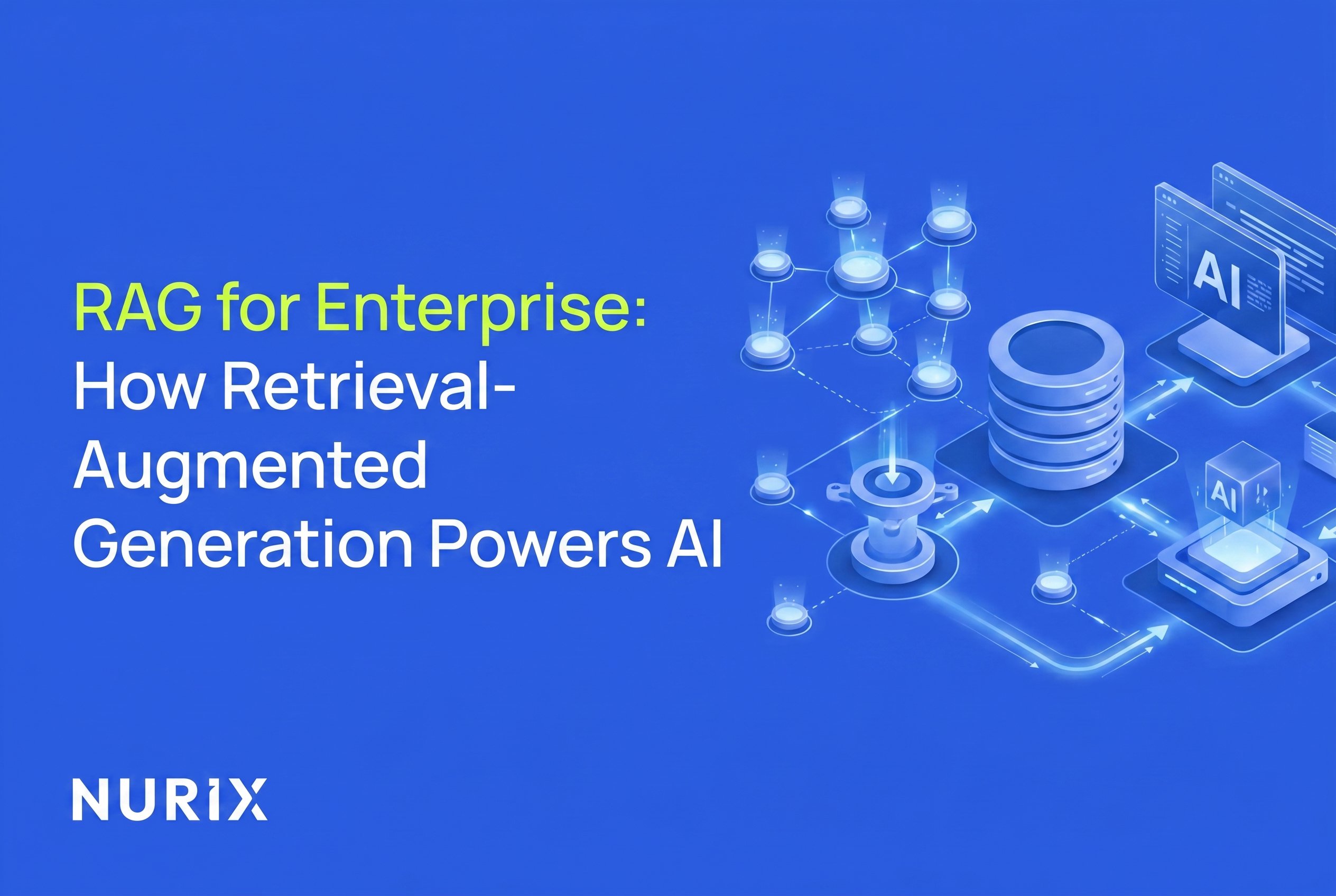

Enterprise RAG, or retrieval-augmented generation, gives an AI system relevant information from a separate knowledge base when it answers. It retrieves relevant material, supplies that material as context to a generative AI model, and can update the knowledge available to the system without retraining the model. NIST definition
Enterprise AI needs more than a capable model connected to a collection of documents. It needs controlled sources, permission-aware retrieval, evidence in the response, testing, and a way to investigate failures.
That matters because generative artificial intelligence (AI) is already producing business risk. In its March 12, 2025 global survey, McKinsey reported that 47% of respondents at organizations using generative AI said their organization had experienced at least one negative consequence from its use. This is a survey result about generative AI broadly, not a statistic about retrieval-augmented generation (RAG). McKinsey, March 12, 2025
What is enterprise RAG?
Enterprise RAG is a generative AI system that pairs a model with a separate information-retrieval system or knowledge base. When a user asks a question, the system identifies relevant information and supplies it to the model as context for its response. The National Institute of Standards and Technology (NIST) also states that RAG can modify the knowledge available to a model without retraining it. NIST
The word enterprise describes the operating standard around that architecture. An enterprise RAG implementation should define:
- Which knowledge sources are approved
- Who owns each source
- When each source became effective
- Which version supersedes another
- Which users, agents, or workflows may access it
- How answers show supporting evidence
- How retrieval and response quality are evaluated
- How source, prompt, retrieval, and model changes are controlled
RAG is more than search. Search returns relevant material. RAG passes that material to a generative model as context so the model can formulate an answer. NIST
RAG also does not make source content inherently safe or true. A retrieved document may be outdated, incorrect, poorly governed, or maliciously modified. The Open Worldwide Application Security Project (OWASP) warns that RAG does not fully mitigate prompt injection, including cases where a modified document influences a model to produce misleading output. OWASP LLM01:2025
The original RAG research provides useful historical grounding. Lewis and colleagues combined a pretrained sequence-to-sequence generator with a dense index of Wikipedia accessed by a neural retriever. On the tasks they evaluated, the RAG models produced more specific, diverse, and factual language than their parametric-only baseline. The paper also identified provenance and knowledge updates as open problems. Lewis et al., 2020
How enterprise RAG works: from source to cited answer
A production system is a chain of decisions, not just a model and a database. The implementation choice should follow the job the system must perform, rather than treating RAG as a replacement for every model or search use case.
1. Set approved sources
Start with the information the workflow is allowed to use. Depending on the use case, this may include policies, product data, process documentation, customer relationship management (CRM) records, or support tickets.
Each source should have an owner and a defined purpose. A document can be relevant to a question without being authoritative enough to answer it.
2. Prepare content and metadata
Prepare source material so retrieval can preserve meaning and provenance. Retain details such as:
- Title and document type
- Source owner
- Effective date
- Superseded or current status
- Access rule
- Source identifier or link
- Parent-document relationship
The system should be able to connect a retrieved passage to the larger document and its current status. This helps an operator determine whether a failure began with poor source management or later in the pipeline.
For a practical discussion of enterprise retrieval design, see this enterprise RAG guide.
3. Authenticate before retrieval
The system should establish who is asking the question, or which agent is acting, before selecting information. Retrieval should apply the relevant permissions to source or passage metadata.
Filtering after retrieval creates a risk that restricted information has already entered the model’s context. Permission testing therefore belongs in the retrieval design, not only in the user interface.
4. Construct the context
The system combines the user’s question, selected passages, source metadata, and instructions for handling insufficient evidence. A useful instruction is to state when the supplied material does not answer the question rather than filling the gap from unsupported assumptions.
Context construction should also avoid sending every potentially relevant passage to the model. More text can add noise, obscure the useful evidence, or make it harder to identify which source supports a claim.
5. Generate with evidence
The model formulates a response using the question and retrieved context. The application should show supporting evidence beside the relevant claim where the workflow requires traceability.
Evidence may include a source title, document version, effective date, passage, or link. A citation is useful only when it points to the material that actually supports the response.
6. Evaluate and operate
Log enough information to reconstruct the response:
- The query
- The user or agent permissions
- The passages retrieved
- The context supplied to the model
- The generated response
- The citations shown
- User or operator feedback
- The resulting workflow outcome
This trace lets a team separate retrieval failure from generation failure. The ARES evaluation framework similarly treats context relevance, answer faithfulness, and answer relevance as separate dimensions rather than reducing the whole system to one score. ARES
The implementation choice should follow the job the system must perform, rather than treating RAG as a replacement for every model or search use case.
This table is a decision framework, not a universal ranking. Use RAG when the workflow depends on information that must be selected at query time. Consider fine-tuning separately when the workflow needs learned behavior, a particular format, or a consistent task pattern.
Worked example: answering a returns-policy question
Hypothetical: A customer asks, “Can I return a sale item bought online 35 days ago?” The system retrieves the current returns policy, a seasonal extension notice, and the customer’s order date after confirming the agent may access that order. It gives the model the effective dates and policy excerpts. The response cites the policy version and explains whether the extension applies. If the evidence conflicts or order data is unavailable, it says it cannot confirm eligibility and routes the case for review.
This example uses four production retrieval criteria:
- Source authority: The system distinguishes an approved returns policy from an informal discussion or outdated copy.
- Effective date: It checks whether the policy and seasonal notice applied on the relevant purchase date.
- Permissions: It confirms that the agent may access the customer’s order information.
- Abstain-or-escalate path: It does not invent an eligibility decision when the evidence is missing or conflicting.
Semantic similarity alone is not enough. A passage can look relevant because it shares words with the question while failing to answer the actual issue.
What makes RAG enterprise-ready: a buyer checklist
Use the following checklist when evaluating an enterprise RAG design. OWASP’s 2025 prompt-injection guidance supports least-privilege access, separation of untrusted external content, human approval for high-risk actions, and adversarial testing. OWASP LLM01:2025
Knowledge governance
- Can the team identify the owner of every important source?
- Does each source have an effective date?
- Can the system distinguish a current document from a superseded version?
- Is there a process for correction, deletion, and re-indexing?
- Can the team identify which source version informed a response?
Access control
- Does the system authenticate the user or agent before retrieval?
- Are permissions applied to source and passage metadata?
- Can the team test a restricted record that closely matches an authorized query?
- Are model tools and connected systems limited to the access required for the workflow?
Retrieval evaluation
- Can the team inspect the passages returned for a query?
- Can it assess whether a passage is relevant before judging the final answer?
- Does testing include exact identifiers, ambiguous language, and multi-part questions?
- Can operators distinguish a missing source from a failed retrieval?
Response control
- Does the response show the evidence supporting its claims?
- Does the system state when the available evidence is insufficient?
- Does it route uncertain or conflicting cases to a person or another controlled process?
- Are high-risk actions subject to human approval?
Security testing
- Has the team tested documents containing instructions aimed at changing model behavior?
- Is untrusted external content clearly separated from system instructions?
- Have direct and indirect prompt-injection scenarios been tested?
- Are least-privilege access and connected actions tested as separate controls?
Traceability
- Can an operator see the query, retrieved passages, context, response, and citation?
- Can the team determine whether a failure began with the source, retrieval, context selection, or generation?
- Can changes be compared against prior evaluation results before release?
These questions turn “Does the demo answer questions?” into a production decision. They also expose whether the system is a document-search demonstration or an operated workflow component.
Failure cases and success checks
Treat these as tests an implementation team should run, not as claims that every deployment will fail in these ways.
A practical starting point is a 50–100-question evaluation set. Include high-volume intents, high-risk intents, restricted-access cases, no-answer cases, expected citations, and adversarial prompts. Re-run it after meaningful source, retrieval, prompt, or model changes.
ARES supports separating context relevance from answer faithfulness and answer relevance, which helps identify whether a poor result came from the passages selected or from the response generated from them. ARES
For additional reading on failure modes, see hidden RAG challenges. Treat vendor explanations as design input, then validate the relevant controls against your own sources, permissions, and workflows.
RAG in enterprise agents and the NuPlay AI context layer
Retrieval supplies information as context for a model. In an agent workflow, that context can support a task or decision, but retrieval alone does not define the complete workflow. The surrounding system still needs orchestration, permissions, tool controls, monitoring, and escalation paths. See this guide to AI agent orchestration and chatbots for that distinction.
Within NuPlay AI, NuContext is the context layer that holds information in three tiers: Organizational, Agent, and User. The organizational tier represents what the business knows, the agent tier represents information relevant to the agent, and the user tier represents customer or user context.
The NuPlay platform describes a model covering execute, build, inform, improve, and monitor:
NuPlay runs enterprise workflows in production and improves them after every run through NuLoop, with agents, the systems they operate, and the context they draw on under one platform.
For an enterprise evaluating RAG, the relevant question is not only whether a platform can retrieve a passage. Ask how it manages context, connects that context to the workflow, records evidence, and gives operators enough visibility to investigate the result.
If you are assessing where retrieval could support a production workflow, Talk to the team.