.gif)

Most voice AI gets evaluated in near-perfect conditions: a quiet room, a clear mic, a caller speaking slowly and clearly for the benefit of the person watching the demo. That's not what a production call looks like.
A real customer call runs through a spotty cell connection, in a noisy kitchen, on a warehouse floor, or through a headset half-falling out of someone's ear. People talk over each other. They speak fast when they're annoyed. They mumble account numbers under their breath. None of this is unusual - it's just what talking on the phone actually sounds like.
This gap between demo conditions and production conditions is where most voice AI vendors get exposed. A system tuned only for clean audio has no answer for the moment it can't hear something clearly. And what it does in that moment is the real test of whether it's built for enterprise use, or built to look good in a sales call.
Where reliability actually breaks down
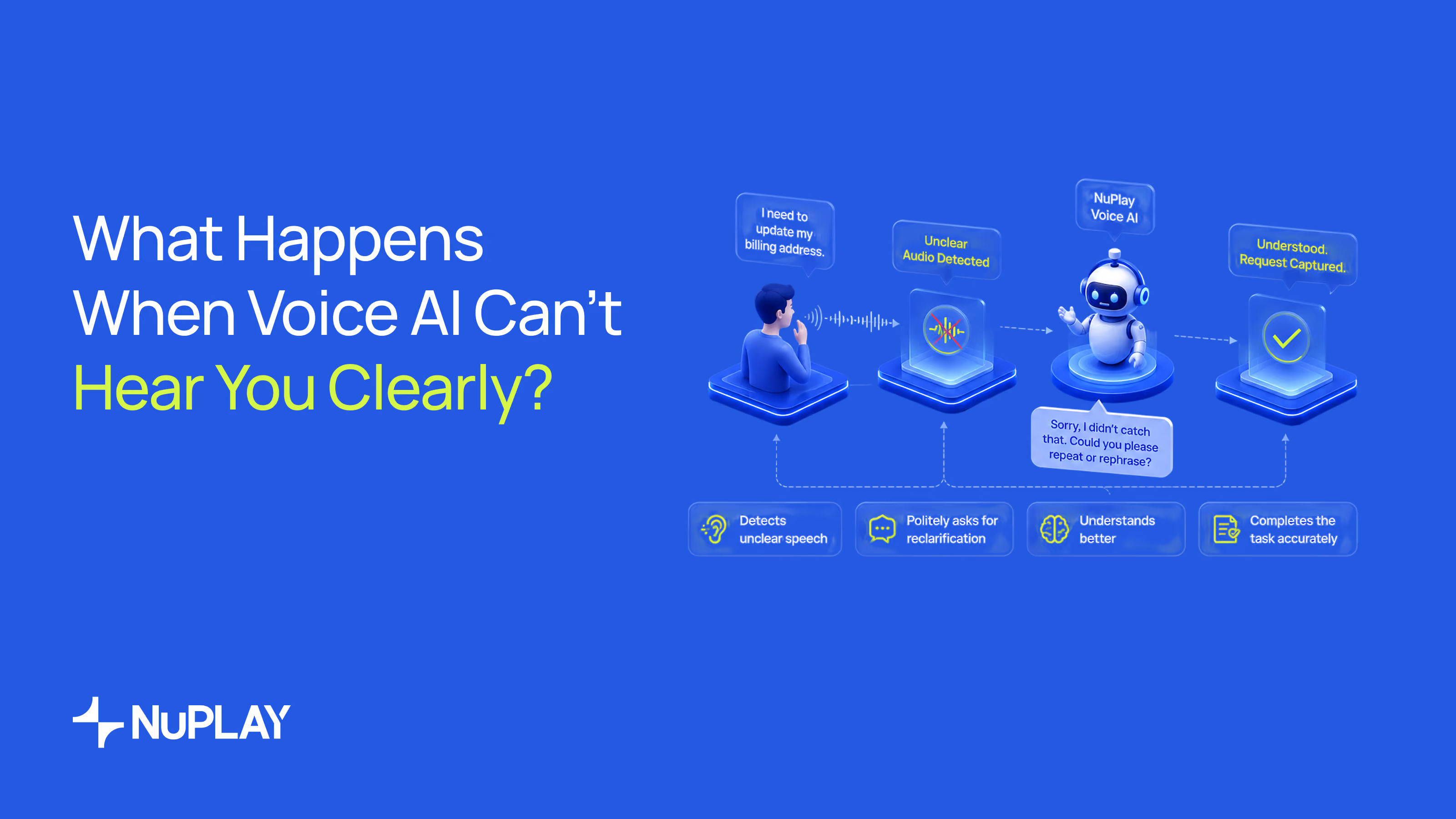
The failure point is usually the same: the speech-to-text layer, which converts what a caller says into text the AI can act on. That conversion needs a minimum level of audio clarity to work. Background noise, a weak or unstable network, cross-talk, or fast speech can all push the audio below that threshold.
When that happens, the system is left with an incomplete or low-confidence transcript. What it does next is where reliability is either engineered in, or missing.
The common default is to do nothing. The system waits on a silence timer, hoping the caller says something new to respond to. To the person on the other end, that pause doesn't read as a technical limitation - it reads as the call freezing, or the AI ignoring them. That's the moment trust in the interaction breaks, regardless of how well the rest of the call was handled.
What reliable design looks like instead
We built STT reclarification into NuPlay to close exactly this gap. When a transcript comes back incomplete, the agent doesn't wait passively - it detects the gap in real time and asks the caller to repeat, in a natural line generated for that moment, in whatever language the caller is speaking. The call keeps moving instead of stalling.
This isn't a single clever feature bolted onto an existing system. It's one example of a broader principle: a production voice AI system has to account for the ways real audio fails, not just the ways it succeeds. That means handling dropped words, unstable connections, overlapping speech, and ambient noise as expected conditions to design around, not edge cases to patch later.
What this means for evaluating voice AI
If you're assessing a voice AI vendor for enterprise use, the demo will almost always work. That's not the useful signal. The useful question is what happens when it doesn't hear something clearly - does it recover gracefully, or does it go silent and let the caller carry the burden of figuring out what went wrong?
Ask vendors directly: What happens on a bad connection? What happens when the transcript comes back incomplete? What happens when two people are talking at once? The answers to those questions tell you more about production readiness than any demo will.
Voice AI built for real enterprise use has to be reliable in the conditions real calls actually happen in - not just the conditions a demo is recorded in.