.gif)
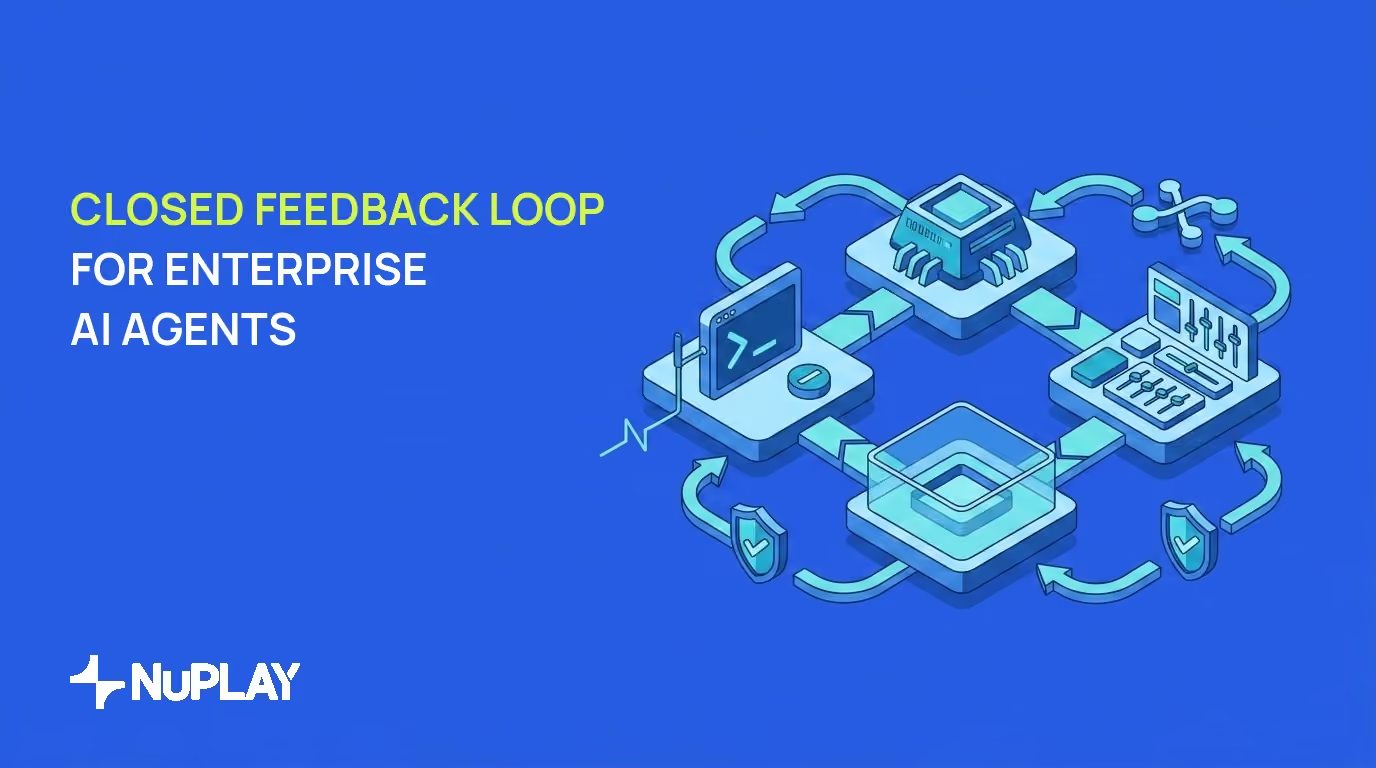

What Is a Closed Feedback Loop for Enterprise AI Agents?
A closed feedback loop for enterprise AI agents collects signals from every workflow run, evaluates outcomes, proposes fixes, and ships changes only after human approval. This structure keeps production systems aligned with evolving business conditions instead of allowing performance to drift.
Enterprise teams in retail, insurance, financial services, collections and mortgage, and home services run high-volume workflows that must stay reliable day after day. Static agent deployments often lose ground once live data diverges from the conditions present during initial setup. A closed feedback loop addresses that gap by turning every production run into structured input for controlled improvement.
Gartner's August 2025 forecast predicts that 40% of enterprise applications will feature task-specific AI agents by 2026, up from less than 5% in 2025. As agent coverage grows, the cost of unmanaged drift rises with it. NuPlay AI (formerly Nurix) builds NuPlay, which runs enterprise workflows in production and improves them after every run through NuLoop, with agents, the systems they operate, and the context they draw on under one platform. The sections below define the mechanism, explain why it matters for production reliability, and show how governance keeps changes traceable.
What is a closed feedback loop for enterprise AI agents?
A closed feedback loop for enterprise AI agents is a structured cycle that turns production signals into validated updates. It follows four parts: signal collection, evaluation, improvement, and controlled rollout. Each part produces an auditable record so teams can trace why a change was made and how it was tested.
A complete feedback loop has four distinct parts: signal collection, evaluation, improvement, and controlled rollout. Skip one, and the loop breaks. You either collect feedback you never act on, or you ship changes you cannot attribute to a specific improvement.
Signal collection captures both explicit feedback, such as corrections from operators, and implicit signals, such as outcome metrics from completed tasks. Evaluation compares those signals against expected results and attributes shortfalls to specific workflow steps, tools, or context layers. Improvement generates candidate fixes and tests them against historical runs. Controlled rollout ships only the fixes that pass human review.
Static deployments lack this cycle. Production data diverges from training distributions over time, a pattern often called distributional shift. Ad-hoc signals rarely produce traceable change. Enterprise buyers therefore require a loop that records every step and routes every change through approval rather than informal chat threads or one-off tickets.
In practice, the four-part structure answers a procurement question as much as an engineering one. Can you show who approved a change, what evidence justified it, and how you would reverse it? If the answer is no, you have monitoring, not a closed loop. That distinction matters when workflows touch claims, collections, mortgage servicing, or customer commitments that carry regulatory and brand risk.
Why closed feedback loops matter for enterprise AI agents
Agentic systems perform multi-step tasks that span several decisions and tools. In these systems, memory functions as accumulated learning from both self-reflection and human feedback. Feedback becomes a first-class component once workflows move beyond single-turn interactions and start chaining tools, policies, and handoffs.
Production data diverges from the distributions used during initial training or configuration. Without a loop that captures and acts on that divergence, gaps widen and outcomes degrade. Teams that operate without this structure often discover issues only after customer impact occurs. A closed loop surfaces those issues through systematic signal collection and routes them through diagnosis and testing before any rollout.
Governance and rollback protect high-stakes workflows in regulated industries. Human approve-to-promote ensures that no change reaches production until a qualified reviewer has examined the evidence and the proposed fix. That gate is not optional theater. Gartner's September 2025 survey found that just 15% of IT application leaders are considering, piloting, or deploying fully autonomous AI agents. Most enterprises still expect human control over what ships.
The business case is reliability under change. Product catalogs shift. Policy language updates. Seasonal volumes spike. Partner systems return new error codes. A static agent that looked strong in a pilot can quietly fail those new cases while dashboards still show green status. Closed loops convert that silent failure mode into a managed pipeline: detect, attribute, test, approve, ship, and roll back if needed.
For heads of AI, CTOs, and operations leaders, the loop is also an operating model. It defines who owns signal quality, who diagnoses root cause across workflow versus tool versus context, and who holds the approve-to-promote key. Without those roles, feedback piles up as noise. With them, every run can strengthen the next one through diagnosis and coverage rather than through ad-hoc patches.
How a closed feedback loop works in practice
The loop operates through five stages that map directly to NuLoop. The Report stage captures explicit and implicit signals from every run, including outcome metrics and operator notes. The Diagnose stage attributes failures to specific workflow, tool, or context layers so the root cause is clear before anyone proposes a fix.
The Propose stage generates candidate fixes based on the diagnosis. The Try stage tests those fixes against past runs to measure impact and surface regressions. The Ship stage requires human sign-off before any change is promoted. This approve-to-promote step keeps every update traceable and reversible.
Those stages look like this in sequence:
- Report: Capture explicit corrections and implicit outcome signals from each production run.
- Diagnose: Attribute the failure to workflow design, tool behavior, or context gaps.
- Propose: Generate a targeted fix for the layer that holds the problem.
- Try: Replay the fix against historical runs and check for regressions.
- Ship: Promote only after a human approves, with rollback available.
Zylos AI's research on agent data flywheels describes how production agent interactions generate feedback signals that become training data for improved models. The same research notes that many production flywheels stall by month three when easy patterns are exhausted or when distribution shift outpaces the update process. The five-stage structure turns that flywheel into a governed process rather than an open-ended collection of signals.
NuLoop executes these stages while NuPulse provides the dashboard that shows status, volume, and outcome trends. The two components remain separate: NuPulse surfaces what is happening; NuLoop changes how the system operates. Fixes route to whichever layer holds the problem, are tested against real past runs, and ship only after a human approves. Nothing in this cycle is unsupervised promotion.
For enterprise buyers evaluating platforms, ask vendors to walk a single failed run through all five stages. If the path stops at a dashboard alert or a thumbs-down score, you are looking at monitoring. If the path ends in a tested, approved change with an audit trail, you are looking at a closed loop.
Key components that benefit from closed-loop improvement
Workflow design improves when deterministic checks from domain experts are captured and reapplied. A claims intake path, a collections escalation rule, or a mortgage document checklist can encode expert judgment as explicit gates. The loop then watches whether agents honor those gates and where they fail under live load.
Tool design and descriptions become more precise once correction capture and evaluation identify where agents select the wrong action or misinterpret parameters. Small wording changes in a tool contract can prevent repeated misfires. Without a loop, those corrections live in tribal knowledge and never reach the system that needs them.
Agent context expands through curated examples and organizational knowledge that the loop validates and promotes. Context is not a dump of every document. It is a governed set of examples, policies, and prior outcomes that help the agent handle the next similar case. Closed-loop promotion keeps that set current as the business changes.
Automated evaluations aligned with human judgment scale refinement across high-volume runs. LangChain's writing on human judgment in the agent improvement loop explains how expert input translates into scalable agent improvement when it is structured as test suites, annotation queues, and evaluation criteria. Subject-matter experts review flagged traces; their judgments calibrate automated evaluators and feed future analysis.
This approach keeps changes focused on coverage and diagnosis rather than broad, opaque retraining. Teams see concrete updates to specific steps instead of model updates that are difficult to audit. The practical benefit is operational: fewer surprise failures on known edge cases, clearer ownership of each layer, and a repeatable path from a bad run to a governed fix.
When you map components to the loop, assign each fix to one primary layer:
- Workflow: routing, checks, and decision order defined by domain experts
- Tools: APIs, actions, and descriptions the agent calls
- Context: organizational knowledge, examples, and memory tiers the agent reads
- Evaluations: human-aligned tests that decide whether a proposed fix is ready to try
That mapping prevents the common failure mode where every problem is treated as a prompt tweak. Many production issues are workflow gaps or tool contracts, not model wording. A closed loop that diagnoses first keeps improvement honest.
Governance and human oversight in enterprise loops
Explicit signals, such as direct corrections, and implicit signals, such as outcome metrics, carry different governance requirements. Explicit signals often need lighter review because intent is clear. Implicit signals require stronger attribution and testing because the cause is inferred from metrics rather than stated by an operator.
Controlled rollout includes rollback capabilities so any promoted change can be reversed quickly if downstream effects appear. Alignment with enterprise standards for data protection and auditability requires that every signal, diagnosis, and approval is logged. Buyers in insurance, financial services, and collections should treat that audit trail as a requirement, not a nice-to-have.
Zylos AI's research on agent data flywheels maps maturity progression from ad-hoc monitoring toward automated pipelines that still retain human review for high-stakes decisions. Most organizations currently operate between explicit feedback collection and implicit signal integration. The closed loop provides a clear path to higher maturity while preserving the approve-to-promote gate.
Gartner's June 2025 forecast predicts that over 40% of agentic AI projects will be canceled by the end of 2027. Weak operating models and unclear value paths drive much of that risk. Governance is part of how serious programs avoid becoming a canceled pilot. A loop with human sign-off, rollback, and layer-level diagnosis gives leaders a defensible story for risk, compliance, and operations stakeholders.
Maturity typically advances in stages:
- Ad-hoc monitoring: dashboards and tickets with no structured fix path
- Explicit feedback collection: operator corrections captured but inconsistently applied
- Implicit signal integration: outcome metrics joined to runs and diagnoses
- Governed continuous improvement: Report through Ship with human approve-to-promote for production changes
Moving up that ladder does not mean removing humans. It means giving humans better evidence, clearer attribution, and a safer path to ship validated change. For high-stakes workflows, the final promotion decision stays with a person who can weigh compliance, customer impact, and business fit.
Conclusion
A closed feedback loop for enterprise AI agents is the difference between a static deployment that degrades and a production system that improves run over run through diagnosis, testing, and human-approved change. The four-part structure of signal collection, evaluation, improvement, and controlled rollout, executed as Report, Diagnose, Propose, Try, and Ship, gives enterprises a traceable path from a failed run to a governed fix.
As agent coverage expands across retail, insurance, financial services, collections and mortgage, and home services, the organizations that sustain performance will be the ones that close the loop with rollback, auditability, and approve-to-promote controls. Evaluate platforms that run workflows in production and improve them after every run under one system. NuPlay is built around that model through NuLoop. Request a demo to see how a governed loop applies to your workflows.




.jpeg)