.gif)

AI Agent Governance in Regulated Industries: A Practical Framework
AI agent governance creates rules, oversight mechanisms, and controls that keep agents operating safely and in line with regulations. It centers on identity, authorization, guardrails, runtime enforcement, and human approval for every change rather than prompt-level checks alone. Enterprises in regulated sectors gain traceability and accountability when they apply structured approve-to-promote workflows.
Rapid agent adoption now outpaces oversight in many organizations. Regulated industries face extra pressure because decisions affect compliance, data privacy, and customer outcomes. Heads of AI, CTOs, and operations leaders in insurance, financial services, collections and mortgage, retail, and home services need a way to change agents without losing auditability. A practical framework addresses this gap by treating every production run as input for diagnosis, coverage checks, and governed change. The result is controlled improvement instead of static systems that degrade over time.
NuPlay runs enterprise workflows in production and improves them after every run through NuLoop, with agents, the systems they operate, and the context they draw on under one platform.
What is AI Agent Governance?
AI agent governance is the process of creating rules, systems, and oversight mechanisms to ensure that AI agents operate safely, ethically, and in alignment with organizational and regulatory requirements.
Agents differ from traditional models because they execute multi-step work across tools and carry state between steps. A single run may read customer records, call payment or claims systems, update case status, and hand off to a person. Risk compounds across that chain. A permission that looks narrow in isolation can enable broader outcomes when combined with other tools and retained context. Governance therefore focuses on execution controls rather than prompt-response limits alone.
The framework covers verifiable identities, role-based permissions, input validation, scope restrictions, application programming interface (API) and data access rules, real-time monitoring, and structured human oversight. Every change follows an approve-to-promote requirement so accountability remains with people. Execution always runs under that model, never as unsupervised self-modification.
In regulated industries these controls support the traceability and auditability that compliance teams already expect from other production systems. You define who the agent is, what it may touch, how policy is enforced at runtime, and who signs off before a fix reaches production. That is the practical difference between governing a chatbot reply and governing an agent that acts inside a workflow.
Why AI Agent Governance Matters in Regulated Industries
Adoption has moved ahead of oversight. MintMCP's AI agent security statistics report that 82% of organizations already use AI agents, but only 44% have policies in place to secure them. The same MintMCP summary reports that 97% of organizations experiencing AI-related security incidents lacked proper access controls. Those gaps matter when agents can open tickets, move money-adjacent work, or touch protected health or financial data.
Planned rollout shows the same pattern. Evolvance Market Research's 2026 AI Governance Statistics show that 74% of organizations plan agentic AI adoption within two years, yet only 21% have mature governance models. Value is real when controls keep pace: PwC's 2025 AI Agent Survey found that nearly two-thirds (66%) of those adopting AI agents report increased productivity. Those gains still depend on controls that keep changes auditable.
Regulated sectors face additional requirements for traceability, data protection, and human accountability. A collections workflow that contacts customers, a mortgage status update, or an insurance claims triage step can trigger scrutiny if you cannot show who authorized the agent, what data it used, and how a change was tested and approved. Without governance, agent sprawl creates blind spots that internal audit and external regulators examine closely.
For buyers in retail operations, customer experience, and digital transformation, the urgency is operational as well as legal. Missing access controls and immature oversight models turn every new agent into a new exception path. Structured ai agent governance closes that gap before scale multiplies the blast radius.
Core Components of an AI Agent Governance Framework
Effective governance operates across five dimensions: Identity and Authorization, Guardrails and Constraints, Tool Governance, Runtime Enforcement, and Human Oversight, as described in Airia's AI agent governance framework. Treat these as a single control plane, not a checklist you finish once.
Identity and authorization establish verifiable agent identities, role-based permissions, and delegation rules that require human approval for sensitive actions. Each agent should be distinguishable from a human user and from other agents, with clear owners and least-privilege roles.
Guardrails and constraints apply preventive input validation, scope enforcement, and action restrictions before execution begins. They bound what the agent may attempt, including prohibited data classes and disallowed destinations.
Tool governance controls API calls, data access, and workflow triggers so agents cannot reach systems outside approved boundaries. Catalog every integration, and revoke tools the agent no longer needs.
Runtime enforcement applies real-time monitoring, anomaly detection, and policy application during every run. Logs should show the path taken, the tools invoked, and any policy blocks, so incident review does not depend on reconstruction after the fact.
Human oversight supplies structured escalation paths and the approve-to-promote requirement before any change ships. Together these dimensions create a closed loop that maintains compliance while supporting production use. In high-volume environments, the human role is not to re-check every routine step. It is to own exceptions, risk thresholds, and promotion decisions so the system never ships unsupervised change.
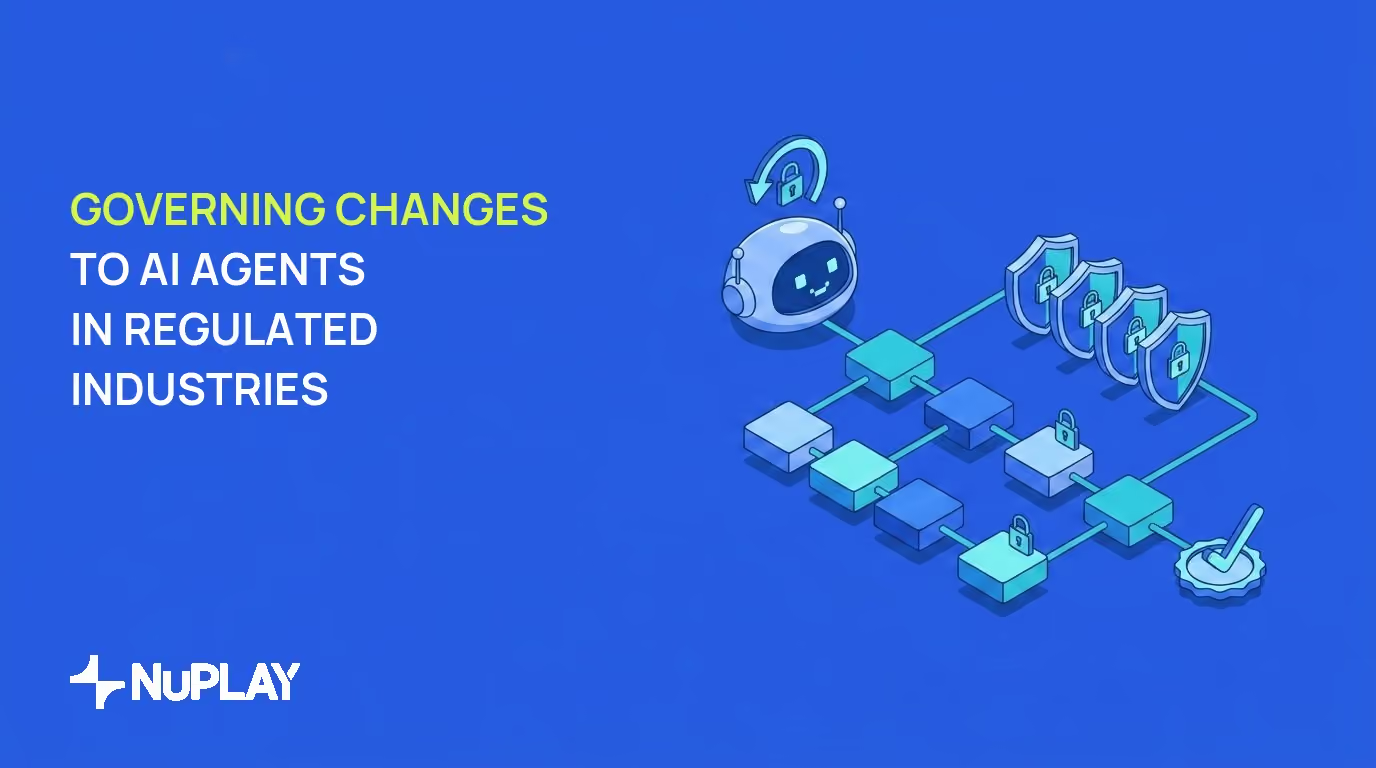
How Changes to AI Agents Are Governed
Governed change follows a repeatable sequence that keeps accountability with people. Static deployments drift as products, policies, and customer behavior shift. A change process built on diagnosis and coverage turns that drift into controlled updates instead of silent failure.
The sequence is straightforward:
- Report observed issues from production runs, including failed steps, unexpected tool use, and coverage gaps.
- Diagnose root causes across agent, system, or context layers so the fix lands where the problem lives.
- Propose validated fixes based on historical data rather than one-off prompt edits.
- Try changes against real past runs with rollback capability before anything reaches live traffic.
- Ship only after human approval under an approve-to-promote model.
This model prevents unsupervised updates. It also creates the audit trail regulated teams need: what was wrong, what was proposed, what was tested, who approved, and when it shipped. Diagnosis and coverage, not unsupervised tuning, drive the improvement path.
NuPlay platform supports governed change through a closed feedback loop that routes fixes to the correct layer and requires explicit sign-off before promotion. The approach maintains audit trails required in regulated environments while allowing run-over-run improvement through diagnosis and coverage. For a CTO or VP of engineering, the decision criterion is simple: can you show the path from production signal to approved change without a side channel of shadow edits?
Common Challenges and Misconceptions
Shadow AI and agent sprawl create blind spots when organizations lack a systematic inventory of deployed agents. Teams stand up helpers in customer service, back-office ops, or partner workflows without registering identity, data paths, or owners. Without discovery, governance cannot cover every workflow that affects compliance or customer data.
A common misconception holds that governance slows innovation. In practice, structured frameworks enable safe scaling by reducing the risk of incidents that trigger regulatory scrutiny or remediation work. Leaders who wait for a perfect policy document often freeze pilots, while leaders who ship without approve-to-promote create unreviewable change. The middle path is clear ownership, runtime controls, and human sign-off on promotions.
Over-reliance on model-level controls leaves tool-use and state risks unaddressed. Agents that maintain context across steps require oversight at the workflow level, not only at the model boundary. A content filter on a prompt does not stop an over-permissioned tool call two steps later.
Fragmented platforms increase the need for platform-independent oversight layers that apply consistent policies across tools. If each vendor console holds a different view of identity, logs, and change history, audit teams cannot reconstruct a single story. Central visibility and a shared promotion gate matter more than another model-only control. Address sprawl first, then deepen guardrails, or you will govern only the agents you already know about.
Implementing Governance: Practical Steps for Enterprises
Implementation follows a phased approach that regulated enterprises can map to existing control owners. Zenity's guidance on AI agent governance frames the work as systematic discovery, policy definition, control implementation, and ongoing monitoring. Use that sequence as the operating plan, not a one-time project.
First, map all agents, their identities, integrations, and data paths so nothing operates outside visibility. Include voice and chat entry points, batch back-office agents, and any vendor-hosted helpers that touch customer records.
Second, define policies for authorization levels and human intervention triggers based on risk and regulatory requirements. Decide which actions stay in human mode, which may run automated, and which may run in agent mode with escalation rules.
Third, implement runtime guardrails and centralized visibility so teams can monitor execution and detect anomalies. Wire alerts to owners who can pause or roll back without waiting for a weekly review.
Fourth, establish lifecycle management from initial deployment through updates and retirement to maintain an auditable record. Every promotion should leave a trail of report, diagnosis, proposal, trial results, and approver identity.
Fifth, align controls with compliance requirements such as SOC 2 Type 2, ISO 27001, HIPAA, and GDPR. NuPlay AI maintains SOC 2 Type 2 and ISO 27001 certifications and supports HIPAA and GDPR compliance requirements. Treat those references as the approved compliance set for platform evaluation, and keep customer-specific obligations (such as sector rules your counsel names) outside marketing claims.
Practical rollout tip: start with one high-volume workflow in insurance, financial services, collections and mortgage, retail, or home services. Prove inventory, runtime policy, and approve-to-promote on that path, then extend the same pattern. Broad mandates without a working change loop produce paperwork without control.
Conclusion
Structured governance with human sign-off turns agent changes into controlled, auditable improvements. Enterprises gain the ability to diagnose issues, expand coverage, and ship fixes only after approval, which supports regulatory compliance and operational resilience. The work is not a one-time policy memo. It is inventory, runtime enforcement, and a repeatable Report, Diagnose, Propose, Try, Ship loop that never implies unsupervised autonomy.
If you lead AI, engineering, customer experience, or operations in a regulated industry, start by mapping agents and closing the promotion gate. Request a demo to see how NuPlay applies these principles to high-volume workflows in regulated industries.