.gif)
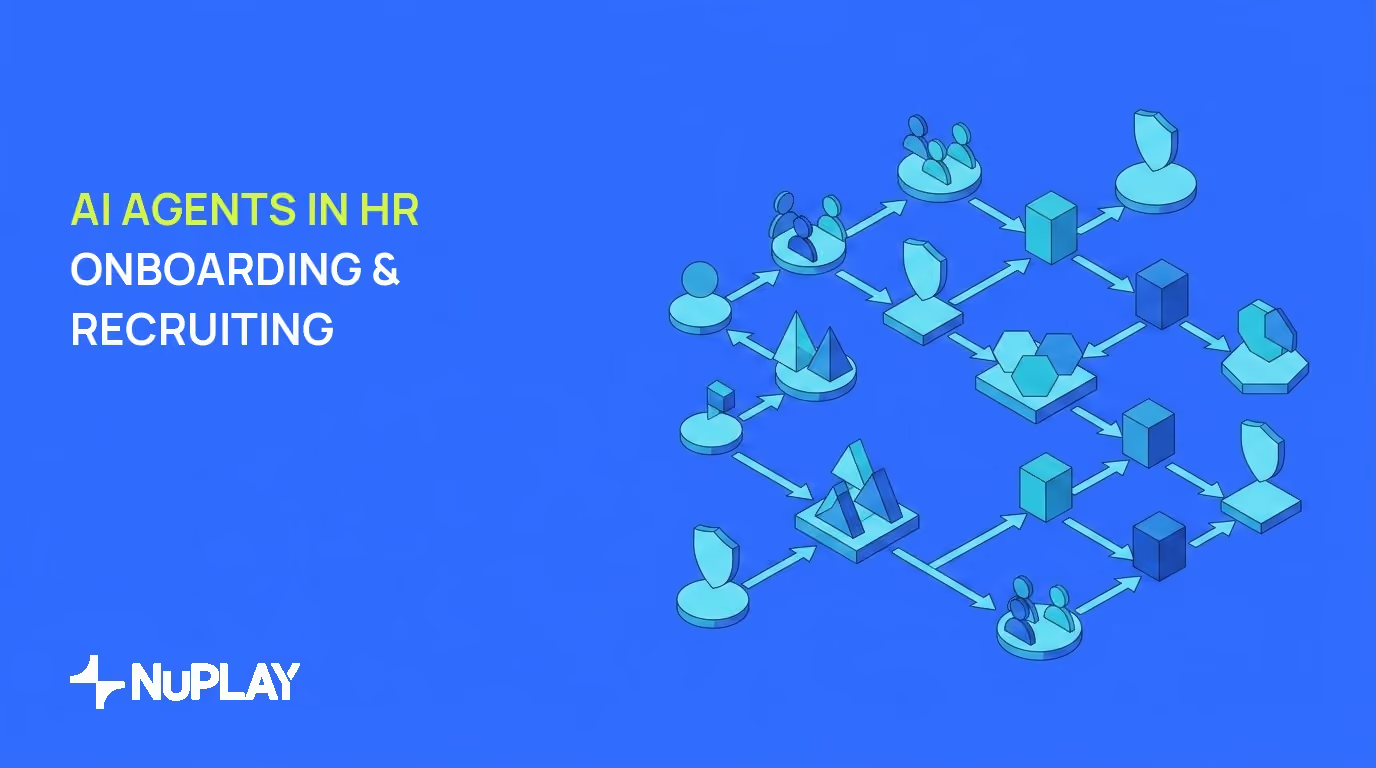

AI agents in HR execute employee queries, onboarding, and recruiting by interpreting intent, coordinating tasks across enterprise systems, and adapting within defined guardrails. They shift routine work away from staff while keeping human sign-off before policy changes, access grants, or hiring decisions. Governance, not full autonomy, determines whether the operational gains hold in production.
HR teams carry steady volume in policy questions, document collection, system access, and candidate coordination. Rule-based automation helps with fixed steps, yet it stalls when inputs change or exceptions appear. AI agents add reasoning so a single goal can span multiple systems, preserve context, and escalate when policy limits are reached. The capacity gain is real only when leaders decide which tasks run as human, automated, or agent work, and when every high-stakes action still requires a person to approve.
What are AI agents in HR?
AI agents in HR are software systems that use a large language model (LLM) to interpret a goal, break it into tasks and decisions, execute across connected systems, and adjust within policy guardrails. A workflow here means the set of tasks and decisions that produce a business outcome, such as resolving a benefits question or completing new-hire setup. An agent produces an output or a routing decision; it does not replace HR accountability.
They differ from traditional HR automation. Rule-based tools follow fixed if-then logic and stop when a case falls outside the script. Agents reason over context. They pull policy text, employee records, and role data through retrieval-augmented generation (RAG) and LLMs connected to human capital management (HCM) platforms, applicant tracking systems (ATS), identity tools, and knowledge bases. When the next step is unclear, they can propose options, request missing inputs, or hand the case to a person with the trail intact.
Every task or decision should run in one of three modes: human, automated with fixed rules, or agent with reasoning. The design choice is which work belongs in agent mode, not how to remove people from the process. Agents draft, route, and coordinate. Humans keep authority on policy interpretation, access exceptions, and final hiring outcomes.
How can HR use AI agents?
HR can use AI agents for high-volume, repeatable work across the hire-to-retire cycle. Common applications include routing and answering routine employee questions, collecting onboarding documents and triggering access requests, drafting job descriptions, screening profiles against stated requirements, ranking shortlists, and scheduling interviews. Each use case still needs clear escalation paths and human review before changes that affect pay, access, or employment status.
What are the 7 types of AI agents?
Taxonomies differ by source, yet a common seven-part set covers reactive agents, model-based agents, goal-based agents, utility-based agents, learning agents, hierarchical agents, and multi-agent systems. In HR practice, goal-based and hierarchical designs matter most because they decompose an outcome such as “complete onboarding” into ordered sub-tasks and coordinate specialized agents for benefits, identity, and records under a supervisory layer.
How AI agents handle employee queries
Employee query volume is a constant drain on service desks. Agents receive requests from portals, chat, or email, classify intent, and route work through a supervisory layer to specialized agents for benefits, leave, payroll basics, or records updates. Each specialized agent checks policy, retrieves the employee’s relevant data, and prepares a response or a transaction draft.
For administrative work such as routine transactions, forms, and reporting, PwC estimates AI agents can enable over 88 percent of HR workflows. The same PwC analysis says agents can help drive or assist roughly 50% of advisory work. Separately, one documented AMD deployment using another vendor's platform reported that 50% of employee queries were resolved through self-service after rollout. These figures describe task coverage in specific analyses and deployments, not a promise for sensitive cases that require judgment, negotiation, or exception handling.
Across HR overall, PwC puts the reduction in human effort at 40 to 50 percent, rising to over 60 percent for day-to-day functional processes. PwC's analysis of agentic AI in HR report that teams using AI in HR service delivery can achieve a 20% to 30% efficiency boost while improving employee experience. The gain depends on clean knowledge content, clear routing rules, and a review step before responses leave the system.
Human oversight remains part of the path, not an afterthought. Accuracy checks, tone review for sensitive topics, and escalations for ambiguous policy sit with HR staff. When an agent cannot resolve a case, it should pass full context (prior turns, retrieved policy, employee identifiers already in scope) so the person does not restart from zero. Leaders who skip the supervisory layer trade short-term speed for inconsistent answers and compliance risk.
AI agents in onboarding workflows
Onboarding is a multi-step workflow that crosses HR, IT, facilities, and the hiring manager. Agents can own the coordination layer: collect required documents, confirm completion status, trigger system access provisioning requests, schedule day-one and early check-ins, and keep a running view of what remains open. Context should persist across organizational, agent, and user tiers so a delayed start date or a role change updates downstream tasks instead of leaving stale tickets behind.
When inputs change, agents re-plan within guardrails. A new location may alter equipment and access bundles. A missing tax form may block payroll setup until the file arrives. Agents can notify the right owners, reopen dependent tasks, and log the reason for the delay. Exceptions that fall outside policy, such as privileged access or nonstandard equipment, should stop for human review rather than auto-approve.
The operating goal is consistent execution at volume, not replacement of HR judgment. People still decide role fit, manager readiness, and how to handle edge cases that affect security or employment terms. Agents reduce dropped handoffs and status chasing. They do not decide whether a hire is ready for production systems without an approved path.
Practical rollout usually starts with a narrow slice: document collection and status tracking for one employee population, then access request drafting with mandatory approvers, then scheduled check-ins. Each slice needs named owners for data quality, a definition of done for every task, and a clear list of actions that always require human sign-off. Without that map, onboarding agents create parallel work instead of removing it.
AI agents in recruiting and hiring
Recruiting combines content, screening, coordination, and decision work. Agents can draft job descriptions from role requirements and competency frameworks, parse inbound profiles against must-have criteria, rank candidates for human review, and schedule interviews across calendars. They can also send status updates that keep candidates informed without adding recruiter busywork.
Sourcing and first-pass screening consume a large share of recruiter and hiring-manager time. Agents take the repetitive matching and coordination steps so people spend more time on interviews, stakeholder alignment, and offer design. Shortlists should always surface with the criteria used, the evidence matched, and the gaps flagged, so reviewers can challenge the ranking instead of treating it as a black box.
Final selections, compensation exceptions, and offer approvals stay with humans. Agents accelerate the pipeline; they do not own hiring outcomes. Bias and compliance controls belong in the workflow design: approved criteria only, documented reasons for advance or reject, and audit logs for regulated roles. If a profile is borderline, the agent should escalate rather than force a binary decision.
A sound pattern separates three lanes. Lane one is content and logistics (descriptions, scheduling, reminders). Lane two is assisted screening with mandatory recruiter confirmation. Lane three is decision support that never auto-sends offers. Teams that collapse those lanes into unsupervised end-to-end automation create legal and brand risk faster than they create speed.
Benefits and measured impact
Measured impact shows up first as coverage and effort, then as how leaders reinvest the time. PwC's AI Agent Survey finds that 79 percent of executives say AI agents are already being adopted in their companies. PwC's HR-specific analysis reports that agents can reduce human effort between 40% and 50% across HR, and that talent sourcing savings for hiring managers can reach 70%. These are planning ranges for workflow redesign, not guaranteed outcomes for every HR function.
Coverage figures help set scope. Industry analysis tied to that PwC research, summarized in practitioner guides, describes agent-automated or assisted work above 60% for day-to-day functional HR processes and above 88% for administrative workflows. Treat those as planning ranges for which task classes can move into agent mode, not as a promise that every process is ready on day one. Administrative work with stable rules moves first. Judgment-heavy advisory work stays human.
Retention outcomes connect to how the freed capacity is used. In talent sourcing, PwC estimates agentic tools can save recruiters up to 70 percent of the time spent on sourcing activities. PwC's analysis of agentic AI in HR, citing an EY-Qualtrics Alliance survey, states that companies with engaged employees have 50% less employee turnover than those that do not. When HR shifts hours from ticket handling and status chasing toward coaching, workforce planning, and manager support, engagement work becomes feasible at scale. The causal chain is indirect: agents create capacity; leaders must still redesign roles so that capacity lands on relationship and strategy work.
Operational gains compound when improvement is governed. Structured loops of report, diagnose, propose, try, and ship let teams widen coverage and fix failure modes after real runs, with human approve-to-promote before any change goes live. That is diagnosis and controlled change, not an unsupervised accuracy curve and not a claim of autonomy.
Common misconceptions and governance requirements
A frequent misconception is that AI agents in HR operate on their own once deployed. In production, human sign-off should precede any change to policy content, access rights, candidate status, or other high-stakes actions. Approve-to-promote is the default control: agents propose; people release.
Another misconception is that quality rises automatically with volume. Improvement comes from a deliberate loop. Teams report what failed or stalled, diagnose the cause (data, prompt, tool, policy, or handoff), propose a fix, try it against prior runs with rollback, and ship only after a human approves. Skipping diagnosis and shipping untested changes recreates the brittleness of static automation under a newer label.
Data quality, policy alignment, and exception handling remain human responsibilities. Agents amplify whatever knowledge base and record quality they receive. Stale policies produce confident wrong answers. Missing HCM fields produce incomplete provisioning. Leaders should assign owners for source systems, define which systems of record agents may write to, and list exception types that always escalate.
Evaluation criteria for platforms should favor governance features over demo fluency. Look for explicit human approval gates, full run logs, separation between monitoring and change, integration patterns for HCM and ATS, and the ability to move only selected tasks into agent mode while leaving others automated or human. The question “which AI tool is best for HR” has no universal answer; fit depends on those controls and on whether the operating model keeps accountability with HR and legal stakeholders.
Job-impact fears often assume replacement. The stronger pattern is reallocation. Agents absorb repetitive coordination and first-line answers so HR can spend time on advice, design, and exceptions. Roles change. Headcount panic is the wrong frame when oversight, policy ownership, and exception handling still require skilled people.
Conclusion
AI agents in HR deliver durable value when leaders treat them as governed production systems. Define the workflow, choose the mode for each task, keep human sign-off on high-stakes actions, and improve through report, diagnose, propose, try, and ship rather than unsupervised change. Query handling, onboarding coordination, and recruiting support are strong starting domains because volume is high and success criteria are observable.
The practical takeaway is simple. Move the right work into agent mode, leave judgment with people, and measure coverage, cycle time, and escalation quality. Enterprise buyers comparing platforms should inspect approval gates, auditability, and how fixes return to the live workflow under human direction. NuPlay AI (formerly Nurix) publishes further material on production-grade agent workflows for teams that want a deeper operating-model view; request a walkthrough when you are ready to map guardrails to a concrete HR process.