.gif)

AI Agents in Procurement and Supplier Onboarding
AI agents in procurement are software systems that use large language models to execute tasks and decisions across source-to-pay workflows, supplier onboarding, and policy enforcement. These systems run in production environments with structured governance that keeps human oversight on changes while allowing run-over-run improvement through feedback loops.
Enterprises face pressure to move beyond static automation that breaks when business rules shift. Fixed scripts and rigid bots handle yesterday's policies well, then fail when thresholds, supplier categories, or approval paths change. The real challenge is adopting agentic systems that handle high-volume repeatable workflows reliably while maintaining compliance and control. Heads of AI, operations leaders, and procurement owners need a clear model for what agents do, where humans stay in the loop, and how policy stays enforceable as volume grows.
What Are AI Agents in Procurement?
An AI agent is software that uses a large language model (LLM) to produce an output or decision. Agentic AI refers to moving a task or decision into an agent mode rather than leaving it in human or fixed-rule automated mode. In procurement, that means an agent can classify a requisition, score a supplier response, or flag a contract clause against current policy, then hand the result to the next step in the workflow.
Procurement teams encounter three modes for any task or decision: human execution, automated execution under fixed rules, or agent execution that reasons over context. The decision to shift a task into agent mode depends on volume, repeatability, and risk level. High-volume intake, document extraction, and data validation tasks often move first. High-risk spend approvals, sole-source justifications, and material contract deviations stay with humans until the organization defines clear escalation rules.
Fixed-rule automation follows predetermined if-then paths and degrades when policies or supplier data change. Adaptive agents draw on memory layers, orchestration logic, and tool integrations to adjust outputs based on current context. LLMs supply reasoning. Separate orchestration handles workflow routing. Memory supplies organizational, agent, and user context. Tool calls connect to existing enterprise resource planning (ERP), source-to-pay (S2P), and supplier master systems. The result is not a chatbot bolted onto procurement. It is a governed path for moving the right tasks into agent mode while leaving judgment calls with people.
How AI Agents Operate Across Source-to-Pay Workflows
How can AI be used in procurement? AI agents classify intake, support request-for-proposal scoring, monitor contracts, match invoices, and route exceptions, all inside defined policy boundaries with human review on high-risk steps.
Source-to-pay covers the full lifecycle from requisition through payment. Agents handle intake and orchestration by classifying requests, routing them to the correct sub-workflow, and triggering downstream actions. PwC's 2026 report on agentic AI in procurement found that agents can automate about 80 percent of intake and orchestration work while humans retain high-risk decisions. That split matters: scale comes from removing repetitive routing work, not from removing accountability.
In strategic sourcing, agents support request-for-information (RFI) and request-for-proposal (RFP) processes by gathering supplier responses, scoring them against defined criteria, and flagging outliers for review. They assist negotiation preparation by summarizing contract terms and surfacing comparable historical deals. The same PwC analysis notes that sourcing cycle time can be cut by 50 percent or more when agents manage the repetitive analysis steps. Humans still set evaluation criteria, approve shortlists, and own commercial outcomes.
Contract lifecycle management benefits from agents that monitor renewal dates, extract obligations, and run compliance checks against current policy. Purchase order creation, invoice matching, and payment processing occur with real-time adjustments when exceptions arise, such as price variances or delivery delays. Agents log each decision for later review rather than executing in isolation. A practical operating pattern looks like this:
- Intake agent classifies the request and attaches policy tags
- Sourcing agent prepares RFx packages and scores responses
- Contract agent tracks obligations and renewal windows
- Accounts payable agent matches invoices and flags variances
- Human reviewers approve exceptions above defined thresholds
This structure keeps the S2P chain moving while preserving clear ownership of risk.
Supplier Onboarding and Management with AI Agents
How is agentic AI being used in procurement for suppliers? Agentic systems validate onboarding documents, screen risk signals, update master data after human approval, and monitor performance so teams catch issues earlier without removing control points.
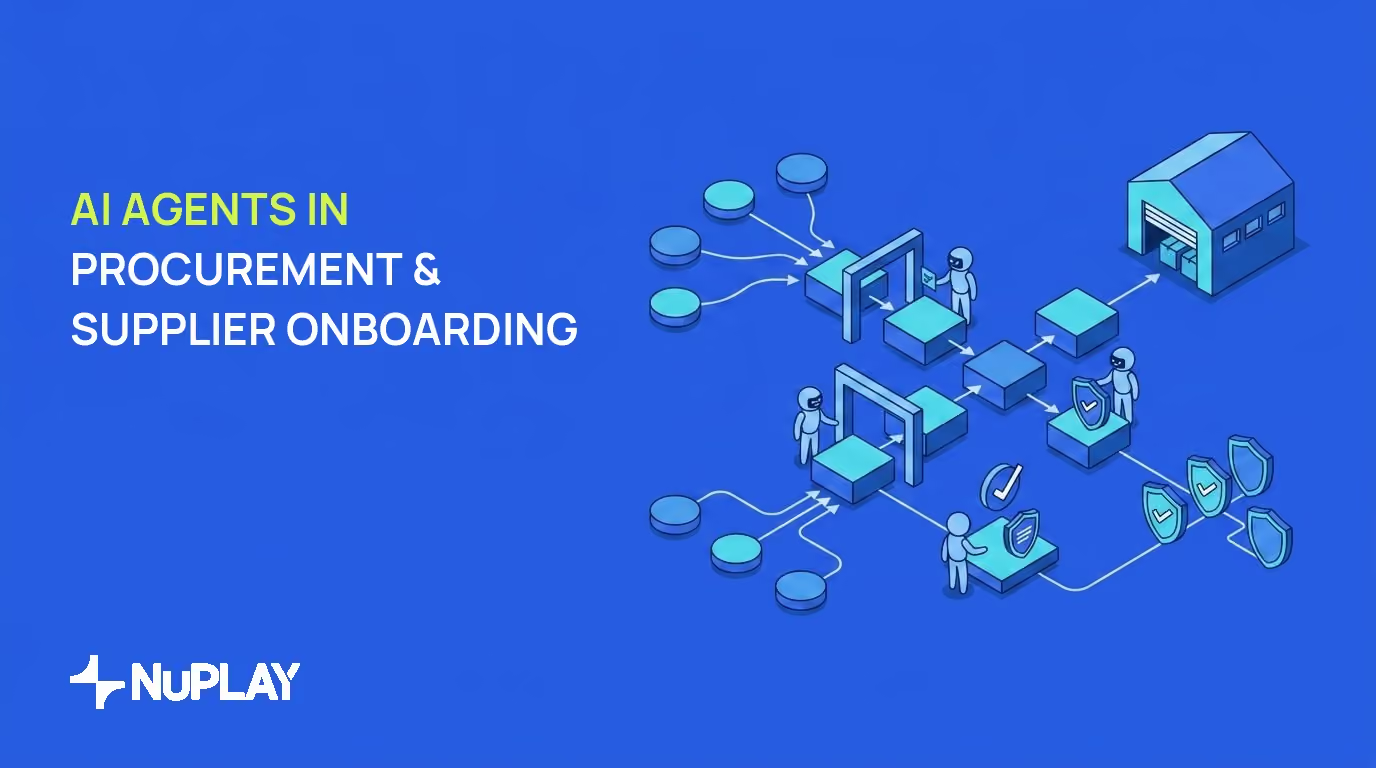
Supplier onboarding requires validation of documents, risk screening, and master data entry. Agents automate document classification and extraction, cross-check against external watchlists, and update supplier records once human reviewers approve the package. This reduces manual handoffs while preserving control points at identity verification, banking details, and sanctioned-party checks.
Data quality is the main constraint. Art of Procurement's State of AI in Procurement summary reports that 74 percent of procurement leaders say their data is not AI-ready. Fragmented supplier masters, inconsistent tax identifiers, and incomplete certificates cause agents to stall or escalate. Unified S2P data models and clear field ownership are prerequisites, not optional cleanup work after a pilot.
Continuous monitoring follows onboarding. Agents track performance metrics from purchase orders and invoices, then surface external signals such as financial health changes or regulatory alerts. When thresholds are crossed, the agent creates a task for human review rather than acting alone. Policy-compliant steps remain enforced through routing logic that requires approvals at defined stages. Cycle times shorten as repetitive validation moves out of human queues, and supplier records stay cleaner because updates occur against a single source of truth. Teams that skip the data foundation see noisy escalations and low trust in agent outputs, which stalls adoption even when the workflow design is sound.
Policy Control and Governance in Agentic Procurement
Policy control requires agents to route requests according to approval thresholds, flag exceptions, and enforce segregation of duties. Agents evaluate each workflow instance against current policy before proceeding and create an exception task when conditions fall outside defined bounds. Without that gate, automation simply accelerates non-compliant spend.
Approve-to-promote mechanisms ensure that any proposed change to an agent or workflow receives human sign-off before it ships. The process follows five stages: Report observed outcomes, Diagnose root causes, Propose a fix, Try it against prior runs, and Ship only after approval. This structure prevents unsupervised drift while allowing the system to adapt as policies, catalogs, and supplier categories change. Improvement is framed as diagnosis, coverage, and governed change, not as an unsupervised rewrite of production behavior.
Audit trails capture every decision, input, and output. Compliance checks reference frameworks such as SOC 2 Type 2, ISO 27001, HIPAA, and GDPR where the enterprise scope requires them. Risk flagging occurs when data quality or policy coverage gaps appear. Unified data foundations across organizational, agent, and user tiers support reliable policy execution because agents operate from consistent context rather than fragmented sources.
Governed, production-grade agent platforms combine execution, context, and improvement loops under one system so that policy remains enforceable even as volume scales. NuPlay AI (formerly Nurix) builds NuPlay, which runs enterprise workflows in production and improves them after every run through NuLoop, with agents, the systems they operate, and the context they draw on under one platform. Static deployments that ship once and never revisit failure modes degrade as the business changes. Governed loops keep humans in charge of what ships while agents handle the volume that no longer needs manual touch.
Key Benefits and Measured Impact
What are the key trends in procurement for 2026? Teams are moving repetitive work into agent mode, measuring cycle-time and productivity gains, and confronting a wide gap between individual tool use and large-scale governed deployment.
Productivity gains appear when agents absorb repetitive tasks. PwC's 2026 report on agentic AI in procurement found that at least 75 percent of procurement activities are expected to become agent-driven, with productivity jumps of 30-70 percent in those areas. That range is not a promise for every function. It applies where volume is high, rules are clear, and data is clean enough for agents to act without constant escalation.
Efficiency improvements of 25-40 percent are cited for procurement functions adopting agentic AI, and GenAI is estimated to automate 50-80 percent of current procurement work, according to Art of Procurement's summary of McKinsey and KPMG benchmarks in its State of AI in Procurement coverage. Sourcing cycle times drop because agents prepare and score responses faster than teams working without support. The shift moves procurement from reactive exception handling to proactive identification of risk and opportunity, such as early renewal flags, price variance patterns, and supplier concentration alerts.
These gains depend on clean data foundations, clear policy definitions, and human approve-to-promote gates before agents are trusted at scale. Organizations that chase automation percentage without governance often stall after the pilot because exceptions overwhelm reviewers and trust collapses. Measured impact follows design choices: which tasks move to agent mode, which stay human, and how proposed workflow changes are tested and approved.
Common Misconceptions and Adoption Challenges
A common misconception is that agents operate with full autonomy. In practice, enterprises keep high-risk decisions in human mode and use approve-to-promote gates for any system change. Hybrid models preserve oversight while allowing scale on repeatable work. Framing the goal as "replace the team" creates resistance and poor design. Framing it as "move the right tasks into agent mode" creates a clearer path for operations and risk owners.
Data readiness remains a barrier. Many organizations discover that supplier and transaction records contain gaps or inconsistencies that prevent reliable agent performance. Integration with existing ERP and S2P systems requires mapping of data fields, approval workflows, and exception queues before agents can act. Without that mapping, agents produce partial outputs that still need full manual rework, which erodes the business case.
Adoption statistics show the gap between individual use and enterprise scale. Art of Procurement's State of AI in Procurement summary notes that 94 percent of procurement executives use generative AI at least weekly, up 44 points from 2023, yet only 4 percent of teams achieved large-scale deployment despite 49 percent piloting in 2024. Pilots outnumber production rollouts because teams underestimate governance infrastructure: success metrics, test environments that mirror production, rollback paths, and a clear human review process for proposed improvements. Closing that gap requires treating policy control and data foundations as first-class workstreams, not afterthoughts once a demo looks promising.
Conclusion
AI agents succeed in procurement when autonomous execution pairs with governed improvement loops and human oversight at key points. This combination allows enterprises to scale source-to-pay and onboarding processes without sacrificing policy control. The operating model is hybrid by design: agents take high-volume repeatable work, humans keep high-risk decisions, and approve-to-promote gates stop unsupervised drift.
Organizations evaluating platforms should examine how each system handles approve-to-promote workflows, whether improvement cycles remain under human direction, and whether execution, context, and monitoring sit under one governed foundation. Request a demo to review how governed agent platforms apply these principles to high-volume procurement workflows.