.gif)
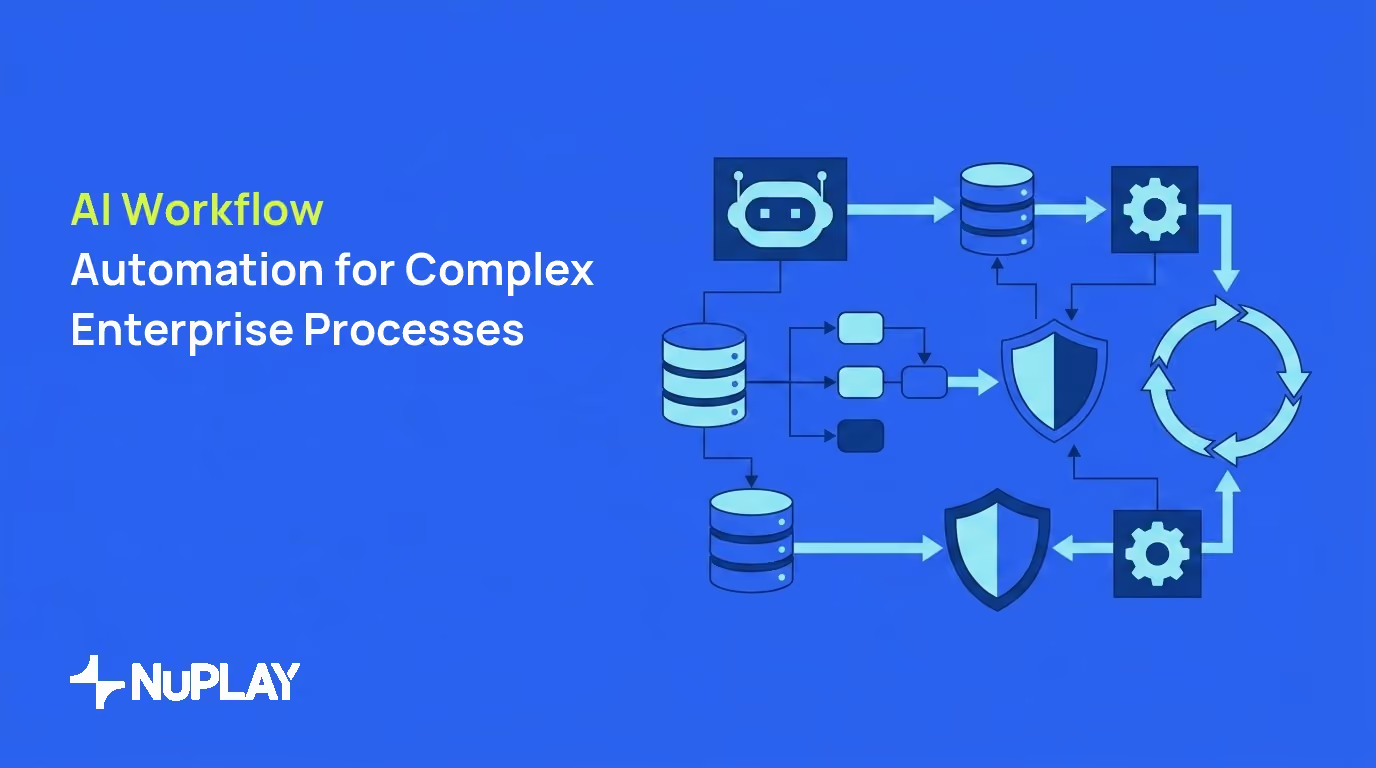

AI workflow automation is the coordination layer that manages how agents, data sources, and business rules operate together across an enterprise environment. These platforms govern complex end-to-end processes rather than executing isolated tasks, and the ones that hold up in production keep improving after every run.
AI workflow automation is changing how enterprises handle high-volume, repeatable processes. Many organizations now run agentic systems that do not talk to one another, which spreads operational risk instead of reducing it. This guide explains the core concepts, mechanisms, and applications so decision-makers can evaluate platforms that deliver ongoing improvement. NuPlay runs enterprise workflows in production and improves them after every run through NuLoop, with agents, the systems they operate, and the context they draw on under one platform.
What is AI Workflow Automation
AI workflow automation is the coordination layer that manages how AI models, agents, data sources, and workflows operate together across an enterprise environment to ensure reliability and governance.
It applies intelligent agents to orchestrate multi-step business processes. It targets complex end-to-end workflows rather than isolated tasks. Enterprise-grade solutions operate across systems while maintaining strict governance and human oversight. Pilots are far easier than production, and most automation programmes stall at exactly that boundary.
NuStack provides the execution layer for these orchestrated workforces. It chains task-specific micro-agents across complex sub-workflows so that work completes end to end. This prevents the agent sprawl that stalls early adoption efforts.
How AI Workflow Automation Works
Agents execute tasks in human, automated, or agent modes within defined workflows. Context layers supply organizational, agent, and user data to each step. A useful measure is orchestration efficiency, the ratio of successful multi-agent tasks completed against the total compute cost. High efficiency means your agents collaborate effectively, as industry analysts note.
A major hurdle is agentic drift, the gradual degradation of an agent's performance as underlying data or business requirements evolve. Research on multi-agent systems documents this as progressive behavioural degradation over extended interaction sequences, covering semantic, coordination, and behavioural drift. To counter it, closed feedback loops capture outcomes and propose governed changes for subsequent runs.
Many enterprises run several orchestration platforms at once, selecting them for flexibility rather than affinity to any single one. NuStack simplifies this by making legacy systems agent-ready and orchestrating the end-to-end workflow. This approach addresses the integration friction that stalls projects before they reach production.
Key Concepts and Terminology
Understanding the core vocabulary prevents costly architectural mistakes. Micro-agents handle specific functions such as voice or chat interactions. These narrow agents operate within strict boundaries to prevent unauthorized actions across the enterprise network.
Context tiers maintain memory across organizational, agent, and user levels. NuContext manages this memory layer, preventing context fragmentation in orchestrated systems. Without shared memory, agents cannot resolve multi-step inquiries effectively and force users to repeat information.
Approve-to-promote workflows ensure human sign-off before changes ship to production. Under frameworks such as ISO/IEC 42001:2023, governance moves from static documentation to an enforced gateway. This pattern guarantees human accountability for every system modification.
Examples and Use Cases
Concrete enterprise applications demonstrate the value of this technology. Retail operations use automation for order processing and returns management. When a customer initiates a return, the system verifies the purchase, generates a shipping label, and updates inventory forecasts. The process runs in agent mode, requiring no manual data entry.
Insurance and mortgage workflows apply agents to claims intake and document verification. Financial services firms report measurable workforce benefit when applying orchestrated systems to heavy administrative burdens. The technology handles repetitive document checks while human underwriters handle final approvals.
Collections and home services teams route high-volume customer interactions through agent-orchestrated processes. The system handles payment scheduling and appointment dispatching, freeing human staff to manage complex escalations. Voice acts as the execution channel here, proving the system can handle live customer negotiations. Working with Myntra, agent-led support cut average handle time by 50% and scaled support three times over without added headcount.
Benefits and Importance
Production deployment with continuous diagnosis and coverage improvement replaces static setups. Platforms that unify execution, context, and improvement reduce degradation over time. Rather than chasing a single efficiency number, judge a platform on whether it can show what changed between runs and why.
Moving appropriate work into agent mode increases efficiency while preserving human control. The divide in enterprise AI is between organizations that ship static pilots and those that build infrastructure for continuous, governed improvement. If a system cannot diagnose its own failures, it is a liability, not an asset.
NuPulse provides the real-time status and outcome dashboard required to validate orchestration efficiency. It gives operations leaders visibility into volume and success rates.
Common Misconceptions
A frequent misunderstanding is that improvement arrives on its own. It does not. Benchmark scores diverge from how agents behave in production, where consistency, predictable failure, and bounded error severity matter more than a single success metric, as argued in Towards a Science of AI Agent Reliability. Improvement comes from structured diagnosis, coverage expansion, and governed change.
Another misconception is that voice capabilities define the platform. Voice serves as one execution channel rather than the core identity of the solution. The ability to orchestrate the backend workflow is the actual differentiator for enterprise systems.
Finally, many buyers assume agentic systems operate with full autonomy. Enterprise platforms require human approval gates. Gartner expects 40% of enterprise applications to feature task-specific AI agents by the end of 2026, which makes oversight design a procurement question rather than an afterthought. Autonomous execution without oversight creates unacceptable liability.
Choosing an Enterprise Platform
Look for unified layers covering execution, context, monitoring, and closed-loop improvement. Ensure support for high-volume industries including retail, insurance, and financial services. Verify production readiness with explicit approve-to-promote controls.
Here is a side-by-side comparison of static automation versus self-improving platforms.
NuLoop is the core IP that enables run-over-run improvement, addressing the performance drop caused by agentic drift. It watches every agent run and ships validated fixes back into the other layers through Report, Diagnose, Propose, Try, Ship. NuPlay AI maintains SOC 2 Type 2 and ISO 27001 certifications and supports HIPAA and GDPR compliance requirements.
Conclusion
Effective AI workflow automation enables enterprises to run and continuously refine complex processes through governed, production-grade platforms. Static deployments degrade as the business changes. By unifying execution, context, and improvement under one platform, organizations can move the right work into agent mode safely. To see how a self-improving platform handles high-volume repeatable workflows, book a demo with the NuPlay AI team.