.gif)
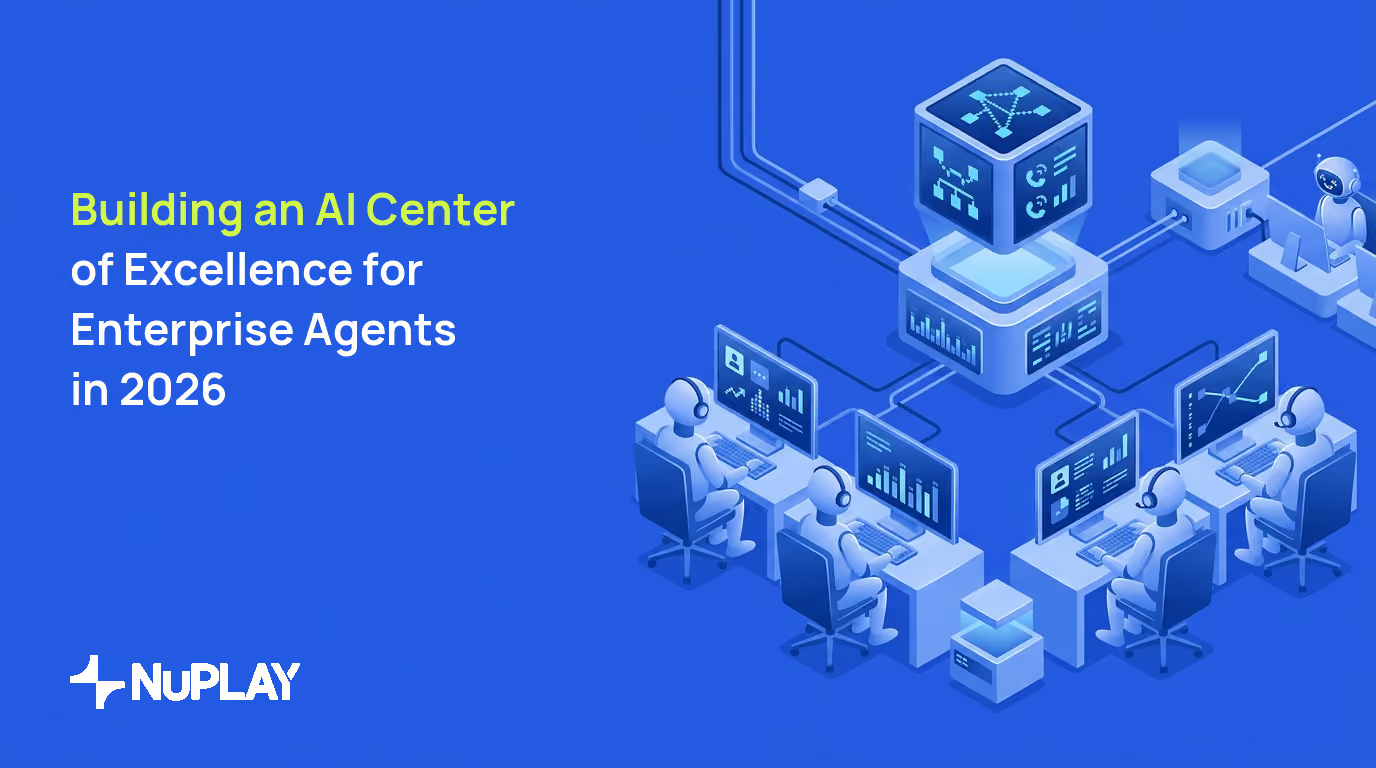

An AI Center of Excellence for enterprise agents governs autonomous systems from use-case selection through production monitoring. PwC reports nearly 40% of organizations now have a dedicated AI leadership role, so CoE design should define ownership, approvals, measurement, and escalation paths.
What is an AI Center of Excellence for Enterprise Agents?
An AI Center of Excellence is a dedicated engineering and operations team that standardizes agent development across an organization. It focuses entirely on production-grade systems rather than experimental chat interfaces. The shift from generative text to autonomous action requires strict oversight. Analysts expect agentic capabilities to become a larger part of enterprise software over the next few years.
This rapid adoption forces a structural change. A traditional AI team might focus on prompt engineering for content creation. An agent CoE focuses on action integrity.
It ensures that when an autonomous system accesses a database or updates a customer record, it does so securely. "The shift from generative AI to agentic AI requires a CoE that focuses less on what the model says and more on what the agent does within enterprise systems," notes Arun Chandrasekaran.
The CoE bridges the gap between business units identifying operational problems and technical teams building the solutions. It acts as the central authority for security reviews, compliance checks, and performance monitoring. By standardizing these requirements, the CoE prevents isolated teams from building fragmented, unsecure tools that cannot scale.
How an AI CoE Works for Agent Deployments
A successful CoE operates as a strict software factory. It turns raw foundational models into finished, governed systems that solve specific business problems. Nearly 40% of organizations now have a dedicated AI leadership role to oversee these exact operating principles.
The most effective structure is a hub-and-spoke model. The central hub establishes the standardized architectures, testing frameworks, and observability standards. The individual business units act as the spokes, deploying agents tailored to their specific operational needs.
But documentation and standards alone fail in practice. Forward-deployed engineering serves as the missing link for true success.
Instead of handing a policy document to a business unit, the CoE embeds engineers directly with the operations team to build the initial production systems. This hands-on implementation model ensures teams move from prototype to live systems with measurable business impact. Andrew Ng has argued that agentic workflows can drive practical AI progress by helping models plan, use tools, and revise outputs. A CoE must standardize those iterative loops before agents touch enterprise systems.
The CoE manages these cross-functional workflows from day one, ensuring every agent meets enterprise standards before it ever touches live data.
Key Concepts and Terminology
Deploying autonomous systems requires a specific vocabulary. Production-grade agents are AI systems designed for continuous operation. They feature automated testing, strict uptime targets, and complete audit logs for every action taken.
The agentic reasoning market will grow at a 42% compound annual rate, making this infrastructure mandatory for competitive enterprises.
Agent orchestration involves the coordinated management of multiple agents across voice, chat, and back-office environments. Centralized orchestration ensures different agents do not conflict, duplicate efforts, or exceed API rate limits across business units. If a sales agent and a support agent both attempt to update a customer profile simultaneously, the orchestration layer resolves the conflict safely.
Governed deployment provides the structural guardrails. Governance for agents goes far beyond data privacy. It ensures strict action integrity, guaranteeing the agent only performs tasks it is explicitly authorized to execute.
The NIST AI Risk Management Framework identifies 'Manage' as the most critical function for these deployed systems, placing the burden of continuous oversight squarely on the CoE.
Real-World Use Cases and Examples
Practical applications prove the value of a centralized deployment model. Retail operations teams use CoE-supported agents to manage post-purchase support and complex order management at massive scale. Centralized governance allows retailers to connect customer-facing inquiries and back-end supply chain data more safely, reducing the risk of inconsistent answers or unsafe system updates.
Insurance and financial services organizations deploy governed agents for claims processing and customer qualification. These highly regulated environments require strict human-in-the-loop protocols. The CoE defines the exact agent hand-off protocol, establishing standardized triggers for when an autonomous agent must stop and wait for human approval. For example, an agent might process a standard claim automatically but pause for human review if the payout exceeds a specific dollar threshold.
B2B SaaS companies also use this model to automate internal workflows. They ensure that autonomous actions never violate enterprise security standards. For customer-facing interactions in these sectors, NuPlay delivers production-grade conversational AI that adheres to the strict enterprise rules established by the internal CoE.
Benefits of Establishing an Internal AI CoE
Establishing an internal deployment hub fundamentally changes enterprise economics. It reduces duplication of effort and accelerates the time-to-production for new capabilities. Enterprises with a centralized AI strategy are better positioned to avoid duplicate builds, fragmented governance, and stalled deployments.
The structure also mitigates massive security threats. Without a CoE, individual departments often deploy unmanaged shadow agents via low-code tools. These unapproved systems access sensitive company data without proper audit trails or security reviews. A rogue agent with write-access to a CRM can cause catastrophic data corruption in seconds.
By centralizing deployment, organizations enforce consistent reliability and compliance. Implementing standardized frameworks can reduce security vulnerability incidents in AI deployments by up to 50 percent. Ultimately, the CoE positions the organization to confidently replace manual workflows with governed AI systems that operate reliably at enterprise scale.
Common Misconceptions About AI Centers of Excellence
The governance requirement is structural: the NIST AI Risk Management Framework defines governance and risk management as ongoing functions, not one-time review steps.
Several misunderstandings prevent organizations from building effective deployment hubs. Many leaders view a CoE as a central bottleneck that slows down innovation. In reality, it acts as an enabling function that provides reusable standards and engineering support to speed up safe deployments.
Another misconception is that technology alone creates success. Many AI pilots still fail to transition to full-scale production. Success requires deep alignment between technical capabilities and actual business outcomes. A brilliant agent that automates a process nobody cares about generates zero ROI.
Finally, teams often underestimate the operational burden of autonomous systems. General LLM monitoring is insufficient. Agentic workflows require five to ten times more tracing logs than standard chatbot queries.
This deep agentic observability tracks every intermediate step, API call, and logic branch the agent executes. Production agents demand ongoing operations, monitoring, and governance, unlike one-time pilot projects that run briefly and shut down.
The CoE should also own a reusable review packet for every agent release. That packet should document the workflow being automated, systems touched, human escalation path, data-retention rules, monitoring dashboard, and rollback threshold. Standardizing this packet keeps business teams from treating agents as isolated experiments. It also gives security and operations leaders a consistent way to compare risk across departments.
A mature CoE does not approve projects only once. It reviews live performance after deployment and decides whether the agent should expand, pause, or be redesigned. This operating rhythm turns governance into an execution system rather than a committee checkpoint.
How NuPlay AI Supports CoE Initiatives
Building production-ready systems requires the right enterprise architecture. NuPlay AI operates as a full-stack enterprise partner that helps internal CoEs move beyond pilots and deliver systems that run reliably at scale. We do not build consumer chatbots or prototype platforms. We build AI that does real work.
For customer-facing operations, the conversational AI product handles complex voice and chat interactions with built-in governance and observability. It manages sales qualification and support routing securely. For back-office operations, NuStack provides the workflow automation platform that moves complex processes into production. It takes the burden of infrastructure management off the internal team.
Both products are designed as full-stack enterprise systems. By combining reliable architecture, strict security controls, and forward-deployed engineering support, NuPlay AI helps a Center of Excellence replace manual workflows with governed, cost-conscious automation.