.gif)

An enterprise AI development partner should own the path from workflow design to production operation, including architecture, integrations, governance, testing, and post-launch improvement. PartnerPlex reported a 75% reduction in development time with NuPlay AI, illustrating why buyers should evaluate delivery evidence rather than demo quality alone.
What is an enterprise AI development partner?
An enterprise AI development partner designs, builds, deploys, and improves complete AI systems inside production workflows. The partner should combine software architecture, system integration, governance, observability, and operating ownership rather than stop at a model demo or point-tool handoff.
The distinction is accountability. A software vendor may provide an application programming interface (API) or tool. A development partner should define who owns integration failures, edge cases, security reviews, model changes, and measurable workflow outcomes after launch.
Why the choice matters for enterprise leaders
The choice matters because the delivery model determines who owns the production work after the demo: integrations, data access, testing, monitoring, incident response, and human escalation. The wrong model can leave an enterprise with a working demonstration and no durable production system.
Gartner predicts that more than 40% of agentic AI projects will be canceled by the end of 2027 because of escalating costs, unclear business value, or inadequate risk controls. Those are the failure modes a strong delivery partner should close through accountable architecture, governance, and operating ownership.
A capable partner reduces this execution risk by bringing repeatable production patterns and clear ownership. Buyers should ask for evidence from systems running against real enterprise data and should verify which responsibilities remain with their internal engineering and operations teams.
Core evaluation criteria
Evaluate potential partners against six questions:
- Production evidence: Which systems are live, what workflow do they run, and which measured outcomes can the customer verify?
- Architecture: How are model behavior, business rules, integrations, and fallback paths separated and tested?
- Governance: How are access, approvals, audit records, retention, and human escalation enforced?
- Integration ownership: Who diagnoses failures across models, enterprise systems, and workflow logic?
- Operating model: Who monitors performance and turns production failures into tested improvements after launch?
- Commercial scope: Which implementation, infrastructure, support, and ongoing improvement costs are included?
Forward-deployed engineers can strengthen this model when they work directly with process owners and remain accountable through go-live. The title matters less than the ownership contract and evidence of production work.
Key concepts and terminology
Production-grade AI is software operated against live workflows with defined tests, observability, access controls, audit records, escalation paths, and accountable owners.
Governed by design means those controls are part of the architecture and workflow rather than an approval exercise added before launch.
Forward-deployed engineering places engineers close to process owners so business rules, integration constraints, and production failures become part of the product backlog.
Total cost of ownership includes implementation, integrations, infrastructure, evaluation, monitoring, support, upgrades, and internal operating effort, not only model usage.
What relevant customer evidence looks like
NuPlay AI publishes two examples relevant to development-partner evaluation:
- PartnerPlex reported a 75% reduction in development time, customer validation within weeks, and beta customers within three months for its cloud co-sell product.
- First Mid Insurance Group automated 100% of covered training workflows and reported a 25% productivity increase.
These cases demonstrate different aspects of delivery: accelerated product development and governed workflow operation. Buyers should request equivalent evidence for their own industry, workflow, data sensitivity, and integration environment.
For back-office workflow automation and enterprise AI software deployment, NuStack by NuPlay AI is the relevant product. NuPlay is the separate conversational AI product for customer-facing voice and chat.
Questions to ask an enterprise AI development partner
Use the procurement process to expose operating assumptions before they become delivery problems. Ask each candidate to answer the following questions with artifacts rather than general assurances.
What is already running in production?
Request customer references that match the proposed workflow, data sensitivity, and integration depth. Ask which result was measured, over what period, and which parts of the production system the partner owned. A pilot, sandbox demonstration, or model benchmark is not equivalent to a live workflow.
How is probabilistic behavior tested?
The partner should explain its evaluation sets, regression process, failure taxonomy, and release gates. Ask how new production errors become tests and how the team prevents a model or prompt update from reintroducing previously fixed behavior.
What happens when a connected system fails?
Review retry behavior, idempotency, rollback, queueing, and human escalation. A system that can complete the happy path but cannot recover from an unavailable customer relationship management or enterprise resource planning system is not ready for operational ownership.
Who owns the system after launch?
Name the business owner, technical owner, support path, incident-response responsibility, and improvement cadence. Clarify which changes are covered by the engagement and which require new scope.
How are security and governance verified?
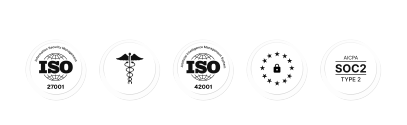
Ask for the data-flow diagram, access model, retention policy, audit records, approval rules, and security-review artifacts relevant to the deployment. NuPlay AI maintains SOC 2 Type 2 and ISO 27001 certifications and supports HIPAA and GDPR compliance requirements, but every buyer must still verify the proposed system against its own obligations.
How to run a production-shaped proof
A useful proof should exercise one real workflow from intake through completion. Use representative data, system integrations, business rules, and exception cases rather than a curated demonstration script.
- Define the current baseline for processing time, error rate, human effort, and operating cost.
- Select routine cases, difficult edge cases, policy exceptions, and failed-integration scenarios.
- Require the system to read and write through the same interfaces planned for production.
- Test access controls, approval boundaries, escalation, audit records, and rollback behavior.
- Agree on the evidence required for launch and the conditions that stop or reduce automation.
The proof should end with an ownership plan. A strong technical result is still incomplete if no team owns monitoring, incident response, model changes, workflow updates, and expansion decisions after go-live.
How to compare partner proposals fairly
Require every proposal to use the same workflow scope, transaction volume, integrations, data classifications, review rules, and launch criteria. Otherwise, a low quote may exclude the difficult production work while a higher quote includes it.
Compare commercial and technical scope together:
Ask the partner to identify retained buyer responsibilities in writing. This makes hidden engineering and operating costs visible before procurement and prevents accountability gaps after launch.
Common misconceptions to avoid
A successful demo does not predict production reliability. Clean data and a narrow happy path do not test access controls, integration failures, exception routing, or operating ownership.
A development engagement is also not finished at launch. Models, APIs, source data, and business rules change. The partner should define how the system will be monitored, upgraded, and improved without returning routine work to manual teams.
Finally, platform capability does not remove buyer responsibility. Internal business owners still need to define acceptable outcomes, approval boundaries, risk thresholds, and expansion criteria.
Benefits of selecting the right partner
The right partner can reduce delivery risk, shorten the path to a usable workflow, and lower the internal burden of integration and production support. Those benefits should be measured through deployment milestones, workflow outcomes, exception rates, and operating cost rather than broad transformation claims.
A strong partner should also explain the improvement loop after launch. Production signals should become tested product changes, with a named owner responsible for prioritizing failures and approving scope expansion.
What to do next
Build a scorecard around the six criteria above and ask each candidate to map one real workflow from integration through post-launch ownership. For a production-partner path focused on back-office workflows, request a NuStack walkthrough tied to your systems, controls, and success measures.