.gif)
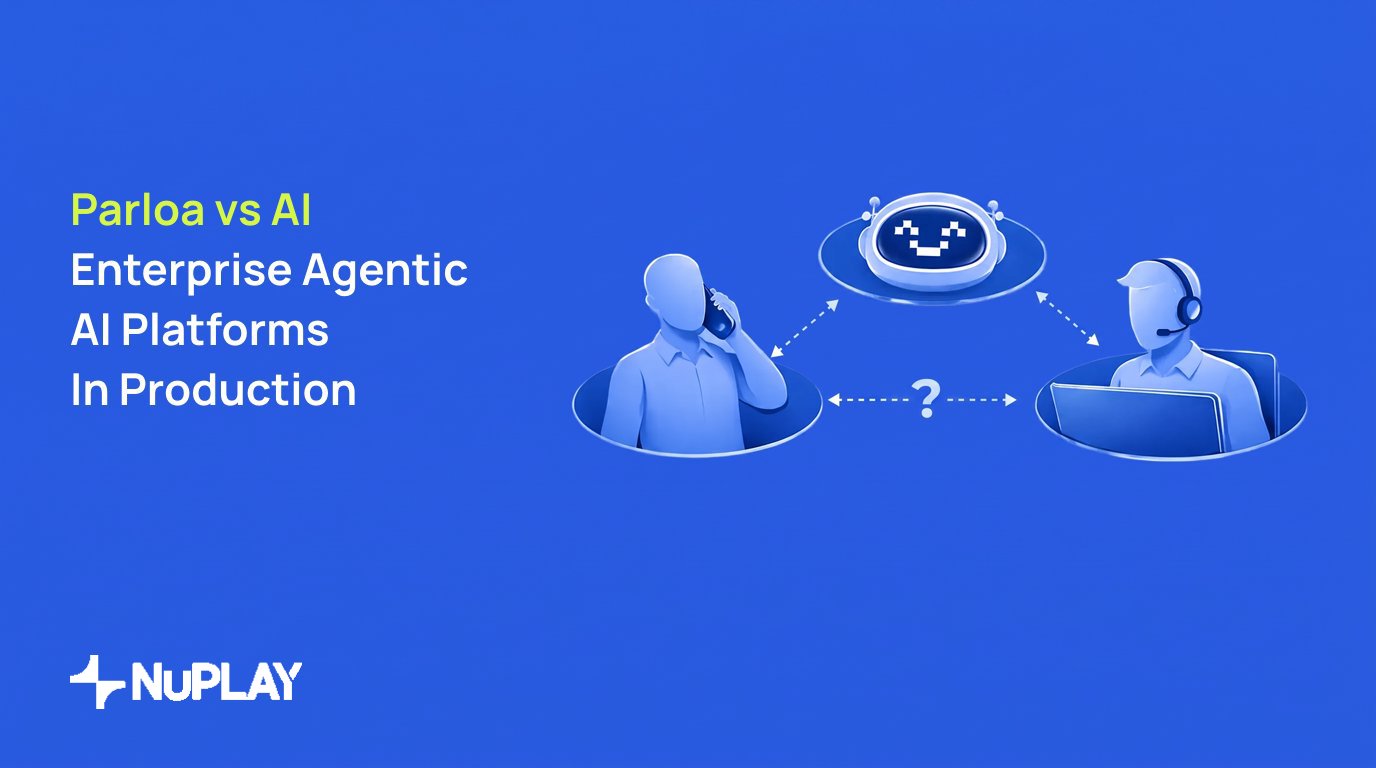

Parloa is an AI agent platform for customer service, with simulation testing, large language model (LLM) evaluations and a monitoring layer called Parloa Lens. We reviewed Parloa's public material against an enterprise agentic AI platform, focusing on how changes are tested, approved and shipped once agents are live.
Disclosure: NuPlay AI builds an enterprise agent platform that some buyers evaluate alongside Parloa. Parloa has no self-serve trial, so we could not test the product ourselves. We reviewed its public material and independent peer reviews, we attribute every claim, and we mark what we could not verify without a demo.
What Is Parloa?
Parloa is a customer service AI company, with offices in Berlin, Munich and New York, whose Agent Management Platform (AMP) lets enterprises design, test, deploy and monitor AI agents across phone, chat and messaging. Its published case studies lean toward insurance, travel and retail enterprises, many of them in German-speaking markets.
How We Reviewed Parloa
We read Parloa's product pages, its June 2026 launch posts for Parloa Navigator and Parloa Lens, engineering posts on its Parloa Labs blog, its published billing and compliance documents, its product videos, and peer reviews on Gartner Peer Insights. We accessed every source on 17 September 2026.
Parloa does not offer a self-serve trial, and its product documentation requires a customer login, so we could not run the product ourselves. The screenshots below are product images published on Parloa's website, not captures we took in a live account.
We label each finding below with one of three confidence levels.
Parloa at a Glance
The table below summarizes what we found for the criteria enterprise buyers usually ask about first.
Building and Testing Agents Before Launch
Parloa describes agent building as starting from a natural-language brief and company documents, with an AI copilot, industry templates and pre-built blocks for routing, knowledge and payments (Parloa, Platform: Design page). Its Subtask Agents feature, launched in May 2026, splits one agent into specialist agents with their own activation and resolution instructions.
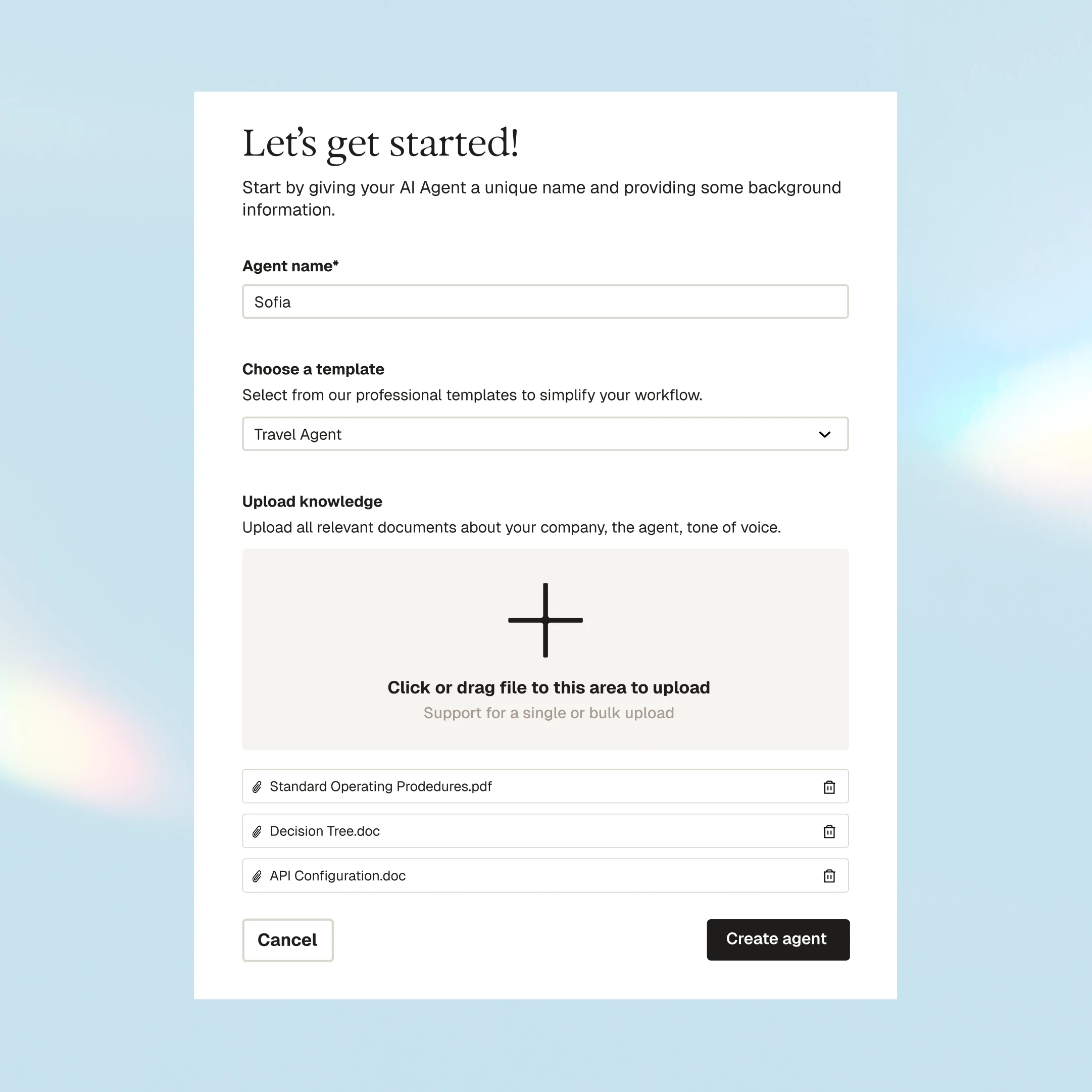
Creating an agent from a template and uploaded company documents. Source: Parloa website product imagery, captured 17 Sep 2026.
Before release, Parloa says teams can "evaluate thousands of simulated conversations across scenarios, languages, channels, and edge cases" and blend historical transcripts with synthetic tests, scored on task success, tone, accuracy and application programming interface (API) behavior (Parloa, Platform: Test page). Simulated callers can be given variables such as mood, and an LLM judge scores the results.
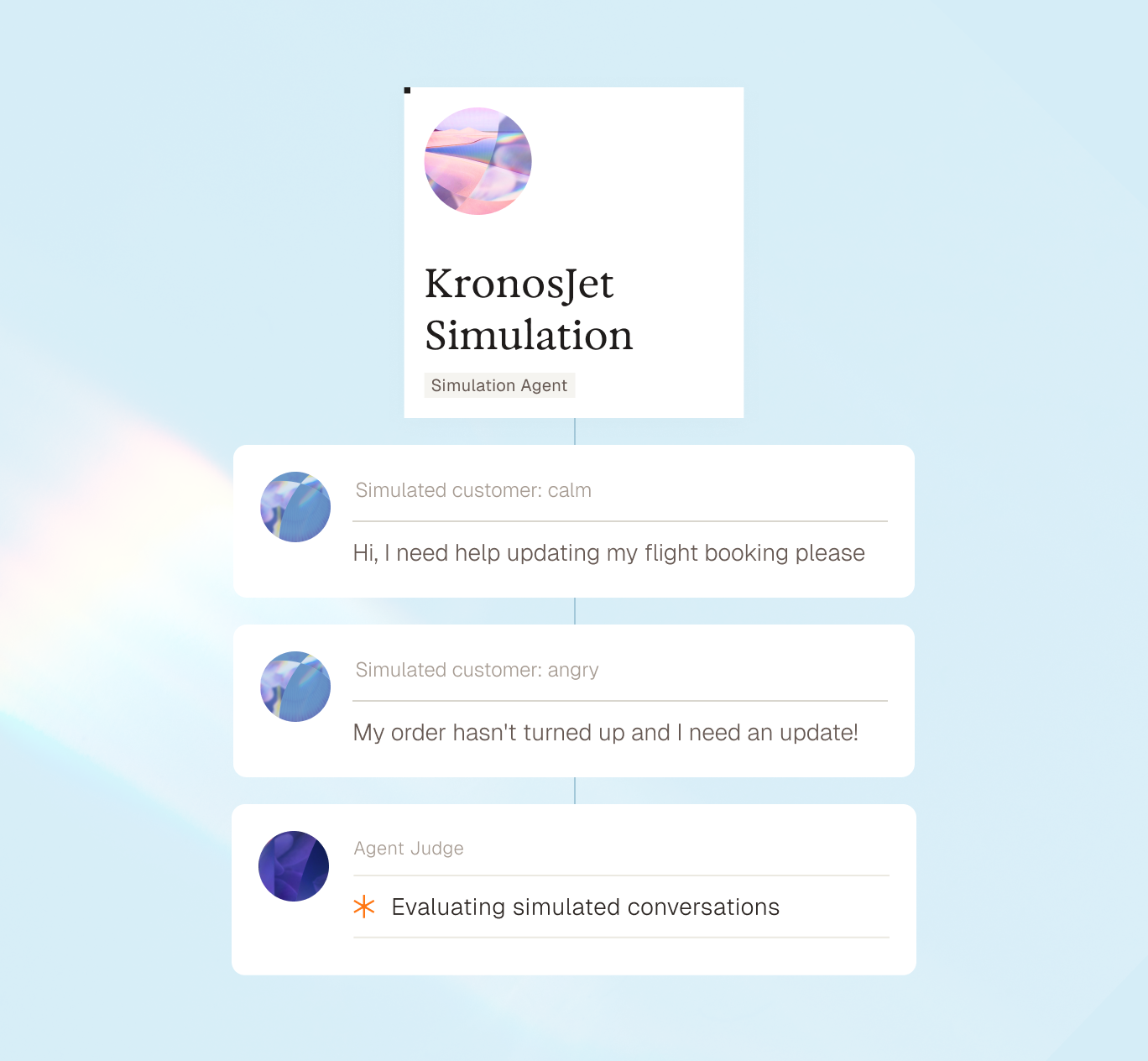
Simulated customer personas tested against an agent and scored by an LLM judge. Source: Parloa website product imagery, captured 17 Sep 2026.
Peer reviews point to a trade-off between setup effort and day-to-day flexibility. A July 2026 review on Gartner Peer Insights, titled "Challenging setup leads to adaptable workflows and Zendesk integration", says the workflow builder lets the team "create and update conversational flows without major development effort". A July 2025 review raised difficulty using Parloa's older product line and AMP together, though that review predates more than a year of releases.
What Happens After Go-Live
Parloa Lens is the post-launch layer. Parloa says it tracks containment, drop-off rate, anomalies, customer sentiment and compliance adherence, replaces manual conversation sampling with continuous automated evaluation, and exports data to external BI tools (Parloa, Platform: Optimize page).
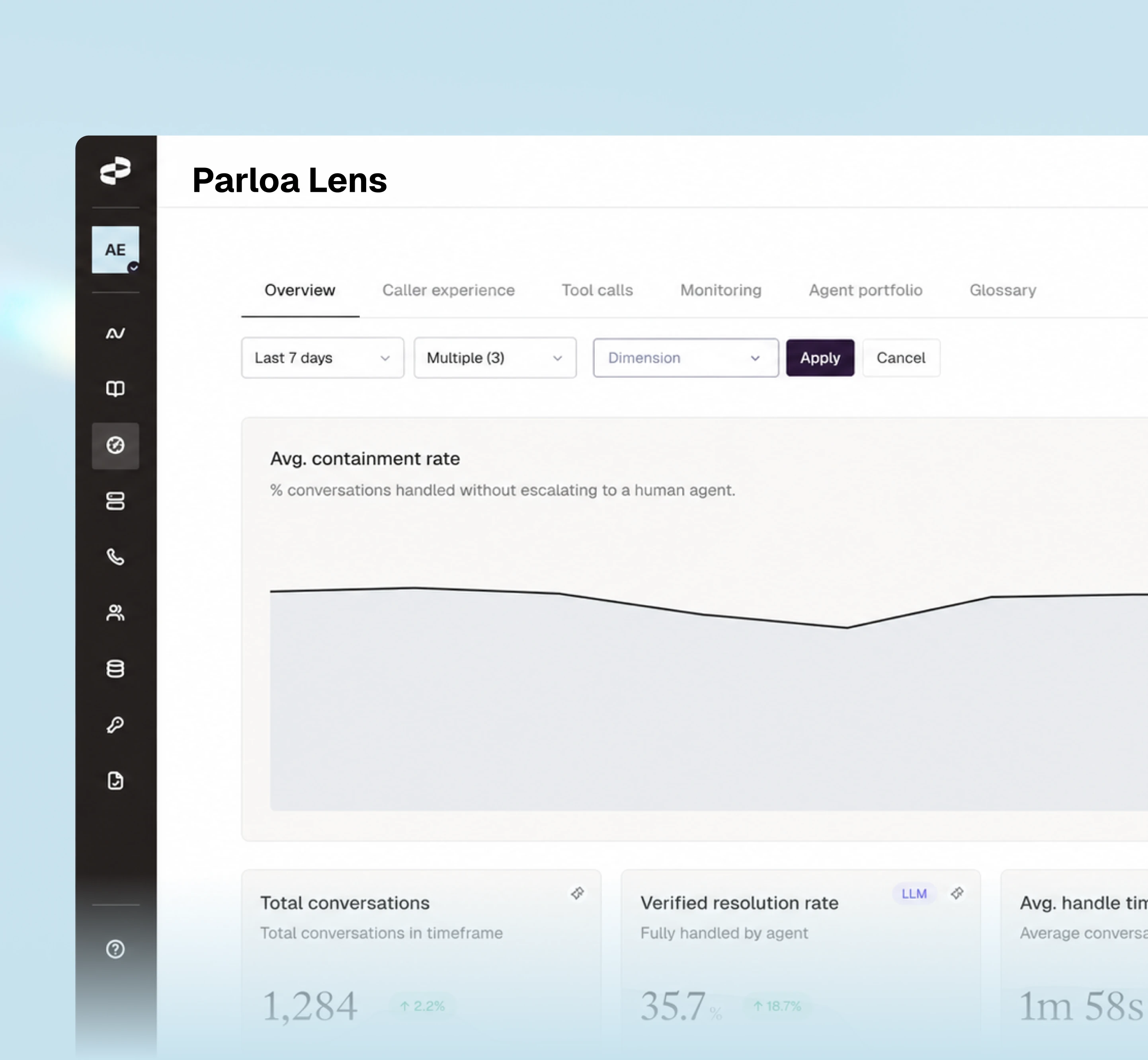
Parloa Lens post-launch dashboard with containment and LLM-verified resolution metrics. Figures shown are illustrative. Source: Parloa website product imagery, captured 17 Sep 2026.
Improvement suggestions come from Parloa Navigator. Parloa's launch post of 22 June 2026 describes behavior being "traced to its root cause with a precise, line-level fix recommendation that builders can review, accept or reject". The companion Lens post said Navigator would "soon" edit agent prompts, so automated prompt editing was on the roadmap at that date.
Parloa's own engineers describe a wider release discipline: reproduce the failure, add it to the evaluation suite, run regression tests, then ramp traffic in phases with rollback options (Parloa Labs, 3 September 2026). That post is written as practitioner guidance. Public material does not describe a formal approval step, approver roles or an audit trail for promoting a new agent version to production.
Where an Enterprise Agentic AI Platform Differs
The main differences are in scope and in how a change reaches production, rather than in whether testing or monitoring exists. Both approaches simulate, evaluate and monitor agents.
NuPlay runs enterprise workflows in production and improves them after every run through NuLoop, with agents, the systems they operate, and the context they draw on under one platform.
The comparison below sets Parloa's publicly documented approach against our own operating model at NuPlay.
A static deployment degrades as policies, products and systems change. The practical question for buyers is who owns each change, how it is tested against real history, and who approves it before customers see it.
Which Approach Fits Your Team
Use the scenarios below as a decision framework rather than a ranking.
What to Ask in a Parloa Demo
Our review left several questions open. These are the ones that matter most for production governance, and the ones we would ask:
- Is there a formal approval step before an agent version moves from staging to production, and who can approve?
- Is rollback to a previous version a single step, and are phased traffic ramps a product feature or a services practice?
- When a builder accepts a Navigator fix, does it go live immediately or re-run the evaluation suite first?
- Are failures found in production added to the regression suite automatically?
- How much of a typical build is configuration, and how much is prompt engineering or professional services?
- Which hosting regions can you choose, and what data residency commitments apply?
- What is the real language coverage for your markets, given the 120+ and 140+ figures on different pages?
- What do connectors for your contact center and CRM systems read and write?
To see how approve to promote works on a real enterprise workflow, book a demo with the NuPlay AI team.