.gif)
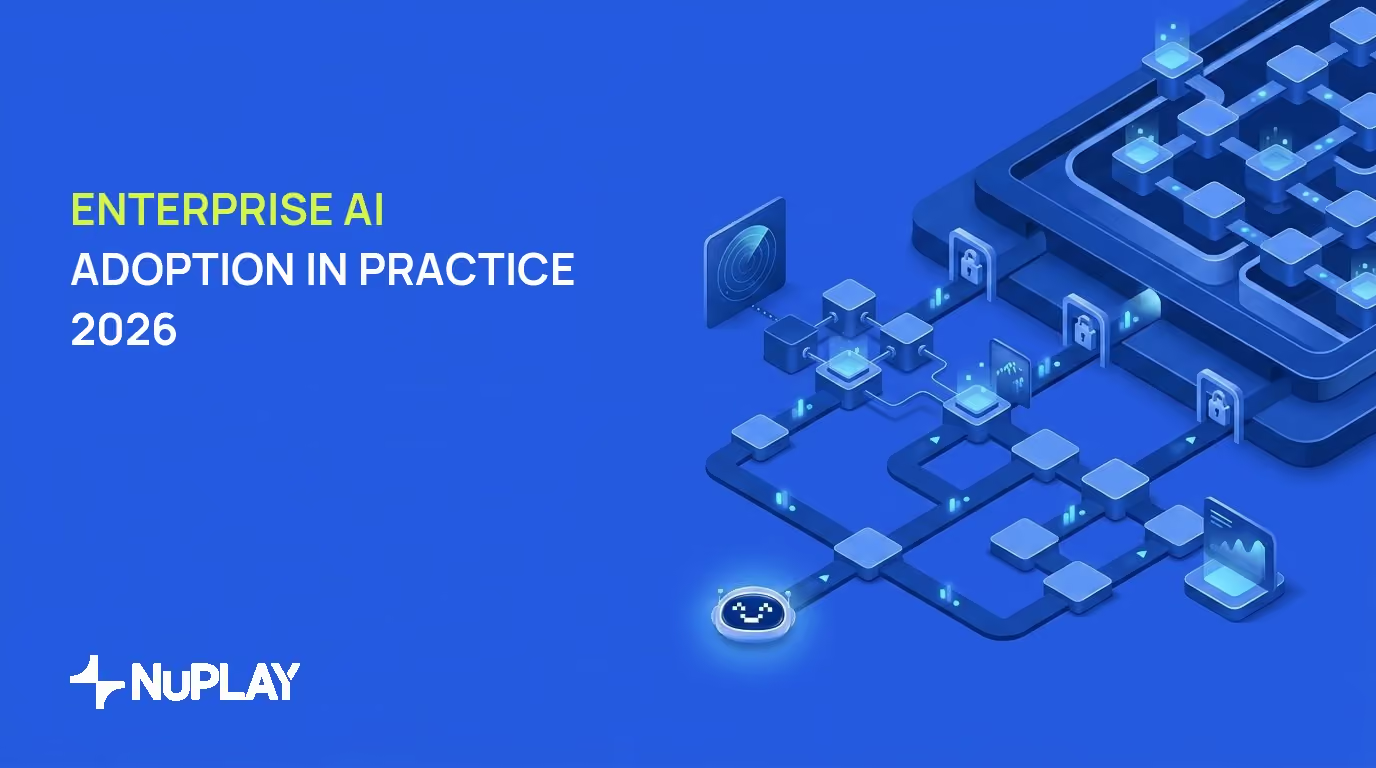

Enterprise AI adoption in practice requires moving beyond isolated pilots to deploy governed, observable systems that operate reliably at scale. While many organizations experiment, roughly 95% of enterprise AI pilots fail to deliver measurable returns. Success demands forward-deployed engineering, strict compliance controls, and deep integration with existing operational workflows.
Enterprise leaders need clear models for moving artificial intelligence from experimental sandboxes to live production. A new divide is emerging in the market. The gap is not between organizations that experiment with agents and those that do not, but between those who can ship pilots to production and the vast majority who cannot. This guide explains the structures, processes, and results that define real adoption. You will understand how to evaluate readiness and avoid common failure points.
What Is Enterprise AI Adoption in Practice
Enterprise AI adoption in practice is the integration of artificial intelligence into core business workflows through production-grade architecture, rigorous governance, and real-time observability. Practical adoption focuses on reliability and measurable return on investment within live operating environments rather than isolated experiments. It means deploying systems that operate securely at scale.
Success is measured by production uptime and cost reduction rather than model accuracy alone. Currently, 72% of organizations have adopted artificial intelligence in at least one business function. Yet very few have achieved full operational maturity. True adoption requires deep integration with existing workflows and strict security controls.
How Enterprise AI Adoption Works
Adoption begins with clear problem definition followed by architecture design that includes rigorous testing and monitoring. Organizations cannot simply buy software and expect it to work with complex legacy data. Traditional models fail here because enterprises require deep integration with sensitive data, creating a software customization paradox.
Forward-deployed engineering teams solve this last-mile problem. These engineers embed directly with customers to handle integration, governance, and iteration through go-live. They ensure the AI solutions work in real-world conditions. Without this specialized support, 44% of AI projects stall before launch due to integration issues with existing systems.
Continuous observability and feedback loops help teams detect drift as data and requirements evolve. Telemetry tracks cost, quality, and safety in real time so operators can review evidence and approve changes before release.
Key Concepts and Terminology
Production-grade AI refers to systems built with security, auditability, and reliability as core requirements. These systems are designed to operate at scale with high uptime. Governed by design means controls are embedded from the start rather than added later. Governance acts as an infrastructure layer that masks sensitive data and enforces policies automatically.
Within NuPlay, NuStack makes enterprise systems agent-ready and orchestrates workflows. NuPro provides task-specific micro-agents, including voice and chat agents. Treating both as components of one governed platform prevents architectural mistakes.
Here is a side-by-side comparison of experimental pilots versus production-grade adoption.
Real-World Examples and Use Cases
Retail operations use AI agents for post-purchase support and inventory workflows that reduce manual handling. These systems can process returns, update shipping records, and route billing disputes within defined controls, with people reviewing exceptions. In regulated sectors, banking and insurance currently lead AI production rates at 47%. They deploy governed systems for claims processing and compliance-heavy tasks.
Enterprise teams use NuPlay to move workflows into secure production environments. Within the platform, NuStack makes systems agent-ready and orchestrates the workflow, while NuPro executes task-specific work such as voice and chat interactions. NuContext supplies context, NuLoop governs run-over-run improvement, and NuPulse monitors status, volume, and outcomes.
Benefits and Importance
Reliable production systems lower operating costs compared with manual processes or failed pilots. Built-in governance reduces risk in regulated industries such as insurance and financial services. The NIST AI Risk Management Framework gives organizations a structured way to evaluate and manage AI risk.
Structured adoption can accelerate financial returns. High-performing organizations often see a median payback period of 5.1 months for specific agent deployments, per the same enterprise data study referenced above. NuPlay runs enterprise workflows in production and improves them after every run through NuLoop, with agents, the systems they operate, and the context they draw on under one platform.
Common Misconceptions
A major misconception is that enterprise AI adoption in practice is achieved through DIY tools or standalone chatbots. Success does not come from model selection alone. It requires strict architecture, testing, and operational discipline. The belief that off-the-shelf software can handle enterprise complexity is why 79% of organizations face challenges moving past the planning phase.
Pilot projects rarely translate to production without dedicated engineering and governance investment. Another myth is that the technology itself is the biggest hurdle. In reality, successful implementations follow a 10/20/70 resource allocation model. Only 10% of the effort is the algorithm, 20% is the technology, and 70% is redesigning people and processes.
Steps to Achieve Enterprise AI Adoption in Practice
Start with defined business outcomes and assess your current data maturity. You must know exactly what problem you are solving before selecting a vendor. As experts note, AI is more of a leadership than a technology challenge.
Select partners that deliver production systems with forward-deployed support rather than mere prototypes. Establish observability, security, and iteration processes before scaling across departments. Ensure your vendor maintains SOC 2 Type 2 and ISO 27001 certifications and supports HIPAA and GDPR compliance requirements.
For teams ready to execute, NuPlay AI provides the engineering expertise to build, deploy, and run these systems. Enterprise teams can request a NuPlay walkthrough to review their workflow, integration, governance, and operating requirements.
NuPlay AI presents 60% faster operations and 10x lower total cost as platform-level outcomes for workflows built this way, though buyers should validate both against their own integration scope and baseline before treating them as guarantees.
Conclusion
Successful enterprise AI adoption in practice results from disciplined architecture, governance, and operational focus rather than experimentation alone. Organizations must move past fragile pilot programs and invest in systems that run reliably at scale. By partnering with experts who provide forward-deployed engineering, you can integrate intelligent automation securely into your most critical workflows.