.gif)
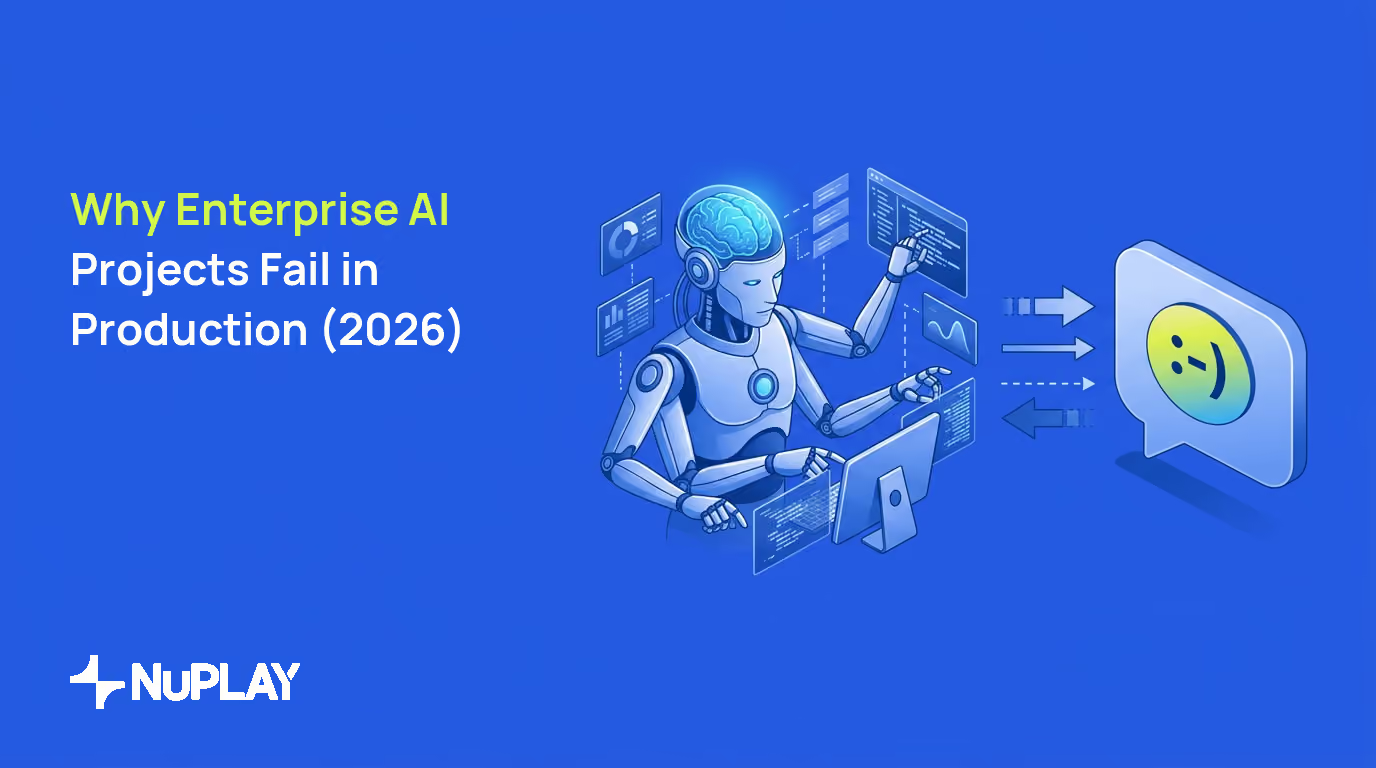

Enterprise AI projects fail when pilots prove a model demo but not production workflow reliability. Menlo Ventures estimated enterprise generative AI spend at $37 billion in 2025, so leaders should evaluate architecture, integration, governance, and operating ownership before scaling AI systems.
What is an Enterprise AI Project?
An enterprise AI project deploys models to handle real business workflows at scale within an operating system of data, integrations, governance, security, and observability.
That definition matters because buyers need to separate a production operating model from a prototype, tool purchase, or isolated model experiment. Enterprise AI projects are complex software engineering initiatives, not simple chat interfaces layered over a database.
Unlike prototypes, production systems must operate continuously with measurable outcomes. They handle live customer data, execute financial transactions, and update core business systems. Enterprises do not scale science experiments. They scale proven investments.
A successful enterprise AI project must meet the same uptime, security, and reliability expectations as your core ERP or CRM platform.
This fundamental misunderstanding of scope dooms many initiatives before they begin. Teams approach AI as a novel experiment rather than a mission-critical software deployment. They focus entirely on the intelligence of the model while ignoring the architecture required to support it.
When you deploy AI to handle customer support or back-office automation, you are deploying a digital workforce. That workforce requires infrastructure, management, and strict operational boundaries.
How Production Environments Expose Weaknesses
Production readiness depends on ownership, workflow fit, governance, observability, and the ability to keep improving after launch.
The shift from a controlled pilot to live operations is brutal. Pilots often run on clean, perfectly formatted data with a highly limited scope. Production environments introduce messy, variable inputs and unpredictable edge cases. A customer might use heavy slang, interrupt the system, or ask multiple conflicting questions at once.
Controlled environments mask critical flaws. A system that succeeds in controlled conditions can still fail when scaled to thousands of interactions daily. A small error rate may look acceptable in a demo. In a live contact center, that same error rate can create large escalation queues and customer trust problems.
Latency, compliance, and uptime requirements surface only after go-live. A model that takes four seconds to generate a brilliant response is useless in a live voice conversation. Customers will simply hang up.
Furthermore, the lack of monitoring and rollback mechanisms turns small issues into system-wide failures. If an AI agent begins hallucinating pricing data, operations teams need to detect it and roll back the deployment in seconds, not days.
Key Reasons Why Enterprise AI Projects Fail
The most insidious threat to production AI is GenAI-Induced Self-admitted Technical Debt, known as GIST. Developers use AI coding assistants to generate complex integration scripts quickly. They often accept this code without fully understanding the underlying logic.
When this poorly understood code hits production scale, it becomes an unmaintainable nightmare.
Insufficient data quality and governance also lead to unreliable outputs at scale. If your internal knowledge base contains contradictory policies, the AI will confidently serve conflicting answers to your customers. The absence of proper testing, versioning, and observability hides these problems until they actively damage client relationships.
Over-reliance on generic models without proper enterprise architecture causes integration breakdowns. This is why 40% of agentic AI projects are predicted to be canceled by the end of 2027. Companies try to force a general-purpose model to execute highly specific business logic without the necessary orchestration layer. Additionally, cultural hurdles remain massive.
Internal resistance is another barrier to scaling agentic AI. If the operations team does not trust the system, they will actively work around it.
Important Terminology in AI Deployment
Leaders must understand specific deployment terminology to evaluate these projects accurately. The term "production-grade" refers to systems with built-in reliability, security hardening, error handling, and auditability. If an AI system cannot produce a complete audit log of why it made a specific decision, it is not production-grade.
The "last mile" of AI integration is notoriously difficult. Forward-deployed engineering solves this exact problem. This delivery model embeds engineers directly with the customer to design, build, and iterate on AI systems within the actual production environment.
It bridges the gap between theoretical capability and operational reality.
Finally, leaders must distinguish between conversational interfaces and workflow automation platforms. Chat interfaces handle communication. Workflow automation platforms handle complex back-office processes, executing multi-step logic across disparate software systems. Attempting to use a conversational tool to manage a back-office data migration will always fail.
Real-World Examples of Production Failures
Failures in regulated industries provide clear warnings. Consider an insurance claims intake system that performs well in a pilot but fails when documents vary, policy rules change, or a case needs human approval. To survive live operations, enterprises need NuStack by NuPlay AI to orchestrate workflows across enterprise systems with governance, observability, testing, and human escalation built in.
NuStack differs from a general-purpose model or conversational point tool because it supports production AI software delivery across architecture, orchestration, observability, testing, security, compliance, and upgrades. Forward-deployed engineers work with enterprise teams through go-live, so changing schemas and policies are managed as production system changes rather than patched into brittle scripts.
Security reviews routinely kill AI projects right before launch. AI-generated code frequently contains security flaws and outdated patterns that do not surface until executed under load. An AI workflow might work perfectly in a sandbox. But if it cannot pass a strict security review or prove that it safely handles personally identifiable information during live operation, the Chief Information Security Officer will never allow it into production.
Why Production-Grade AI Matters for Enterprises
The inability to move past the pilot phase creates a competitive gap between teams that test workflows and teams that only test model responses.
Many companies can launch AI pilots, but production scale requires governance, integration, and operating ownership. Deloitte's State of AI in the Enterprise work frames this as a management and value-realization problem, not only a model-selection problem.
Failed deployments waste budget and severely erode internal trust. When an operations team spends six months testing a tool that gets scrapped, they will resist the next implementation. Conversely, reliable systems reduce manual work, lower operating costs, and deliver perfectly consistent customer experiences at any scale.
Building these systems internally is incredibly difficult. Internal AI builds often struggle when they lack the platform, governance, and operating model required after the pilot. NuStack gives enterprise teams the platform and delivery model to keep complex back-office AI behavior bounded, measurable, and operable after launch.
Common Misconceptions About AI Project Success
Production readiness depends on ownership, workflow fit, governance, observability, and the ability to keep improving after launch.
False assumptions consistently lead to repeated, expensive mistakes. Many leaders assume that strong pilot results predict production performance. They do not.
A pilot proves that a model is capable of answering a question. It proves absolutely nothing about the system's ability to handle concurrent API rate limits, database timeouts, or malicious prompt injection attacks.
Another major misconception involves tooling. No-code tools are frequently mistaken for enterprise platforms capable of complex governance. While no-code tools are excellent for rapid prototyping, they lack the version control, observability, and custom integration depth required for mission-critical enterprise workflows.
Finally, treating AI as a point solution ignores the reality of enterprise software. You cannot just buy an AI model and plug it in. The fastest way to derail enterprise value is to throw AI at problems that are poorly defined or better suited to non-AI solutions. Success requires a full-stack approach, combining the right models with advanced orchestration, secure integrations, and ongoing forward-deployed engineering support.
What to do next
For a production partner path, review NuStack by NuPlay AI as a workflow automation and enterprise AI software deployment option.
Understanding why enterprise AI projects fail in production allows leaders to avoid the traps that consume their competitors. The technology is no longer the primary bottleneck. The failures stem from treating AI as a novelty rather than a strict software engineering discipline.
To achieve reliable automation at scale, enterprises must prioritize architecture, governance, and rigorous engineering practices. By partnering with full-stack enterprise AI companies like NuPlay AI, organizations can bypass the pilot purgatory. They can deploy systems that are reliable in production, governed by design, and designed to lower operating cost at scale.