.gif)
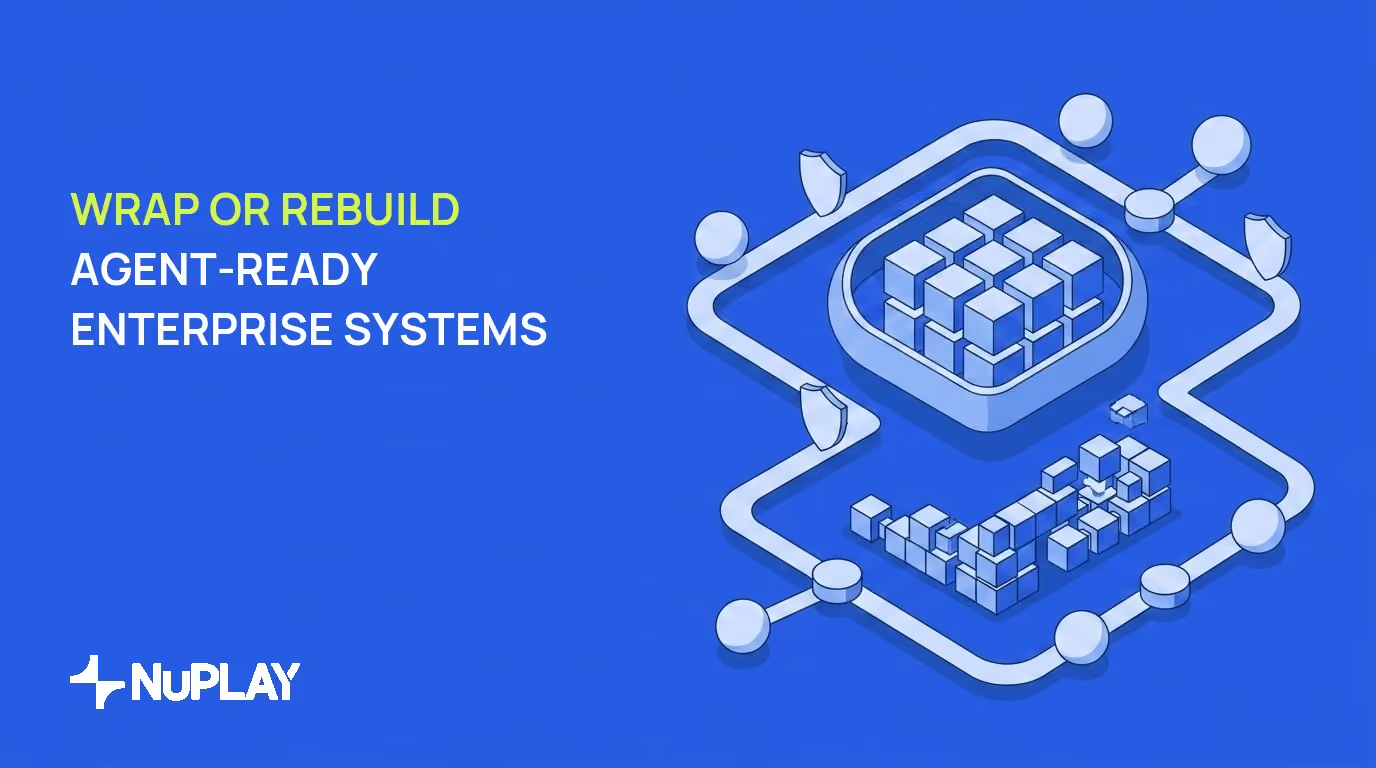

Agent ready systems expose structured, discoverable, predictable, and bounded interfaces that agents can use safely. Enterprises usually choose between wrapping legacy platforms with a governed facade or rebuilding them. The right path depends on risk, data readiness, and production orchestration with human approve-to-promote controls.
Legacy systems still block production agentic workflows because they were built for human screens or rigid APIs. Bain & Company's research, cited in K2View's analysis of data for AI agents, shows the biggest gap between pilot and production success for agentic AI is not model capability but the underlying infrastructure. Heads of AI, CTOs, and operations leaders in retail, insurance, financial services, collections, mortgage, and home services need a clear decision framework that weighs cost, stability, and governed improvement. This article supplies that framework, grounded in architecture patterns and the requirements for safe, repeatable execution.
What is an agent ready system?
An agent ready system exposes structured, discoverable, predictable, and bounded interfaces that agents can use safely alongside human users. Most enterprise systems fall short because they were designed for screen-based human interaction or fixed system-to-system calls. Those designs leave gaps in discoverability, error handling, and explicit governance that agents require before they can take real work in production.
What is the difference between AI and agentic AI?
Traditional AI systems generate recommendations, classifications, or content that a person or a fixed rule engine then acts on. Agentic AI goes further: it plans steps, calls tools, updates systems of record, and routes decisions inside a workflow while staying inside defined permissions. The difference is not the model alone. It is whether the surrounding systems give the agent structured work surfaces, clear tool contracts, and human review points so actions stay bounded.
How do enterprise operating modes relate to agent types?
Public taxonomies of agent types vary by vendor and research community. For enterprise buyers, the useful frame is simpler. Every task or decision runs in one of three modes: Human, Automated (fixed rules), or Agent (reasoning with tools). The goal is to move the right work into agent mode while keeping high-stakes decisions under human oversight. Capability labels such as reactive, goal-driven, collaborative, or learning agents only matter after those modes, permissions, and review gates are clear.
Enterprise systems must provide structured work surfaces, explicit governance, human review points, and orchestration for agents to participate safely in workflows, as AIS's technical analysis on agent-ready software explains. Without those elements, agents cannot operate within defined limits or hand off decisions at the right moments. Agent readiness is therefore an architecture, workflow, and governance challenge, not a feature bolted on after a pilot demo.
In practice, readiness means machine-readable schemas for the entities the agent must read and write, deterministic error contracts instead of free-text failure messages, identity for the agent as a first-class actor, and orchestration that can chain sub-workflows without silent side effects. If any of those pieces are missing, the system is not agent ready, even if an API exists on paper.
Why wrap existing systems instead of rebuilding from scratch
Wrapping adds a middleware or API facade layer that normalizes legacy operations into clean, deterministic endpoints without altering core code. This approach preserves the stability of the system of record while giving agents governed interfaces, such as Model Context Protocol servers. Sidecar or anti-corruption layer patterns further isolate agents through throttling, caching, schema validation, and explicit human review points before irreversible actions.
Rebuilding replaces the system entirely. That path carries high cost and time risk, plus the chance of losing undocumented business logic built over years of exception handling, edge cases, and operational workarounds. Teams often discover that the “simple” core system hides decades of policy nuance that only appears under load or during rare failure modes. A full rebuild can erase that hard-won behavior before agents ever reach production.
Wrapping legacy systems with an API facade or middleware normalizes operations into deterministic endpoints while preserving the system of record, as WSO2's technical guidance on connecting legacy systems to AI agents describes. The lower risk profile makes wrapping the default choice unless the existing architecture fundamentally blocks required agent behaviors or governance controls.
Use the criteria below when you choose a path. Apply the same criteria to each major system of record rather than forcing one answer across the entire estate.
Wrapping still demands engineering discipline. The facade must present task-sized tools, not raw screen scrapes. It must reject out-of-scope calls, emit structured errors, and log every agent action against a durable identity. When those controls are in place, agents interact with a predictable surface while the system of record continues to serve humans and batch jobs without a rip-and-replace program.
How NuStack makes systems agent-ready
NuStack is the Build layer that evaluates existing systems, selects the appropriate pattern (wrap, rebuild, or new build), and orchestrates the resulting workflow across nested sub-workflows. It does not treat agent readiness as a one-off integration ticket. It turns the wrap-or-rebuild decision into production tooling with clear ownership boundaries between build, execute, inform, improve, and monitor layers.
Concretely, NuStack exposes task-specific capabilities as tools with clear identity, task-level permissions, and time-bound access. Agents receive only the operations required for the current task, for only as long as that task runs. That design keeps blast radius small when a prompt, tool contract, or downstream system changes. The same layer coordinates how sub-workflows nest two to three levels deep so a customer, claims, or collections journey can mix Human, Automated, and Agent modes without losing an audit trail.
NuContext supplies three-tier memory (Organizational, Agent, and User) so agents draw on the right context without dumping entire enterprise data stores into a prompt. NuPro is the Execute layer. Its task-specific micro-agents, including voice and chat agents, are used across the workflows and applications that NuStack makes agent-ready and orchestrates. Improvements route through NuLoop's Report, Diagnose, Propose, Try, Ship cycle. Fixes are tested against real past runs with rollback paths, then held for human approve-to-promote sign-off before any change ships into production.
That approve-to-promote gate is non-negotiable for both wrapped and rebuilt systems. Wrapping without governed promotion still creates silent drift. Rebuilding without the same gate recreates the same risk on a new codebase. NuStack's role is to make the chosen pattern operable at enterprise volume: identity, tool contracts, orchestration, and a closed loop that diagnoses coverage gaps and ships governed change, not unsupervised edits.
When you assess a candidate workflow, ask NuStack-oriented questions early. Which systems must be wrapped versus rebuilt? Which tasks become tools? Which decisions stay Human? Which context tiers are required on each step? Which promotion owners sign off before a change reaches production? Those answers determine whether agent readiness is a durable operating model or a brittle pilot.
Data and governance requirements for production agent readiness
Minimum Viable Data (MVD) delivered via entity-centric data products ensures agents receive only accurate, current, contextual information needed for the task. MVD is not a data lake dump and not a full customer 360 by default. It is the smallest reliable set of entities, attributes, and relationship facts the agent must read or write to complete a defined unit of work. Entity-centric products keep those facts consistent across channels so an agent updating a claim, order, or mortgage file does not invent conflicting state.
Governance must assign agents first-class identity, scope permissions to the specific task, and insert explicit human review checkpoints for high-stakes decisions. Treat the agent like any other production actor: authenticated, authorized, logged, and limited. High-stakes steps such as fee waivers, coverage changes, payment plans, or irreversible account actions should require human approval paths that the orchestration layer cannot bypass. Time-bound credentials reduce standing privilege after a task ends.
HFS Research identifies data accessibility, governance, and process readiness as the largest blockers to enterprise-scale agentic AI deployment, as summarized in K2View's industry analysis, which also reports Bain & Company's finding that infrastructure, not model capability, is the primary pilot-to-production gap. Both findings point to the same operating conclusion. A wrapped facade or a rebuilt service fails in production when agents cannot reach trustworthy data, cannot prove who acted, or cannot follow a process that already works for humans and automation.
Structured work surfaces, machine-readable schemas, and orchestration patterns then enable multiple agents to operate together safely. Shared schemas prevent one agent from writing free-text where another expects an enum. Orchestration defines handoffs, retries, and compensation when a downstream system rejects a write. Observability ties each tool call to outcome metrics so operators can see volume, status, and failure modes without reading raw model traces.
Before you fund either wrap or rebuild work, validate four foundations:
- Entity coverage. The entities the agent must touch exist as maintained data products, not ad hoc extracts.
- Freshness and authority. Sources of truth are explicit, and stale copies are not exposed as tools.
- Permission model. Task-scoped roles exist for agents, separate from broad human admin rights.
- Review policy. High-stakes decisions have named human owners and enforceable checkpoints.
If any foundation is missing, fix it in parallel with interface work. Interface quality without data and governance quality only accelerates unsafe actions.
Common pitfalls when modernizing for agents
Treating agent readiness as simply adding APIs or a copilot UI ignores the need for usable work surfaces and explicit governance. An OpenAPI document on a legacy core does not make the system agent ready if payloads are ambiguous, errors are unstructured, side effects are hidden, or no identity model exists for non-human callers. Copilot chat over the same brittle surface often shifts failure from the integration layer into the conversation layer without reducing operational risk.
Assuming full rebuild is always superior overlooks the cost, risk, and potential loss of proven business logic. Rebuild programs stall when teams underestimate exception paths that only senior operators know. Meanwhile competitors who wrap stable cores with governed tools reach production earlier, collect run data, and improve coverage through a closed loop. Rebuild remains correct when the architecture cannot host required controls, but it is not a default badge of modernity.
Underestimating data accessibility and process readiness leaves agents without reliable context even after integration work. Teams celebrate connectivity while agents still guess at missing fields, act on stale caches, or follow process steps that no longer match how exceptions are handled on the floor. Process readiness means the human runbook, the automated rules, and the agent tools agree on the same states and outcomes.
Skipping feedback loops and observability prevents the governed improvement that distinguishes production systems from static deployments. Without Report, Diagnose, Propose, Try, and Ship stages, failures repeat. Without human approve-to-promote, “fixes” ship as unsupervised prompt edits. Without dashboards for status, volume, and outcome, leaders cannot tell whether agent mode is absorbing the right work or creating silent rework for staff.
Other frequent failure modes include exposing overly broad tools (“update account”) instead of task-sized tools (“apply documented hardship plan within policy limits”), omitting compensation logic when a partial write succeeds, and measuring success only by model scores rather than workflow completion and downstream exception rates. Enterprises that address these pitfalls early can move the right tasks into agent mode without destabilizing core operations.
Conclusion
Enterprises succeed when they evaluate wrap versus rebuild through the lens of risk, data readiness, and governed orchestration. Choose wrapping to preserve a stable system of record behind deterministic tools. Choose rebuilding only when the architecture itself blocks safe agent behavior. In both cases, Minimum Viable Data, first-class agent identity, human review checkpoints, and approve-to-promote controls decide whether pilots survive contact with production volume.
NuPlay runs enterprise workflows in production and improves them after every run through NuLoop, with agents, the systems they operate, and the context they draw on under one platform. Leaders ready to assess their own systems can talk to the team about NuStack and the specific workflows they need to move into production.