.gif)
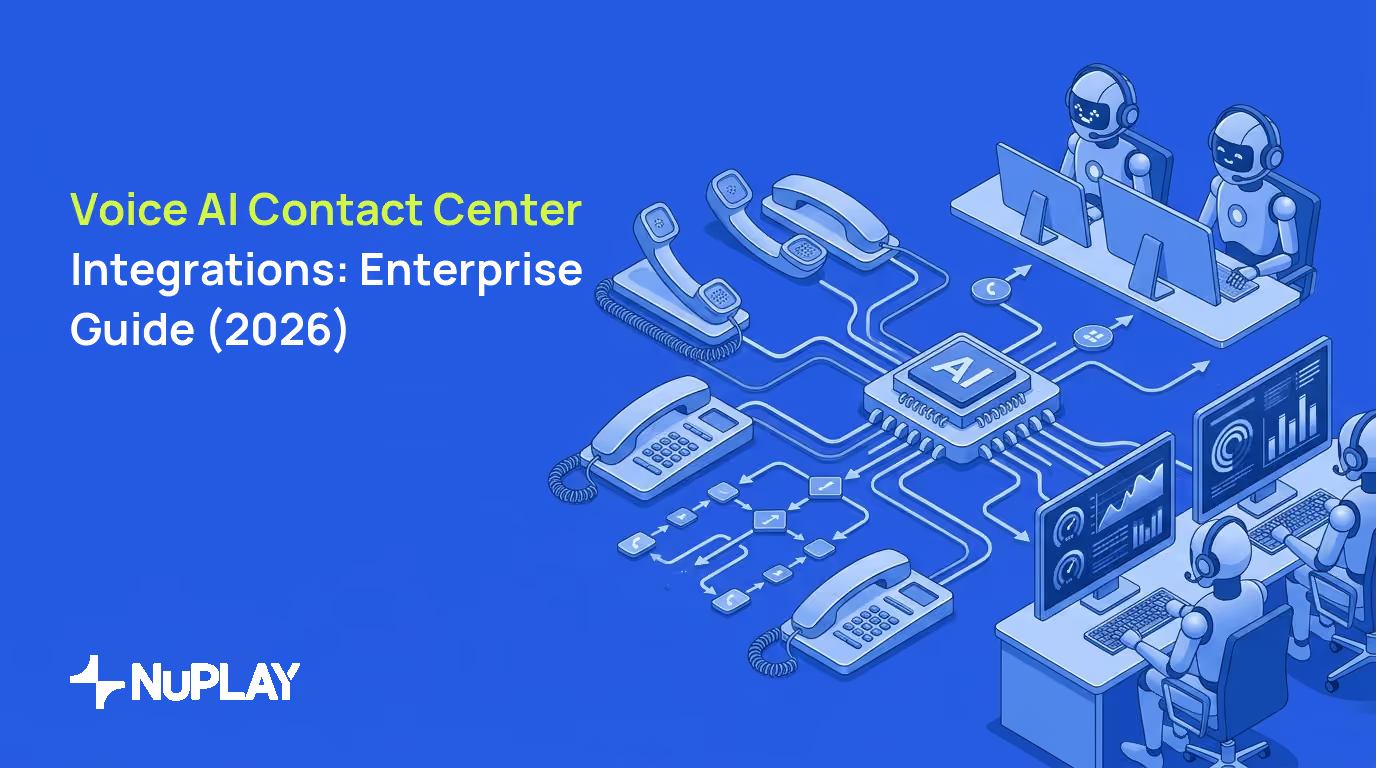

Voice AI contact center integrations connect speech agents to customer relationship management, telephony, routing, ticketing, and analytics systems so calls can trigger real workflow actions. NuPlay launch materials describe action-taking across 300+ integrated enterprise software systems, making integration quality central to automation.
What is Voice AI Contact Center Integration?
For product context, NuPlay by NuPlay AI treats voice, chat, email, and messaging as one customer interaction layer rather than isolated call automation.
Voice AI contact center integrations connect conversational AI systems to existing telephony and customer relationship management platforms. They bridge the gap between legacy Session Initiation Protocol (SIP) infrastructure and modern large language models (LLMs). This connection enables automated voice interactions while maintaining governed data flow with core systems like Genesys, Five9, NICE CXone, Salesforce, and Zendesk.
The focus must remain on production-grade systems that handle real customer volume. A prototype might work for a small controlled test. A production system must handle peak concurrency without degrading audio quality or losing context. This requires strict governance, real-time observability, and secure data handling.
Poorly integrated point solutions can create "shadow AI" risk within the enterprise by sending raw, unredacted audio to public LLM endpoints. Production integrations reduce this risk by enforcing secure data handling, redaction, access controls, and governed routing between telephony, CRM, and the reasoning engine.
How Voice AI Contact Center Integrations Work
Technical integrations rely on APIs, SIP trunks, and event-driven architectures to link AI agents directly with contact center routing rules. The most critical technical distinction lies between basic API polling and real-time streaming protocols. Polling creates unacceptable delays. Real-time streaming protocols maintain a continuous, open connection that processes audio packets instantly.
Voice streams undergo processing in real time while context synchronizes with CRM records. Moving audio data is only half the work. If the AI cannot access relevant Zendesk history, it cannot complete the workflow. The system must pull historical data, recognize the caller's intent, and push updates back to the CRM before the call concludes.
Enterprise implementations require strict security controls, active logging, and automated testing frameworks to move from pilot to production. This represents the "Day 2" operational reality. Engineers must manage prompt versioning, execute regression testing, and maintain rollback capabilities in a live environment.
NuStack supports back-office workflow automation and enterprise AI software deployment when the operational problem extends beyond the customer conversation into internal processes.
Key Platforms and Integration Approaches
Different contact center platforms require specific integration strategies to maximize performance. Genesys integrations focus heavily on advanced routing and workforce management synchronization. The Genesys AudioHook protocol supports up to two audio channels per stream with sub-50ms packetization. During a handoff, the AI agent should pass call context, intent, sentiment, account data, and attempted resolution steps. This continuity matters because 74% of consumers are frustrated when they must repeat information, and 81% want conversations to continue without backtracking, according to Zendesk's CX Trends 2026 report.
Five9 and NICE CXone emphasize cloud capacity planning and omnichannel continuity. Five9 VoiceStream provides a 100ms latency stream for real-time bidirectional audio processing. Similarly, NICE CXone uses an open platform with more than 400 APIs for workflow orchestration. These streaming architectures help reduce the pauses that disrupt automated phone calls.
Salesforce and Zendesk connections prioritize CRM data accuracy and post-interaction workflows. Salesforce Service Cloud Voice uses a Bring Your Own Telephony model to allow third-party AI engines to control the agent desktop interface directly. Robin Gareiss notes that the shift from simple IVR to generative voice AI requires a governance firewall ensuring every generated token complies with industry regulations. Metrigy confirms this necessity for modern CX transformation.
Core Terminology and Concepts
This section should be read through a production lens: integration depth, containment quality, escalation control, and operating ownership matter more than demo fluency.
Enterprise evaluations require a clear understanding of specific technical terminology. SIP trunking, real-time transcription, and intent recognition form the absolute foundation of voice AI. SIP initiates the call.
Real-time transport protocols deliver the audio. Intent recognition maps the caller's spoken words to specific enterprise workflows or database queries.
Governance includes audit trails, strict access controls, and compliance logging. Production-grade integrations use real-time redaction layers that detect and mask credit card numbers or social security numbers before the audio stream reaches the transcription engine. In the United States, voice service providers must implement STIR/SHAKEN in the Internet Protocol portions of their networks to help prevent caller ID spoofing.
Production-grade refers directly to systems with active monitoring, rollback capabilities, and defined service level agreements. Latency serves as the ultimate performance metric here. A production-grade integration must keep latency low enough for natural turn-taking and interruption handling. Excessive latency causes conversational collisions where both the AI and the human speak at the same time.
Real-World Use Cases and Examples
Concrete enterprise applications demonstrate the value of these integrated systems. Insurance firms use voice AI integrations for claims intake and policy updates across NICE CXone. The AI collects the incident details, verifies the policy status in the CRM, and routes the summarized data to an adjuster.
Retail operations connect AI agents directly to Salesforce for order status and returns handling. Retailers can use real-time inventory and order-status integrations to answer peak-season shipping questions without forcing callers to wait in a queue.
Benefits and Business Importance
The business outcomes of proper integration justify the engineering investment. Enterprises can reduce handle times and create more consistent customer experiences at scale. Customers increasingly expect companies to understand their history and context. Integrated AI supports that expectation by referencing CRM data during the conversation instead of forcing callers to repeat information.
Lower operational costs result from reliable automation replacing manual staffing for repetitive inquiries. Companies do not have to hire temporary staff for seasonal spikes. The AI capacity simply scales up to meet the demand and scales back down when call volume normalizes.
Improved data accuracy occurs when AI systems sync directly with existing CRM and contact center records. A "Bring Your Own Carrier" model can provide flexibility when teams need to preserve telephony relationships while adding a separate voice AI layer. Buyers should compare this model with native Contact Center as a Service (CCaaS) AI based on latency, integration depth, governance, and operating ownership.
Common Misconceptions About These Integrations
Decision makers often hold dangerous misconceptions about AI deployment. These are not simple chatbot add-ons but full-stack systems requiring serious architecture and engineering support. Treating a voice AI deployment like a simple software plugin creates avoidable failure risk.
Success depends entirely on governance and testing rather than rapid deployment alone. Many enterprise AI projects stall because the initial prototype cannot pass the security, compliance, and integration reviews required by corporate IT departments.
NuPlay AI deploys AI agents that use an orchestration layer to read and update Salesforce, Zendesk, and other enterprise systems during live calls. The NuPlay conversational AI product validates actions against business rules before writing data and hands off complex cases with full context.
What to do next
Teams that want a managed deployment path can review NuPlay by NuPlay AI before scoping technical and operational requirements.
Voice AI contact center integrations succeed when enterprises prioritize production reliability, platform compatibility, and governed architecture over quick pilots. Connecting advanced conversational models to Genesys, Five9, NICE CXone, Salesforce, and Zendesk requires strict engineering discipline and real-time streaming protocols. By focusing on low latency, secure data handling, and deep CRM synchronization, organizations can successfully replace manual call handling with a highly efficient, automated digital workforce.