.gif)
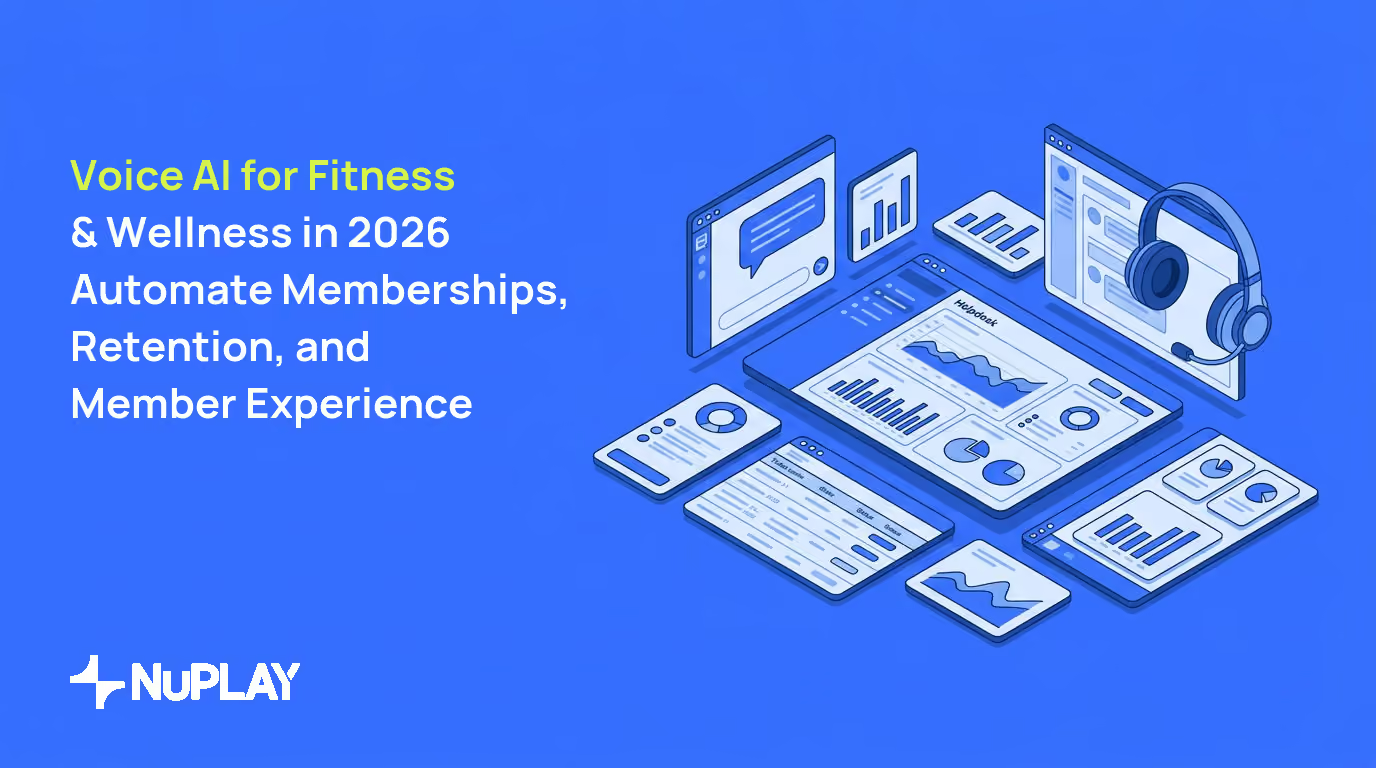

Voice AI for fitness and wellness automates membership calls, retention outreach, class scheduling, and billing workflows for gyms and studios. The core problem it solves is churn: without proactive outreach, monthly membership losses compound into annual attrition that manual teams cannot consistently prevent at scale.
The fitness industry in 2026 faces a structural paradox: demand for gym memberships and wellness services keeps rising, yet the operational infrastructure supporting that demand remains manual, labor-intensive, and prone to failure at scale. Without proactive retention outreach, membership attrition erodes revenue faster than new enrollment can replace it, a structural problem that scales with location count and cannot be solved by adding front-desk staff alone.
Three-quarters of customers now expect consistent cross-channel service, and two-thirds of millennials expect real-time responses, according to McKinsey's 2023 customer-service research. Fitness operations face this expectation with membership desks that are frequently understaffed during peak inquiry hours. Voice AI fitness wellness solutions offer enterprise-grade automation for membership sales, qualification, retention outreach, and billing resolution at volumes no human team can sustain.
The platforms driving this transformation are not basic IVR menus or scripted phone-tree systems. They are full-stack conversational AI systems that integrate directly with CRM platforms, scheduling engines, billing systems, and member databases. Leading voice AI platforms for business now deliver the integration depth that fitness enterprises require to automate high-value workflows end to end. Operators should validate ROI against their own missed-call, booking, attendance, and cancellation baselines before forecasting impact.
What Is Voice AI for Fitness & Wellness?
Voice AI for fitness and wellness is a conversational AI system that handles member-facing phone calls for gyms, studios, and wellness brands, automating joins, cancellations, class scheduling, billing questions, and proactive retention outreach. Unlike IVR menus, it understands natural language, pulls live data from fitness back-offices such as Mindbody and ABC Fitness, and completes multi-step tasks without a human on the line.
Quick Verdict: Voice AI is strongest for high-volume, repeatable fitness workflows such as joins, cancellations, save-offer calls, billing follow-up, and class reactivation. Treat vendor ROI claims as pilot hypotheses, then measure missed-call recovery, trial bookings, churn movement, and staff time saved against your own baseline.
Current State of Voice AI in Fitness Wellness
The fitness industry reached a significant inflection point as demand expanded beyond traditional gym memberships into broader health, wellness, and service experiences. Statista's health and fitness club data lists the US market size at $147.11 billion in 2024, but that scale also exposed operational fault lines.
Many facilities built their membership models around manual processes: phone-based enrollment, in-person tours, and paper-based onboarding. Those workflows worked adequately at lower volumes but struggle under modern demand. The gap between member expectations and operational capacity has become a major drag on revenue growth in the sector.
Why Manual Processes Cannot Keep Up
Membership teams at mid-size and large fitness facilities are structurally unable to keep pace with inquiry volumes during peak enrollment periods. January and September enrollment surges create more phone, form, and tour requests than many front desks can handle during staffed hours. Each missed inquiry represents a prospect who may contact a competitor within minutes.
Retention calls, the proactive outreach to at-risk members that operators widely acknowledge as critical, get systematically deprioritized because front-desk staff are occupied with walk-ins, class check-ins, and billing inquiries. Manual onboarding workflows introduce friction at precisely the moment when a prospect's enthusiasm is highest. The fundamental problem is that the labor model underlying fitness operations does not scale linearly with demand; adding locations or members usually requires proportional headcount increases that erode margins.
Rising Consumer Expectations
Voice AI entered this gap in 2026 at a moment when consumer expectations were shifting rapidly upward. McKinsey's 2021 personalization research found that 71% of consumers expect personalized interactions and 76% get frustrated when that does not happen. For fitness operators, this means members now expect the same responsiveness from their gym that they receive from e-commerce and retail.
This shift creates pressure on fitness operations to deliver personalized, always-available service experiences that match what consumers encounter in retail, banking, and healthcare. Enterprise voice AI platforms automate the initial member interaction, the qualification workflow, and the retention outreach sequence at volumes and consistency levels that human teams cannot match.
Fitness chains evaluating voice AI for membership qualification should treat automation rate as a pilot metric, not a fixed benchmark. The practical target is straightforward: free experienced staff to concentrate on high-value activities like personal training consultations, group fitness programming, and the in-person community building that ultimately drives long-term retention. The AI handles repetitive, high-volume transactional work that can burn out front-desk employees and produce inconsistent results when performed manually at scale.
Advances in Human-Like Voice Technology
Earlier generations of voice automation failed in fitness environments for reasons that are instructive. Gym floors are acoustically hostile spaces: ambient music, clanking weights, group fitness instructors on microphones, and members conversing all create background noise that confounds basic speech recognition systems.
Beyond the acoustic challenges, fitness conversations are emotionally complex in ways that scripted IVR trees cannot handle. A prospect calling about membership pricing might pivot mid-sentence to ask about childcare availability or express anxiety about committing to a long-term contract. Understanding what conversational AI is and how it works helps explain why the 2026 generation of voice AI platforms is meaningfully different from older phone automation.
Sub-Second Latency and Natural Turn-Taking
The 2026 generation of voice AI platforms addresses these challenges through a combination of low-latency inference, advanced noise cancellation, and natural turn-taking algorithms that mimic human conversational patterns. NuPlay's voice agents prioritize sub-second response latency, interruption handling, overlapping speech, and topic shifts. When a prospect asks about class schedules mid-conversation while the AI is describing membership tiers, the system should adjust context, answer the scheduling question, and return to the original topic without losing coherence.
Emotion Detection in Fitness Conversations
Emotion detection capabilities have become particularly valuable in the fitness context because the conversations themselves carry significant emotional weight. A member calling to cancel a membership might be frustrated about a billing error, anxious about an injury that prevents them from exercising, embarrassed about not having visited in months, or simply experiencing financial stress. Voice AI systems equipped with real-time sentiment analysis can detect these emotional states through vocal cues, pitch variation, speaking pace, and word choice, then adjust their responses accordingly. An agent that recognizes frustration can shift to a more empathetic tone, acknowledge the issue directly, and offer concrete resolution options before escalating to human staff.
Grounding Responses in Real Data
Perhaps the most operationally significant advancement is the ability to ground AI responses in live system data rather than static scripts. When a voice AI agent tells a prospect that a 6 PM yoga class has three spots remaining, that statement reflects a real-time query against the facility's scheduling system, not a best guess or a cached response from hours ago. This accuracy matters enormously in fitness operations, where class capacities change by the minute and membership pricing can vary based on promotional windows, contract terms, and location-specific offers. Members and prospects who have been frustrated by outdated information from overwhelmed front-desk staff find the precision of AI-driven responses genuinely refreshing, and that precision builds the kind of operational trust that supports long-term retention.
Multi-modal reasoning capabilities extend the scope of what a single voice conversation can accomplish. A modern voice AI agent can discuss membership tiers in detail, pull up a member's contract to review billing history, process a payment or plan change, and book a trial session or personal training consultation, all within one continuous conversation. The operational advantage comes from embedding voice AI into the full member journey, from first inquiry through ongoing engagement, rather than treating phone automation as a standalone channel.
Connected Integration with Fitness Ecosystems
Voice AI delivers enterprise-grade value only when it operates as a fully connected node within the fitness organization's technology ecosystem. Standalone voice tools that cannot read from or write to the systems of record create data silos, introduce manual re-entry steps, and ultimately generate more operational friction than they eliminate. The integration layer is what separates a novelty from a strategic capability.
CRM and ERP Connectivity
Enterprise voice AI platforms connect directly to CRM and ERP systems so that every interaction produces immediate, accurate updates in the membership database. When a voice agent qualifies a new lead, capturing their contact information, preferred location, membership tier interest, class format preferences, and trial visit availability, that data flows into the sales pipeline tagged and categorized for follow-up. For chains running Mindbody, ClubReady, or ABC Fitness as their management platform, this means AI-qualified leads appear in the sales dashboard with complete context, ready for the next step in the conversion funnel. The elimination of manual data entry removes both the time delay and the inconsistency that can plague hand-keyed CRM records.
Workflow Orchestration for Complex Processes
Membership lifecycle processes are rarely single-step transactions, and workflow orchestration capabilities allow voice AI to manage sequences that would otherwise require multiple staff touchpoints. A renewal conversation might involve verifying the member's plan, checking payment status, reviewing attendance history, presenting an offer, processing payment, and scheduling a follow-up check-in.
Enterprise platforms capture insights from these conversations and feed structured data back into retention strategy models. Platforms like Gymdesk and ABC Fitness offer analytics integrations that help operators correlate conversation outcomes with downstream retention metrics.
Data Compliance for Wellness Information
Compliance requirements add a critical layer of complexity for fitness enterprises that handle sensitive wellness or health-related data. Organizations offering medically supervised fitness programs, physical therapy partnerships, or wellness coaching that touches on health conditions must navigate regulatory frameworks that extend beyond standard commercial data handling.
Organizations handling protected health information should review AI voice agent compliance frameworks including SOC 2 and HIPAA. Hybrid deployment architectures can keep sensitive health data on-premises while routing non-sensitive conversational workflows through cloud infrastructure.
The depth of system integration is ultimately what distinguishes enterprise voice AI platforms from consumer-grade tools. A gym deploying a scripted phone tool can answer scheduling questions and provide facility hours. An enterprise deployment automates the full membership lifecycle, from initial inquiry through qualification, enrollment, onboarding, ongoing engagement, retention intervention, and renewal, while logging every interaction as structured data that informs future operational decisions.
Proven Impact on Membership Automation
Membership sales represent the area where voice AI delivers the fastest and most measurable return on investment, because the top of the sales funnel is precisely where manual processes lose the most revenue. McKinsey's 2023 analysis of generative AI in marketing and sales estimates that a fifth of current sales-team functions could be automated. NuPlay automates lead qualification through to sign-up completion, capturing revenue that would otherwise be lost to operational bottlenecks.
Implementation Pattern: After-Hours Lead Capture
After-hours lead capture is one of the clearest fitness use cases because prospects often call outside staffed desk hours. A voice AI agent can qualify leads by asking about fitness goals and preferred membership types, answer approved questions about amenities, and book trial visits directly into the scheduling system. The measurable outcome should be tracked through missed-call rate, trial bookings, show rate, and conversion rate rather than assumed from vendor benchmarks.
Implementation Pattern: At-Risk Member Outreach
At-risk member outreach is strongest when it uses attendance data rather than generic "we miss you" scripts. A voice AI workflow can identify members who have stopped attending, reference the classes or amenities they previously used, and suggest a concrete next action such as reserving a spot in an upcoming session. The measurable outcome should be tracked against control groups: attendance recovery, cancellation requests avoided, save-offer acceptance, and churn movement over several billing cycles.
Instant Response and 24/7 Coverage
The speed-to-response advantage of voice AI matters in an industry where prospect intent can fade quickly. Voice AI can reduce the delay between a web form, missed call, or referral inquiry and the first follow-up conversation. A prospect who fills out a web form at 11 PM can receive a callback while interest is still fresh, before they move on to researching competitors. AI concierges handle virtual tours, trial class scheduling, and initial payment questions with minimal hold time, removing common friction points during enrollment.
Outbound Retention at Scale
Outbound retention calling is where voice AI can deliver its most meaningful impact, because proactive retention outreach is a powerful lever for reducing churn and one that many operators are not equipped to execute manually. Attendance frequency is a documented predictor of retention, so operators should use their own cohort data to identify the visit threshold below which members are most likely to cancel. Voice AI scales this outreach without proportional headcount, reaching members identified by attendance data rather than only those a human team has time to contact.
The more defensible operating principle is to intervene earlier: use attendance decline, billing issues, and missed classes to trigger re-engagement before the member has fully decided to cancel.
Retention Strategies Powered by Voice AI
Retention economics in the fitness industry are unambiguous: operators have more control over member lifetime value when they keep existing members engaged than when they rely only on new acquisition. Companies that excel at personalization generate 40% more revenue from those activities than average players, according to McKinsey's 2021 personalization research. For fitness operators, this means proactive, personalized retention outreach directly affects member lifetime value.
Proactive Billing Resolution
Involuntary churn from billing failures represents one of the most preventable forms of member attrition, yet it accounts for a meaningful share of monthly cancellations at many facilities. When a member's credit card expires, their bank declines a charge, or they switch accounts without updating payment information, the membership enters a failure state that many facilities handle with automated emails that go unread. Voice AI transforms this process by reaching out proactively after a payment decline, engaging the member in a conversation that identifies the issue and resolves it in real time, updating the card on file, adjusting the billing date to align with the member's pay cycle, or arranging a brief pause rather than a cancellation.
Personalized Re-Engagement
Generic "we miss you" emails perform poorly because members recognize them as mass communications and ignore them accordingly. Voice AI enables re-engagement outreach that is genuinely personalized, drawing on the member's attendance history, class preferences, and engagement patterns to construct outreach that feels relevant rather than formulaic.
A check-in call might say: "We noticed you haven't visited in two weeks. We just added a new HIIT class on Thursdays at 7 PM that matches your workout history. Want me to reserve a spot?" That level of context demonstrates knowledge of the member's preferences in a way that mass communications cannot replicate.
The personalization extends beyond class recommendations. Voice AI can reference a member's progress toward fitness goals they discussed during onboarding, remind them about amenities they expressed interest in but haven't tried, or simply acknowledge their absence in a way that communicates attention rather than algorithmic nudging.
Intelligent Escalation
Not every member interaction can or should be resolved by an AI agent, and the intelligence of the escalation process determines whether complex cases are handled well or badly. When a member expresses frustration about a billing error or vocal cues indicate emotional distress, the AI should transfer the call to a staff member with a complete conversation summary.
The staff member sees the member's account status, the nature of the complaint, the emotional tone of the conversation, and any resolution attempts the AI already made. This context-rich handoff prevents the member from repeating their story and helps staff resolve escalated issues faster.
Measurable Retention Outcomes
The aggregate impact of these retention strategies should be measured across multiple dimensions: class bookings from reminder sequences, attendance recovery among inactive members, save-offer acceptance, billing recovery, and monthly churn movement. Because class attendance is closely tied to long-term retention, operators should evaluate voice AI against attendance and churn cohorts rather than relying on vendor-wide averages. Voice AI changes retention economics when it lets teams reach more at-risk members without building a dedicated outbound call center.
What This Means for Fitness Enterprises
The implications of voice AI adoption extend beyond individual workflow improvements to reshape the operating model of fitness businesses at a structural level. The technology does not merely automate existing processes; it enables operational architectures that were previously impossible given the economics of human labor in a thin-margin industry. Cost reductions achieved through automation free budget for the investments that actually differentiate a fitness brand, coaching quality, facility improvements, programming innovation, and community development.
Scaling Without Proportional Headcount
The traditional scaling model for fitness chains requires roughly proportional headcount increases with each new location: front-desk staff, membership consultants, retention specialists, and billing support for every facility. Voice AI changes that model by centralizing routine member interactions across locations.
A 20-location chain does not need 20 separate front-desk teams covering evening and weekend shifts when a centralized AI system handles after-hours calls, qualification inquiries, and retention outreach. Gartner projects that by 2028, at least 15% of day-to-day work decisions will be made autonomously through agentic AI systems, up from 0% in 2024. For fitness enterprises, this means centralized AI voice systems can absorb routine inquiry and retention call volume across multiple locations without proportional increases in front-desk headcount.
Data-Driven Retention Intelligence
Every voice AI interaction generates structured data that accumulates into an operational intelligence asset over time. Across thousands of conversations, patterns emerge that no amount of manual call logging could surface: which specific objections correlate most strongly with eventual cancellation, which retention offers produce the highest save rates for different member segments, which time slots generate the highest inquiry volume relative to staffing coverage, and which conversation framings most effectively re-engage dormant members. This data transforms retention from an art practiced by experienced managers into a discipline informed by statistically significant evidence, enabling continuous optimization of scripts, offers, timing, and escalation thresholds based on measured outcomes rather than intuition.
Operational Reliability
Enterprise-grade voice AI platforms provide operational reliability that human teams structurally cannot match during demand spikes. During January's New Year enrollment surge or September's back-to-school peak, AI systems scale automatically to handle two to three times normal call volume without the scramble of hiring, training, and managing temporary staff who perform inconsistently and leave after the surge subsides. This reliability extends to holiday coverage, late-night hours, and weekend shifts, time periods when staffing costs are highest and availability is lowest, but when a significant portion of prospect inquiry volume occurs.
Voice AI automates the repetitive, high-volume transactional work that dominates fitness operations so that human staff can concentrate on coaching, community building, and the in-person experiences that fundamentally drive member loyalty. The technology does not replace the human element in fitness; it removes the administrative burden that prevents staff from delivering on it. For a detailed analysis of the financial mechanics, see how enterprises reduce customer support costs with AI.
Related Reading
Conclusion
The fitness industry's core operational challenges, high inquiry volumes, persistent churn, thin margins on memberships, and chronic staffing shortages, create conditions that are well suited to voice AI automation. The technology is mature enough to evaluate through controlled pilots that measure missed-call recovery, booking rates, billing recovery, escalation quality, and churn movement against a real operating baseline. Enterprises that deploy voice AI for membership automation and retention can build structural advantages in cost efficiency, member experience quality, and data-driven decision-making that compound over time as the AI systems learn from each interaction and refine their performance.
The operators still relying entirely on manual processes for lead qualification, retention outreach, and billing resolution will find it progressively harder to compete as member expectations for instant, personalized, always-available service continue to rise. The question for fitness enterprise leaders is not whether voice AI will become standard operating infrastructure for the industry, the trajectory is clear, but whether their organization will be among those that capture the early-mover advantages in retention rates, operational margins, and member lifetime value, or among those that adopt later at higher cost and from a weaker competitive position.