.gif)
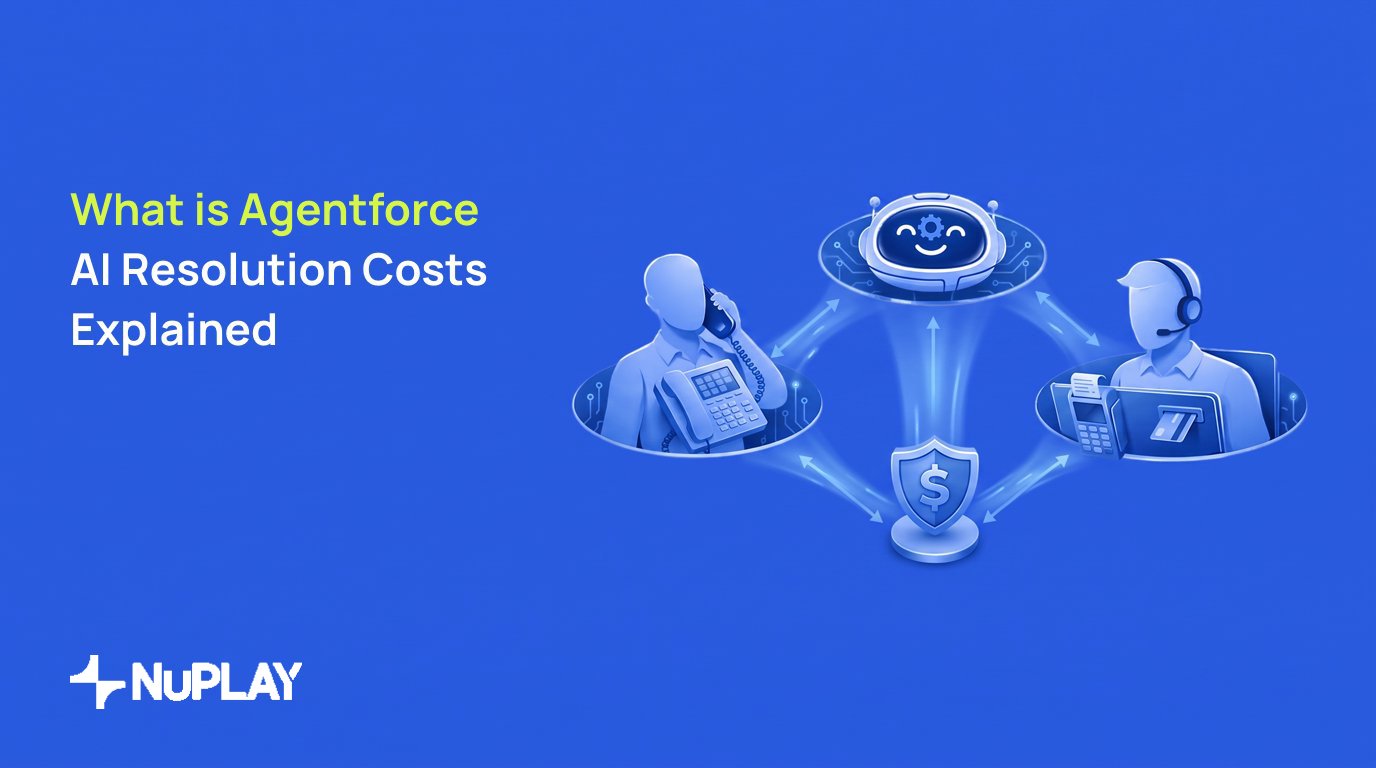

Agentforce is an AI agent platform built natively into Salesforce that uses its reasoning engine to execute business tasks across sales, service, and marketing. It is priced per resolution rather than per seat, which makes the cost of an AI answer a procurement question rather than a licensing one.
This guide explains core concepts, mechanisms, and cost considerations to support informed decisions on production deployments. It contrasts CRM-native tools with self-improving platforms that diagnose and fix their own failures. Operations leaders must look beyond initial setup and consider long-term reliability. This guide covers how these systems run in production and what an AI resolution actually costs.
What Is Agentforce
Agentforce is an AI agent system designed for enterprise task automation within the Salesforce ecosystem. It focuses on handling repeatable workflows across customer and operations domains. The platform emphasizes agent-driven execution with human oversight options, using the Einstein Trust Layer for data masking and toxicity detection.
The difference between Einstein and Agentforce is significant. Einstein acts as a predictive and generative layer for assistants. Agentforce is an autonomous platform powered by the Atlas Reasoning Engine that plans and executes multi-step workflows. However, deploying a CRM-native agent introduces prompt debt. Organizations face a hidden maintenance burden as thousands of custom prompts must be manually updated to reflect changing business logic.
How Agentforce Works
Agents execute tasks using predefined models and context layers. Workflows run in human, automated, or agent modes with approval gates. Reasoning engines combine models, data, business logic, events, and workflows into unified cognitive architectures, acting as fast inference time System 2 reasoners.
However, static configuration relies on manual updates via an Agent Builder. This creates vulnerability to agentic drift. Agentic drift is the gradual degradation of an AI agent's performance in production as underlying data or business requirements evolve. This drift causes a projected measurable degradation in task success over extended runs and rising human intervention requirements within months of deployment.
To counter this, NuStack makes legacy systems agent-ready and orchestrates the end-to-end workflow. It solves the integration friction common in CRM-centric platforms by providing a dedicated build layer.
Key Concepts and Terminology
Clear terminology prevents costly procurement mistakes. AI resolution refers to tasks completed from start to finish without human intervention. Agent mode describes autonomous execution within defined boundaries. The Model Context Protocol (MCP) serves as the emerging standard for connecting agents to external data sources without custom API work.
Feedback loops enable diagnosis, proposal, and governed updates. A static system requires developers to rewrite code when rules change. A self-improving platform uses a closed feedback loop to watch every agent run. It ships validated fixes back into the other layers through a strict Report, Diagnose, Propose, Try, Ship sequence. This process relies on human approve-to-promote sign-off, ensuring that no change ships to production without enterprise consent.
Examples and Use Cases
Retail operations use agents for order processing and returns handling. When a customer requests a refund, the agent verifies the purchase, generates the shipping label, and updates inventory. Insurance and financial services apply agents to claims and account queries. NuPlay AI's NuPro provides the execution layer for these orchestrated workforces, offering a self-improving alternative to static agent execution. It uses task-specific micro-agents, including voice and chat, built on proprietary Astra and SEAL models.
Collections and mortgage workflows apply agents for status updates and documentation. In these high-volume repeatable workflows, voice is proof of execution capability, not the identity of the platform itself. The ability to handle a live, multi-turn voice interaction proves the underlying orchestration is sound.
Benefits and Importance
Agentic systems support the scaling of repeatable processes while maintaining control. They enable the shift of suitable work into agent mode for efficiency. By the end of 2026, 40% of enterprise applications will feature task-specific AI agents. This shift sets new standards for human-agent teamwork.
These platforms provide visibility through status, volume, and outcome tracking. NuPulse, NuPlay AI's monitoring layer, provides the real-time status and outcome monitoring required to validate orchestration efficiency. In 2026, the metric that matters is Orchestration Efficiency (OE). This is the ratio of successful multi-agent tasks to total compute cost, moving beyond simple deflection rates.
Common Misconceptions
A major misconception is that Agentforce operates fully autonomously without sign-off. It functions as one component within broader enterprise systems and requires manual configuration. Another error is assuming a platform gets better on its own. It improves only where something diagnoses what failed, widens coverage, and ships a governed change.
Many enterprises fall into the Say-Do Gap. According to a March 2026 survey of 650 technology leaders, 78% of enterprises run an agent pilot while only 14% have scaled one to production, and governance friction is a leading blocker. NuLoop is the core differentiator that enables run-over-run improvement. This closed feedback loop addresses the performance drop caused by agentic drift, contrasting sharply with static deployments that degrade as the business changes.
Here is a side-by-side comparison of CRM-native agents versus self-improving platforms.
AI Resolution Costs
Costs depend on volume, complexity, and integration requirements. Salesforce's pay-per-resolution model was reported at USD 2 per autonomous resolution at launch, but only if the user's question does not need a human escalation.
This creates a resolution tax paradox. Per-resolution pricing models may inadvertently discourage agents from solving complex, multi-turn problems if the resolution definition is too narrow. This leads to higher human escalation rates for non-standard queries. Enterprises must evaluate total ownership, including monitoring and updates. When reviewing these systems, the focus must remain on decisions, governance, and delivery risks.
Cost per resolution is only half the question; the other half is what the platform does with a failed one. In production with Cult.fit, agent-led support reached a 95% issue resolution rate, and the resolutions that failed fed back into the next run.
Conclusion
Understanding what Agentforce is and how resolution costs work supports the evaluation of production-ready agent platforms. While CRM-native tools offer deep integration, they require heavy manual maintenance to combat agentic drift. NuPlay AI runs enterprise workflows in production and improves them after every run through NuLoop. By keeping agents, the systems they operate, and the context they draw on under one platform, enterprises can move the right work into agent mode securely. Book a demo to see how a self-improving platform handles high-volume repeatable workflows without the hidden costs of prompt debt.