.gif)
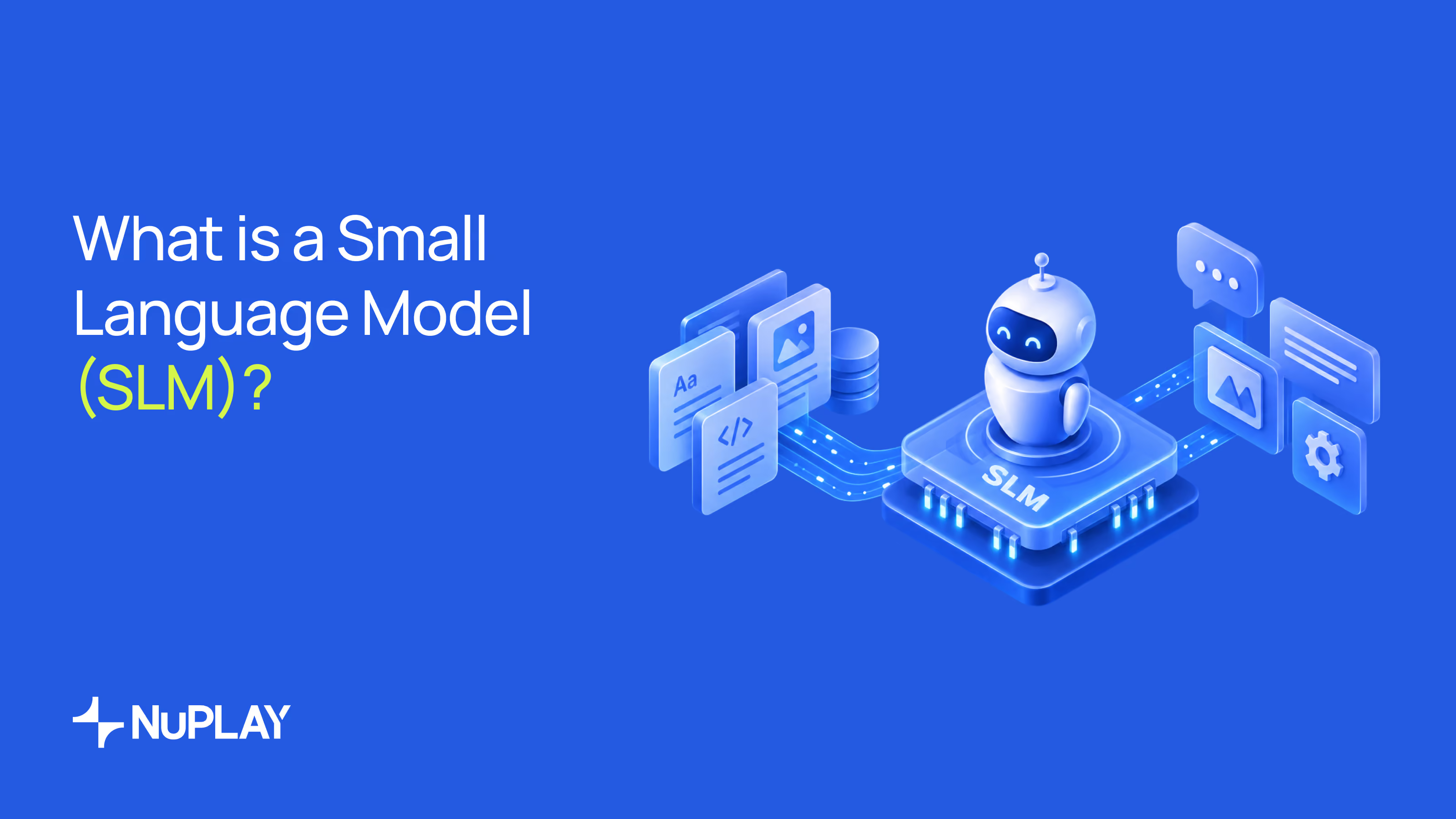

If you ask most enterprise buyers what powers their voice agent, they'll point to one model doing everything - understanding the caller, checking policy, deciding what to say next. It sounds efficient. It usually isn't.
The real question isn't how big your model is. It's whether the model behind every customer interaction is built for that interaction, or just big enough to handle it eventually.
That's the question small language models answer.
What is an SLM?
A small language model is a language model trained to do a specific job well, instead of trying to know everything.
Where a large language model is built for breadth - general knowledge, open-ended reasoning, any topic you throw at it - a small language model is built for depth on a narrower set of tasks. Fewer parameters, sharper focus, trained on the kind of language and decisions a specific business actually deals with.
Both use the same underlying architecture. The difference isn't in how they're built - it's in what they're built for. An LLM is trained to be useful across almost anything. An SLM is trained to be excellent at a defined set of things, and nothing else.
Think of it less as a smaller version of a big model, and more as a specialist instead of a generalist.
Key characteristics of an SLM
Compared to a large, general-purpose model, a small language model typically offers:
- Faster response times, since there's less to compute per request
- Lower infrastructure requirements, making in-house or on-premise deployment realistic
- Easier fine-tuning, since a narrower scope means less to retrain
- Tighter data control, since it's built to run entirely within a business's own environment
- Consistent behavior on the tasks it's trained for, since it isn't stretching to cover unrelated ground
None of this makes an SLM "weaker." It makes it purpose-built.
SLM vs LLM: what's actually different
Neither is "better" in the abstract. An LLM's breadth is the point when the task genuinely needs it. But most enterprise voice interactions aren't open-ended - they're the same handful of intents, questions, and decisions, repeated thousands of times a day. That's exactly the shape of the problem an SLM is built to fit.
Why enterprises are moving this direction
Three reasons keep coming up in conversations with CX and ops leaders:
Cost predictability. A model trained specifically for your business doesn't waste capacity reasoning about things it'll never be asked. That translates to better AI economics at scale - budgets that hold up as usage grows, instead of scaling unpredictably with every conversation.
Data control. A smaller, focused model is easier to run entirely within your own infrastructure. Customer conversations don't have to leave your environment to get answered.
Fit for the job. Trained on how your business actually talks to customers - your policies, your products, your edge cases - a specialized model handles the real shape of your call volume better than a generalist ever will, because it was never trying to be a generalist in the first place.
How SLMs fit into a voice agent architecture
Most mature enterprise AI setups don't pick one model type and stop there - they combine them, each doing what it's suited for.
A useful way to think about it: a larger model can plan and reason through something genuinely open-ended, while smaller, specialized models handle the high-volume, well-defined work - understanding intent, checking a policy, retrieving an account detail, deciding the next step in a known workflow.
That division of labor is what makes a voice agent feel fast and consistent at scale, rather than routing every single turn of conversation through a model built to reason about anything.
Where SLMs make the most difference
Some of the clearest wins show up in:
- Intent understanding - recognizing what a caller actually needs, quickly and consistently
- Policy and compliance checks - applying a business's specific rules without drift
- Routing and escalation decisions - knowing when a query needs to move to a human or a broader model
- Repetitive transactional tasks - order status, appointment changes, account lookups - the bulk of most contact center volume
These are the interactions that make up most of a business's actual call volume, which is exactly why the model handling them matters so much.
The trade-offs, honestly
Small language models aren't a replacement for every use case. It's worth being direct about where they fall short:
- Narrower general knowledge. An SLM won't reason well about something well outside its trained domain.
- Less flexibility on the unexpected. A truly novel question is more likely to need a broader model.
- Dependent on good training. An SLM is only as strong as the data and context it's fine-tuned on - a poorly specialized model underperforms a good general one.
This is why most enterprises land on a hybrid approach - SLMs for the high-volume, well-understood work, a larger model as the fallback for what falls outside that scope, rather than treating it as one-or-the-other.
Where Astra SLM fits?
Astra is NuPlay's family of enterprise AI models, built specifically for how businesses talk to their customers. Alongside the Astra LLM, Astra SLM is the smaller, specialized member of that family - built for the high-volume, narrow-scope work that makes up most of what a voice agent actually does day to day.
Same philosophy as the rest of Astra: in-house, purpose-built, trained for your business rather than bolted onto a general-purpose model. Just sized for the job in front of it.
The bottom line
Bigger isn't the same as better. For most of what a voice agent actually does - understanding intent, checking a policy, moving a conversation forward - a model built for that specific job will outperform one built to know everything.
That's the shift small language models represent, and it's the thinking behind Astra SLM.