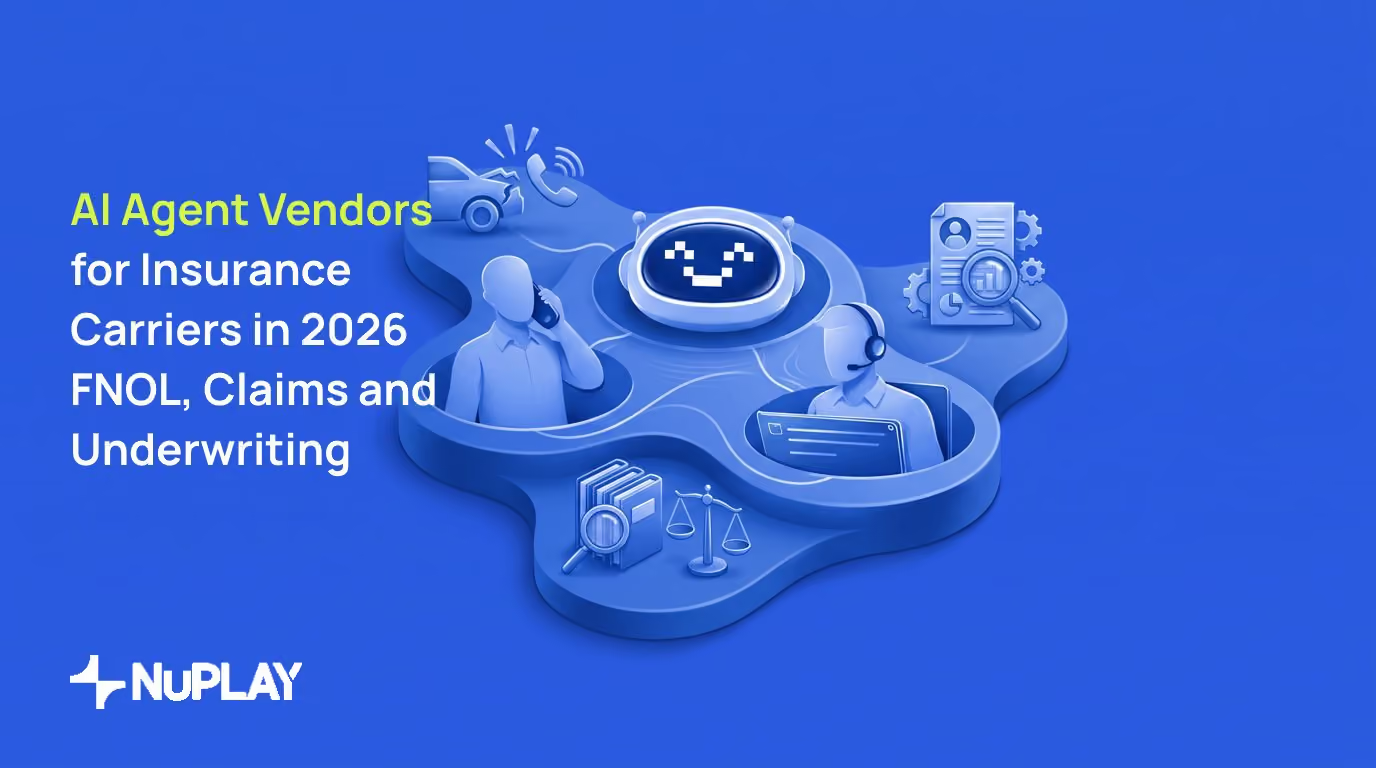
AI Agent Vendors for Insurance Carriers in 2026: FNOL, Claims and Underwriting

Don’t miss what’s next in AI.
Subscribe for product updates, experiments, & success stories from the Nurix team.
Disclosure: NuPlay AI builds a competing platform. We reviewed publicly available product pages and announcements for the vendors discussed below; we did not run self-serve trials or conduct vendor demonstrations.
AI agents for insurance should be evaluated by the workflow they must complete: FNOL intake, claims and policy servicing, underwriting preparation, or work inside an existing core platform. In 2026, carriers should verify system access, structured-data capture, human escalation, testing controls, and governed changes before selecting an agent vendor.
The available industry data measures artificial intelligence and machine learning generally, not agent adoption specifically, and does not establish a market-wide shift beyond experimentation. National Association of Insurance Commissioners (NAIC) insurer surveys found that 88% of 193 responding auto insurers, 70% of 194 home insurers, 58% of 161 life insurers, and 92% of 93 health insurers use, plan to use, or plan to explore AI or machine-learning models. NAIC, updated April 3, 2026
What are AI agents for insurance?
AI agents for insurance are software systems that use language models, rules, and connected systems to complete or support defined insurance tasks. Examples include gathering first notice of loss (FNOL) details, checking policy data, routing work, summarizing claim files, and preparing an underwriting submission.
Insurance agents generally fall into two groups:
- Customer-interaction agents manage voice, chat, email, or messaging for intake and service.
- Workflow and core-platform agents operate within or alongside policy, claims, billing, document, and underwriting systems.
That distinction matters during procurement. A voice agent that collects a loss description is not automatically a claims workflow product. A general enterprise agent that summarizes documents is not automatically an underwriting workbench. A core-platform-native agent may have better access to policy and claims records, but its value depends on the carrier’s existing architecture and the availability of each feature.
The NAIC describes insurance AI use across underwriting, pricing, customer service, claims handling, marketing, and fraud detection. It also states that insurers remain responsible for complying with insurance laws, regulations, and consumer-protection rules. AI is more likely to support insurance professionals than replace them, so human oversight remains important in decisions that affect consumers. NAIC
Compare vendors by documented workflow fit, not category labels
The table separates documented vendor statements from items we could not verify in the public material reviewed. It does not rank vendors overall. A carrier should assess a native core-platform option separately from a standalone customer-interaction or workflow vendor.
Among Sierra, Decagon, and Aisera, Sierra has the clearest reviewed insurance-adjacent claims example. Decagon’s reviewed evidence is financial-services customer experience (CX), while Aisera’s is general enterprise automation. The three should not be treated as equivalent claims-platform offerings. Sierra Decagon Aisera
For voice FNOL, evaluate more than the naturalness of the conversation. Test whether the agent can:
- Collect structured loss information.
- Confirm critical details back to the caller.
- Preserve context when a human takes over.
- Route exceptions to the right team.
- Handle interruptions, corrections, distress, and failed policy lookups.
- Create a usable record in the claims workflow rather than only a transcript.
A carrier already committed to a core platform should also test the native agent layer before adding a separate intake product. The key question is not which demo sounds best. It is which option can complete the required workflow with approved access to the systems of record.
The procurement scorecard carriers should use
The NAIC Model Bulletin states that consumer-impacting actions supported by AI systems must comply with applicable insurance laws and regulations. It also says regulators may request governance information and documentation during an examination or investigation. That makes traceability, testing, escalation, and change approval procurement requirements rather than optional product features. NAIC Model Bulletin
Use the following 100-point scorecard for a controlled vendor evaluation:
Ask vendors to demonstrate the same scenario using the same input records. For FNOL, that could include a straightforward loss, a caller who changes the loss location, an uncertain policy match, an injury indicator, a coverage question, and a caller who needs a human immediately.
Do not assume that a public description of testing or observability is equivalent to evidence that the carrier’s governance requirements are met. Ask for sample trace records, release controls, retention details, access roles, and an explanation of what a human reviewer can approve or reject.
Public materials do not provide like-for-like deployment timelines. A pilot schedule depends on workflow scope, data access, integration approvals, security review, and test coverage. The vendor pages reviewed describe capabilities and releases, not comparable implementation timelines. Guidewire materials Duck Creek release Sierra Parloa Decagon Aisera C3 AI NuPlay AI insurance
Worked example: a controlled FNOL evaluation
Hypothetical carrier evaluation: A regional property and casualty (P&C) carrier wants to handle overnight water-damage FNOL calls while adjusters retain coverage decisions.
A practical starting point is a six-to-eight-week controlled evaluation using about 200 de-identified historical FNOL records plus scripted edge cases. This is a starting point for the hypothetical evaluation, not a universal sample-size rule.
The carrier should score whether the agent captures:
- Loss date and location
- Cause of loss
- Immediate safety concerns
- Claimant details
- Policy identifier
- Required documents and next steps
- Required consent
- Corrections made during the call
- The reason for any human handoff
Require human routing for coverage questions, injury indicators, suspected fraud, distress, or uncertain policy matches. The agent may collect and organize information, but the evaluation should not permit it to make unapproved coverage or claim decisions.
The success checks should be operational:
- The intake record contains the required fields.
- The case reaches the correct queue.
- The caller’s corrections are preserved.
- A reviewer can replay what the agent did and why.
- No coverage or claim decision occurs outside the approved workflow.
- Production changes have documented review and approval.
Likely failure modes include lost caller corrections, unsupported coverage explanations, duplicate claims, incorrect routing, incomplete consent capture, and production changes without documented review. The evaluation should record each failure, its operational impact, and whether the vendor can propose and test a controlled fix.

Don’t miss what’s next in AI.
Subscribe for product updates, experiments, & success stories from the Nurix team.