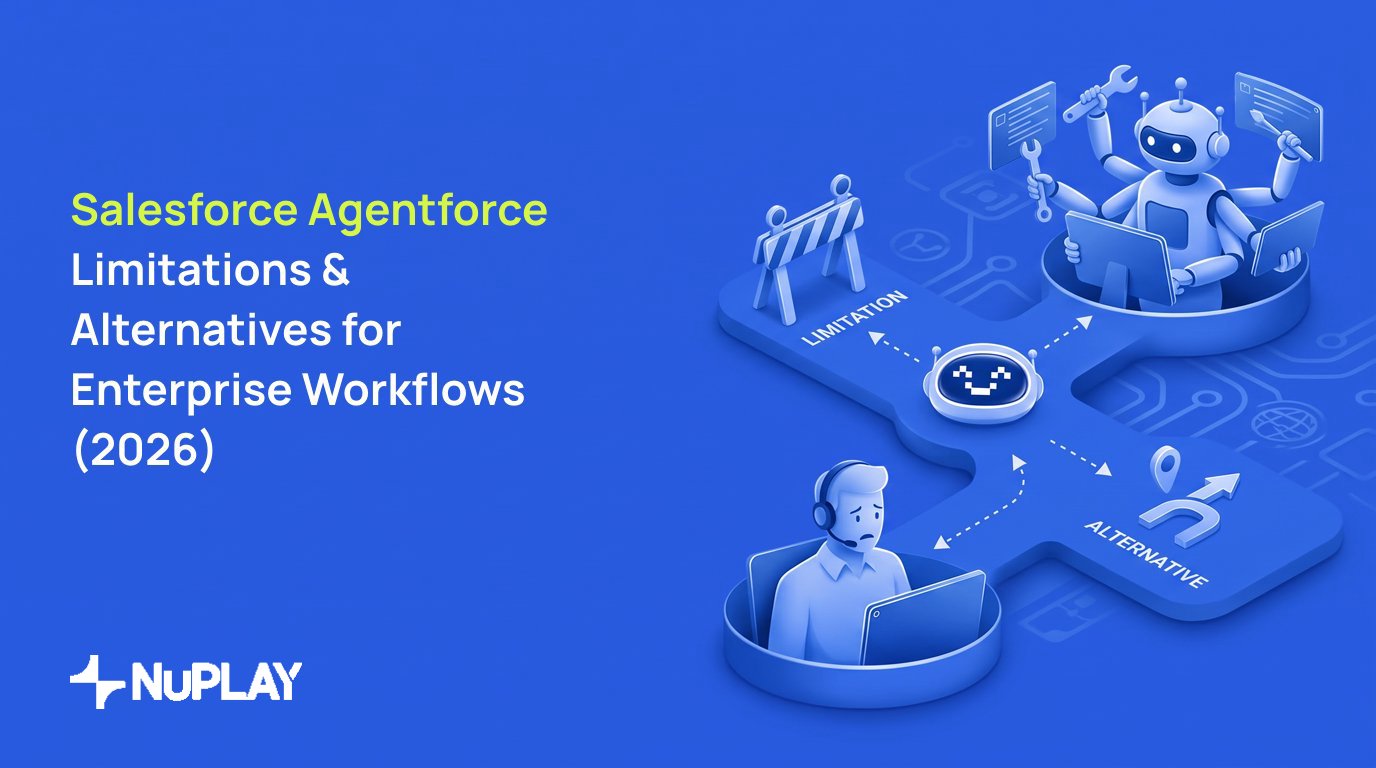
Salesforce Agentforce Limitations and Alternatives for Enterprise Workflows (2026)

Don’t miss what’s next in AI.
Subscribe for product updates, experiments, & success stories from the Nurix team.
Disclosure: NuPlay AI builds a competing platform. This is a documented evaluation of publicly available product pages, documentation and vendor announcements as of October 2026, and not a hands-on test.
Salesforce Agentforce is strongest when Salesforce is your central system of record, data, and workflow layer. It is a less automatic choice when work spans several systems. Compare action coverage, permissions, testing, governance, ownership, and operating model before choosing Agentforce or an alternative.
Meta description: Assess Salesforce Agentforce, cross-system workflow options, alternatives, and build-vs-buy criteria while validating architecture, ownership, and availability.
The practical conclusion is that Agentforce’s main advantage is its connection to Salesforce building blocks. Salesforce describes Agentforce as a layer on the Salesforce Platform that can use Flows, Apex, prompt templates, APIs, Data Cloud, MuleSoft, and existing security controls. Salesforce documented this approach in its October 2024 general availability announcement.
Adoption does not remove the need for operating-model work. In PwC’s May 2025 survey of 300 senior executives, 79% said artificial intelligence (AI) agents were already being adopted. Among organizations already adopting AI agents, 45% said their organizations were fundamentally rethinking operating models. PwC’s survey supports a cautious conclusion: selecting a platform is only one part of putting an agent into production.
The limitations discussed here are fit boundaries and implementation work, not proof that Agentforce cannot support a particular use case. Cross-system work may be possible, but you should validate the architecture, action integrations, testing ownership, and change process before committing.
What is Salesforce Agentforce?
Salesforce Agentforce is a layer on the Salesforce Platform for building and deploying agents that can make decisions and take configured actions. Salesforce’s Agent Builder can use existing Flows, Apex, prompt templates, APIs, and data sources to configure those actions. Salesforce describes these capabilities in its general availability announcement.
Since that October 2024 launch, Salesforce has released Agentforce 360 (October 13, 2025), which added a conversational builder, hybrid reasoning for more control and accuracy, and voice capabilities (Salesforce).
Agentforce is not the same as a copilot
Salesforce positions Agentforce as going beyond copilots and describes it as a system that can make decisions and take configured actions through topics, instructions, and actions, including service tasks such as case, order, reservation, and account management.
That distinction does not remove the buyer’s responsibilities. You still need to define:
- Which actions an agent can take
- Which permissions apply to each action
- When a person must review or approve work
- How escalations are handled
- How changes are tested before production release
- How the business responds when a downstream system is unavailable
What changed in 2026?
Salesforce announced Agentforce Operations for back-office processes in April 2026. It also announced additions to Agent Fabric covering multi-platform discovery, Model Context Protocol (MCP) bridging, model choice, governance, agent identity, and deterministic orchestration.
gentforce Operations reached general availability on April 29, 2026, and is built on technology from Salesforce’s Regrello acquisition. In the April 15 Agent Fabric announcement, AI Gateway, MCP Bridge and Trusted Agent Identity were generally available. Agent Broker, the deterministic-orchestration piece, began in beta with general availability targeted for June 2026, so check its current status.
Salesforce also agreed in June 2026 to acquire Fin, the company formerly called Intercom, for about $3.6 billion (CNBC). Trade coverage reports that the deal closed on September 10, 2026. Fin’s agent is now owned by Salesforce, which changes how to read the Fin comparison later in this article.
These are Salesforce announcements, not independent proof of business outcomes. Some Agent Fabric capabilities were described as beta or planned at the time of the announcement, so confirm current availability, regional coverage, and contract eligibility before making a purchase decision. Salesforce’s Agent Fabric announcement and Agentforce Operations announcement provide the relevant product claims and availability notes.
Where Agentforce fits, and where boundaries matter
The deciding factor is not whether an agent can answer a question, but whether it can safely complete the workflow using the systems your business already runs.
How is Agentforce priced?
Salesforce lists several models. Flex Credits cost $500 per 100,000: a standard action uses 20 credits (about $0.10) and a voice action uses 30 (about $0.15). Customer-facing agents can instead be priced at $2 per conversation, and per-user add-ons start at $125 a month. Because Flex Credits bill per action, retries and multi-step workflows raise the cost, so price your real action path before you commit.
Testing is a meaningful part of this evaluation. Salesforce’s April 2026 Testing Center update describes simulated multi-turn conversations, custom scoring criteria, execution traces, run history, inline test editing, and command-line quality gates through Salesforce’s development tools. These capabilities are documented by Salesforce and should still be tested against your own workflows. Salesforce Testing Center update.
Salesforce’s TDX 2026 roundup also lists session traces through an OpenTelemetry API (beta), an A/B testing API for agent versions (pilot), and custom scorers in Observability (beta), so Salesforce is building its own observe-and-improve loop (Salesforce). Confirm which of these are generally available for your edition.
The Salesforce-first boundary
Agentforce is a logical starting point when Salesforce already owns the customer record, service process, permissions, and actions. Existing Salesforce assets can reduce the need to create a separate action layer for work that already lives inside the platform.
The evaluation changes when Salesforce is only one of several systems of record. A retailer, insurer, or financial services company may need to connect Salesforce with order management, logistics, payments, identity, claims, or policy systems. Agent Fabric’s April 2026 announcement describes multi-platform discovery and MCP bridging, which indicates that cross-system work is part of Salesforce’s direction. It does not establish that a particular customer’s integrations will work without custom design or operational ownership.
Salesforce has also added support for the Model Context Protocol in Agentforce 3, with MuleSoft connectors that turn existing APIs into agent-ready assets (MarTech), and Agent Fabric’s scanners now discover agents on Amazon Bedrock and Microsoft Foundry. That narrows the connectivity gap, but it is a control-plane claim: who owns each action, permission and rollback in a non-Salesforce system is still a design decision.
Practical recommendation: Pilot Agentforce rather than treating it as the default if Salesforce is one of several systems of record. This recommendation is based on Salesforce’s documented Salesforce-native building blocks, not a claim that Agentforce lacks third-party connectivity.
Salesforce Agentforce alternatives: choose by workflow center of gravity
These options overlap in customer-facing automation, but they are not interchangeable enterprise workflow platforms. The capabilities in the table are vendor claims based on the public product material linked in the relevant rows.
This comparison does not establish a universal winner. It separates the center of gravity for each option: Salesforce data and automation, service operations, digital customer conversations, managed delivery, conversational workflow control, or broader enterprise workflow execution.
What was not publicly verified in this review
We reviewed public product pages and documentation rather than conducting trials or vendor demos. The public material did not allow us to verify:
- Whether any option supports a particular retailer’s payment, refund, identity-verification, logistics, or order-management action without custom integration
- Comparative implementation duration
- Total cost of ownership
- Benchmark performance across the same workflow
- A particular customer’s security posture or contractual controls
- How each platform handles a specific organization’s permissions, exceptions, and rollback requirements
The absence of a public description is not evidence that a vendor lacks a feature. It means the feature was not publicly verified in this review.
Build versus buy: apply a production-operating-model test
The useful question is not whether your team can build an agent demonstration. It is whether your organization can operate the workflow after launch.
MIT Sloan reports that, in one 2025 research example, data engineering, stakeholder alignment, governance, and workflow integration consumed 80% of the work. MIT Sloan’s explanation of agentic AI uses that example to show why production work extends beyond prompts and model selection. The example was an agent detecting adverse events in cancer patients from clinical notes, so treat it as an illustration, not a retail benchmark.
Use this decision test:
- Build when the workflow logic is strategically unique and your enterprise can sustain data engineering, integrations, testing, access control, monitoring, incident response, and upgrades.
- Buy or partner when the workflow is repeatable, the business needs production delivery across existing systems, and internal teams should retain policy and workflow ownership without rebuilding every platform layer.
- Layer onto an incumbent when the current CRM or helpdesk remains the system of record but the workflow needs a separate execution, context, or governed-improvement layer.
Hypothetical worked example: a retailer’s order-status workflow
Consider a retailer’s “Where is my order?” workflow. It requires:
- Identity verification
- Order lookup
- Carrier-status retrieval
- A delivery-exception decision
- A possible refund request
- Escalation when activity appears suspicious
A helpdesk AI may be sufficient if the main requirement is answering status questions and creating tickets. Agentforce is a strong candidate if the required actions and records are already governed in Salesforce.
You should evaluate a broader workflow platform when the process spans order management, logistics, payments, and service systems, particularly if the team needs replay-based diagnosis of recurring failure patterns. The decision should depend on the actual action path, permissions, exception rules, and ownership model, not on the agent label.
For a retail reference point, NuPlay AI’s published Myntra story reports a 50% reduction in average handle time while scaling support 3x without added headcount (NuPlay AI). It is a vendor claim about another retailer’s support workflow, not a benchmark for this one.
A gated pilot design
A four-to-six-week gated pilot is a practical starting point, not a universal requirement. Use roughly 100 historical interactions covering:
- Common requests
- Exceptions
- Failed handoffs
- Policy-sensitive cases
- Missing or stale data
- Downstream API failures
Evaluate more than whether the response sounds useful. Check:
- Correct workflow outcome
- Authorized action
- Source traceability
- Appropriate escalation
- Human approval where required
- Documented rollback route
- Regression results after each material change
The pilot should surface failure cases such as stale source data, ambiguous permissions, unavailable downstream APIs, weak identity checks, and changes made without regression testing.
Mid-market retailer choice: Fin vs. Zendesk AI vs. Agentforce
Choose Intercom Fin when digital shopping conversations, ecommerce assistance, and a connected support-and-sales experience are the immediate center of gravity. Choose Zendesk AI when Zendesk ticketing and service operations are central. Choose Agentforce when Salesforce customer, service, or commerce data and workflow actions are central.
The product descriptions behind this comparison come from Intercom’s Fin documentation, Zendesk’s AI agent integration documentation, and Salesforce’s Agentforce announcement. These sources document vendor capabilities, not a common benchmark.
All three options require knowledge maintenance, action permissions, testing, human escalation, and usage governance. A service platform may handle the customer conversation well while leaving the hardest work in downstream systems.
PwC’s May 2025 survey found that 79% of respondents said AI agents were already being adopted. Among organizations already adopting AI agents, 45% said they were fundamentally rethinking operating models. That gap matters for a retailer because an agent added to the front of a fragmented process may move the bottleneck rather than remove it. PwC AI Agent Survey.
Before you choose: a checklist
1. Name the system of record for each step in the workflow.
2. List every action the agent must take, and who owns each permission.
3. Ask each vendor how a change is tested, approved and rolled back.
4. Price your real action path, including retries and escalations.
5. Run a gated pilot on historical cases, including the failures.
6. Confirm whether each feature you are buying for is generally available, in beta, or planned.
7. Decide who owns policy changes after launch.

Don’t miss what’s next in AI.
Subscribe for product updates, experiments, & success stories from the Nurix team.