AI Customer Self-Service Vendors: What a VP of CX Should Evaluate and How to Calculate Cost per Contact (2026)

Don’t miss what’s next in AI.
Subscribe for product updates, experiments, & success stories from the Nurix team.
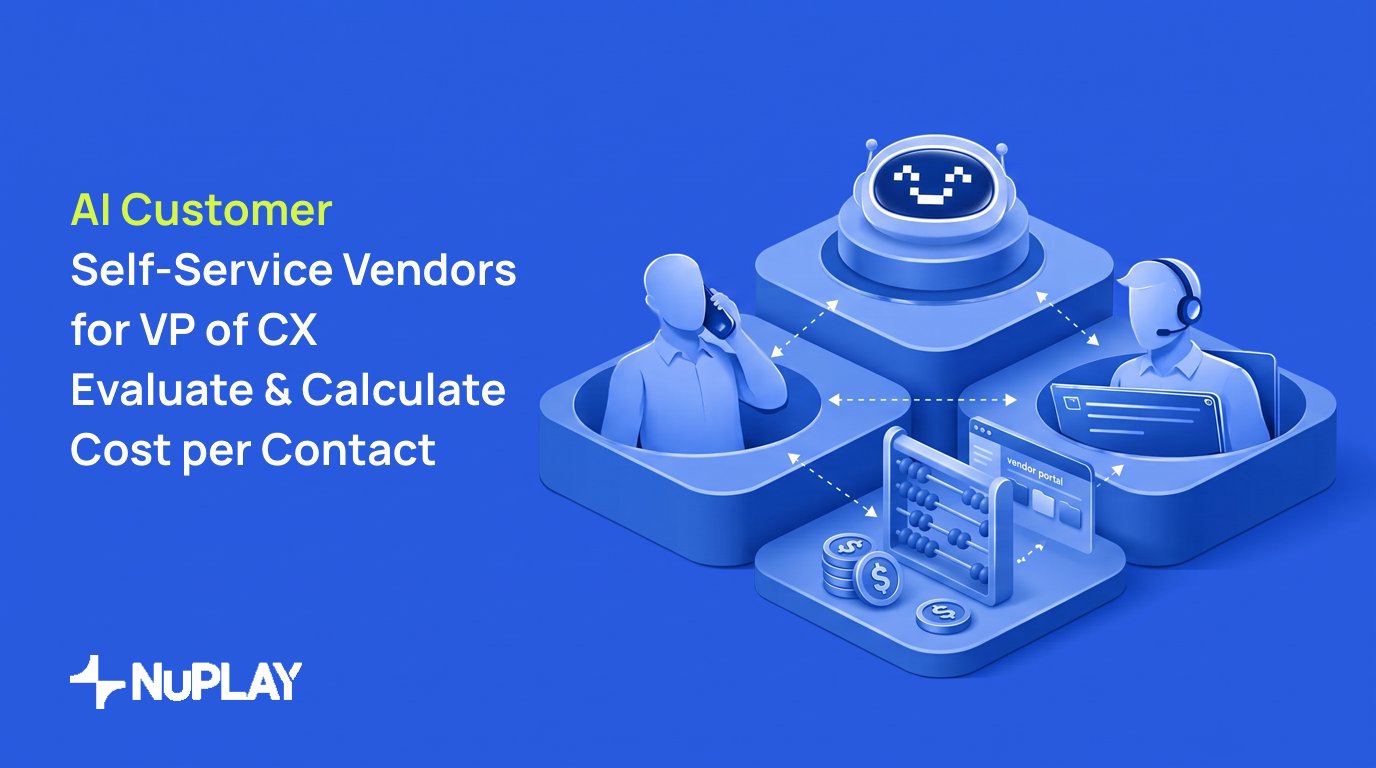
AI Customer Self-Service Vendors: What a VP of CX Should Evaluate and How to Calculate Cost per Contact (2026)
NuPlay AI builds a competing enterprise AI platform. Its platform page describes an enterprise agent platform for executing, orchestrating, and improving workflows in production.
AI customer self-service vendors should be evaluated on whether they can complete a defined customer journey safely, hand off with context, and show the full cost of a resolved journey, not on a headline billing unit. In 2026, we should compare billing definitions, non-usage costs, outcome measures, and a controlled pilot.
A low headline rate is not the same as a low cost per resolved customer need. Gartner reported on August 19, 2024, that only 14% of customer service and support issues were fully resolved in self-service. Its survey of 5,728 customers, conducted in December 2023, also found that customers could not find relevant content in 43% of self-service failures. Gartner's survey
If customers repeat the same request, abandon a journey, or reach a person without useful context, a cheap interaction may still produce poor CX economics. A VP of Customer Experience (CX) cannot compare vendors responsibly from one advertised billing unit. Procurement needs billing definitions, non-usage costs, outcome measures, and a controlled pilot.
What is AI customer self-service vendor software?
AI customer self-service software enables customers to find information or complete eligible service tasks without a live representative, while transferring to a person when the workflow, policy, or customer need requires it. Salesforce describes customer self-service software in similar terms: customers can access information and complete tasks without help from a support representative. Salesforce customer self-service documentation
The category includes three different operating models:
- Knowledge-answering self-service retrieves and explains approved information.
- Workflow self-service authenticates a customer, accesses permitted business systems, and completes an allowed action, such as checking an order or changing an appointment.
- Agent assist helps an employee perform work but does not itself resolve the customer request. It should not count as self-service containment.
Keep two financial measures separate:
- Cost per contact = total support operating costs ÷ all handled contacts.
- Cost per resolved customer journey = total program cost ÷ customer needs resolved to the organization's stated standard.
Decagon defines cost per contact as total support cost divided by total contacts, including escalations and repeat contacts. Its explanation warns that high repeat-contact rates can make a low cost-per-contact result misleading. Decagon's cost-per-contact explanation
The first metric shows the cost of handling volume. The second asks whether the customer need was actually completed. A vendor quote usually describes only one part of either calculation.
Compare commercial models, not headline prices
Public vendor materials describe different billing units, including per-conversation, per-resolution, outcome-based, and consumption models. The following comparison records those descriptions. It does not establish negotiated contract prices, all-in program cost, or which option is cheaper.
The distinction is straightforward:
- Per-conversation pricing bills for handled volume.
- Resolution or outcome pricing bills for a contract-defined result.
- Consumption pricing bills for use, such as minutes or interactions.
None is automatically preferable. The right fit depends on contact mix, channel, volume volatility, and the agreed definition of success. Public pricing descriptions from Decagon, Sierra, and Parloa describe the commercial units, not your eventual all-in cost per contact.
The five-part vendor evaluation scorecard
A useful scorecard evaluates the journey, the operating model, and the cost controls together. NIST's Artificial Intelligence Risk Management Framework (AI RMF) organizes risk work into Govern, Map, Measure, and Manage, and describes risk management as continuous across the artificial intelligence lifecycle. NIST AI RMF Core
1. Journey fit
Can the system complete one high-volume, repeatable journey from a defined starting point to a defined business result?
A system that answers questions but cannot complete the permitted action may reduce some assisted volume without resolving the underlying need. Start with one journey where the eligible customer, required systems, action boundaries, and resolution standard are clear.
2. System access and handoff
Can the system authenticate appropriately, access the required records, write back a disposition, and pass useful context to a person?
Ask vendors to demonstrate the full path, including authentication failure, missing data, integration timeout, and a customer request for a person. Public Salesforce materials describe escalation with customer context, but you should test the fields, timing, and record updates in your own environment. Salesforce customer self-service documentation
3. Billing integrity
Can finance reconcile every billable event to the underlying conversation, action, outcome, escalation, and recontact?
Require sample billing records and a written answer to questions such as:
- What starts and ends a conversation?
- What counts as a confirmed resolution?
- Is a planned handoff different from an unsuccessful escalation?
- How are abandoned sessions treated?
- Can one customer need create multiple billable events?
- What happens when the customer contacts support again within the agreed window?
A vendor's unit price is not comparable until these definitions are mapped to your contact data.
4. Run-the-program model
Who owns knowledge updates, exception review, testing, approval, rollback, incident response, and performance reporting after launch?
A pilot can appear successful while the operating work remains unassigned. Put named owners around content, integrations, quality review, workforce changes, and vendor escalation. Include the expected internal labor in the total-cost model.
5. Risk controls
Require data-access boundaries, action logs, human escalation paths, retention terms, and named accountability.
For higher-risk journeys, define which actions require review, what evidence must be retained, how an issue is contained, and what triggers a rollback. Treat these as operating requirements to test, not statements to accept from a sales presentation.
Worked example: Normalize quotes into one CX metric
This is a hypothetical calculation, not a benchmark.
A support organization receives 10,000 contacts in one month. It routes 6,000 to one AI journey:
- 3,900 meet the company's resolution standard.
- 1,500 are intentionally handed to a person with context.
- 600 end without a confirmed outcome.
- The remaining 4,000 contacts go directly to human support.
The same traffic can produce very different billable volumes:
- A conversation model may create up to 6,000 billable AI conversations.
- A resolution model may create 3,900 billable resolutions, subject to the contract's recontact policy.
- An outcome model may count the 3,900 resolutions and some configured handoffs, depending on the definition.
- A voice-consumption model varies with session length, including authentication and system waits.
These commercial differences are described in public materials from Decagon, Sierra, Parloa, and Intercom.
The example does not produce a final cost because the rates, platform fees, human resolution count, and other program costs have not been supplied. That is the point of normalization: first establish how many events each quote would bill, then add the costs that sit outside the unit.
Use these formulas:
All-in AI cost per total contact = (usage fees + platform fees + implementation amortization + integration maintenance + telephony + quality and governance labor) ÷ total contacts
All-in cost per resolved customer journey = total program cost ÷ confirmed AI and human resolutions after the agreed recontact window
Parloa's July 24, 2026 total-cost guidance identifies integration, connector maintenance, governance, workforce transition, and ongoing performance management as costs beyond the billed interaction. Parloa total-cost guidance
For a defensible comparison, ask each vendor to populate the same model with:
- Expected eligible volume.
- Conversation, resolution, outcome, or consumption assumptions.
- Escalation and recontact treatment.
- Implementation and integration effort.
- Ongoing connector and knowledge maintenance.
- Quality review, governance, and workforce-transition labor.
- Peak-volume and channel assumptions.
Do not declare a vendor cheapest from the unit alone. Normalize each quote against the customer journeys you expect to resolve.
Pilot and decision criteria
Run a practical six-to-eight-week controlled pilot for one low-to-medium-risk journey, using a few hundred eligible interactions per variant where volume permits. Establish the baseline before routing live traffic, and define the resolution standard before reviewing results.
Review:
- Confirmed resolution and repeat-contact rate.
- Correct action completion and escalation quality.
- Transfer-context completeness.
- Customer effort or satisfaction.
- Billing-event reconciliation.
- Recovery from stale knowledge, authentication failures, integration timeouts, and requests for a person.
- Rollback performance when a change creates an unacceptable result.
A pilot should answer both “Can the system handle the journey?” and “Can the organization operate and account for it?” A strong result on the first question does not compensate for unclear billing, weak handoffs, or unassigned maintenance work.
When comparing ongoing operating models, ask how each vendor records runs, identifies underperforming paths, tests changes, and reverses a release. NuPlay AI's published positioning is:
NuPlay AI runs enterprise workflows in production and improves them after every run through NuLoop, with agents, the systems they operate, and the context they draw on under one platform. Platform | NuLoop by NuPlay AI
The public NuLoop page contains different descriptions of promotion controls, including human approval and customer-configured promotion. Confirm the exact production approval configuration before relying on it in an operating model or control review.
Request a demo to evaluate one customer workflow and its operating model.

Don’t miss what’s next in AI.
Subscribe for product updates, experiments, & success stories from the Nurix team.