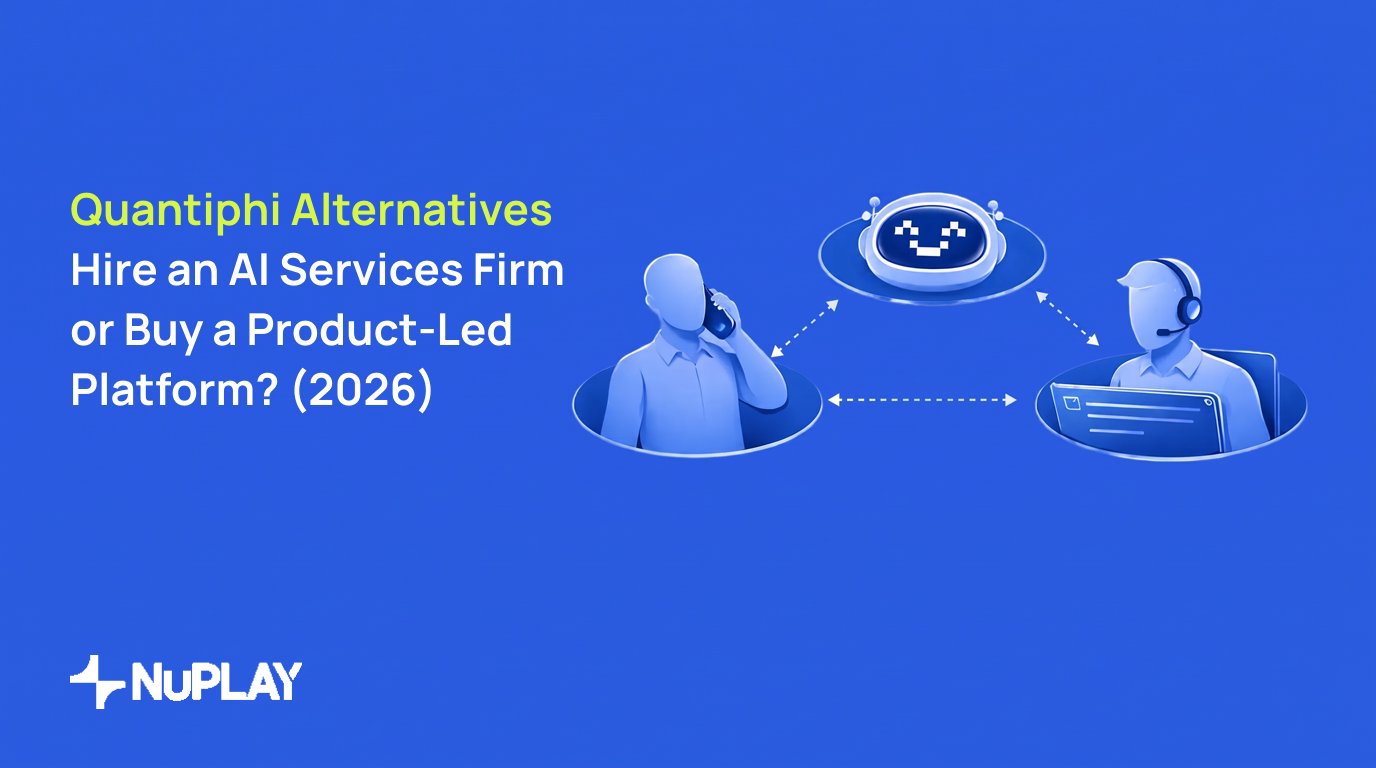
Quantiphi Alternatives: Hire an AI Services Firm or Buy a Product-Led Platform? (2026)

Don’t miss what’s next in AI.
Subscribe for product updates, experiments, & success stories from the Nurix team.
Quantiphi Alternatives: Hire an AI Services Firm or Buy a Product-Led Platform? (2026)
Disclosure: NuPlay AI builds a competing platform. We reviewed Quantiphi’s public product pages and an HFS Research report; we did not test Quantiphi or validate claims that require a demo, contract, or customer reference.
Quantiphi alternatives should not be judged as a simple consulting-versus-software choice. Quantiphi combines AI digital engineering with its own platforms. Hire it when you need a partner to modernize an estate or design a custom program; choose a product-led workflow platform when you need repeatable operating workflows, visible governance, and a defined improvement process. HFS Research
The central decision is about procurement and operating ownership, not whether custom work or software is inherently better. Artificial intelligence (AI) programs also need a risk-management approach. The National Institute of Standards and Technology (NIST) describes its AI Risk Management Framework as voluntary guidance for incorporating trustworthiness considerations into the design, development, use, and evaluation of AI products, services, and systems. NIST AI Risk Management Framework
As a factual anchor, HFS reports that Quantiphi employs around 3,500 professionals and serves more than 400 customers globally. Those figures describe the firm in the HFS report, not a guarantee of delivery capacity for a specific engagement. HFS Research
What is a Quantiphi alternative?
A Quantiphi alternative is any delivery model that addresses the same enterprise need: putting artificial intelligence into production with appropriate workflow integration, governance, and ongoing operating ownership. That can mean another services-led program, an internal build, or a product-led workflow platform.
Quantiphi is an AI-first digital engineering firm, but it also offers proprietary platforms. Documented: HFS describes Codeaira as supporting repeatable modernization work. It describes Baioniq as an enterprise agentic artificial intelligence platform delivered through an onboarding-plus-subscription model, with forward-deployed engineering for custom agent development. HFS Research
Vendor claim: Quantiphi’s agentic AI page says its agents learn, adapt, and execute workflows across enterprise systems. We could not verify the live evaluation, release, or change-control process behind those statements without a demonstration or customer engagement. Quantiphi agentic AI page
That means Quantiphi is not simply a traditional consulting firm, and a product-led platform is not automatically a substitute for modernization services. The relevant question is where your main constraint sits: in the estate that must be changed, or in the repeatable workflow that must be operated after deployment.
Quantiphi vs. a product-led AI platform: compare operating models
The practical difference is who owns the repeatable production system after the initial deployment, and how much bespoke modernization the initiative needs.
NuPlay AI runs enterprise workflows in production and improves them after every run through NuLoop, with agents, the systems they operate, and the context they draw on under one platform. NuPlay platform NuLoop
The public NuLoop page documents a cycle of Instrument, Detect, Propose, Prove, Promote. It describes recording and replaying runs, identifying recurring patterns, creating targeted changes, testing those changes against past traffic and new scenarios, and maintaining versions with rollback. Documented: For procurement, treat approve-to-promote as the required operating default. Confirm which changes require a person’s approval, what thresholds govern promotion, and who owns rollback.
When hiring Quantiphi is the stronger fit
A services-led engagement is more likely to fit when the enterprise problem extends beyond one workflow. Documented: HFS positions Quantiphi for modernization and applied AI programs and describes its use of platform-assisted delivery and custom engineering. It also warns that outcome-based models depend on explicit baselines, attribution rules, and customer-experience constraints. HFS Research
Quantiphi may be the stronger fit when:
- A large application, data, cloud, or legacy-modernization program must happen before individual AI workflows can operate.
- Your organization needs a partner to define the use case, build custom agents, integrate systems, and support broader transformation work.
- Procurement needs a delivery model tied to clearly defined units of work or measurable outcomes.
- You can establish credible baselines, attribution rules, customer-experience guardrails, and exit provisions before signing.
HFS specifically advises buyers to scrutinize portability, data residency, and exit terms for Quantiphi’s platforms. It also says many productivity and margin claims remain provider-asserted, so buyers should request reference-backed validation and security assurance appropriate to the access being granted. HFS Research
Not verified without a demo or contract: This review does not establish Quantiphi’s pricing, implementation duration, support levels, security certifications, data-residency commitments, model providers, or contractual portability.
When a product-led platform is the stronger fit
A product-led platform is more likely to fit when the enterprise already has a defined, high-volume, repeatable workflow and does not need to rebuild its entire technology estate first. Documented: NuPlay AI describes a platform that executes, orchestrates, monitors, and improves enterprise workflows across existing systems. NuPlay platform
Consider this path when:
- The workflow has measurable inputs, decisions, handoffs, exceptions, and outcomes.
- The business has systems of record to connect, rather than an estate that must first be transformed.
- Operations leaders need visibility into workflow runs, exceptions, and outcomes after launch.
- The organization needs a documented method to validate, govern, and roll back workflow changes.
- The buyer wants to reuse one operating model across multiple workflows.
A platform does not remove implementation work. It changes the work. You still need business owners, authoritative data, exception handling, access controls, integration testing, and accountable approvers.
The platform path is also not a promise that every workflow should be automated. A sound design assigns each task or decision to the right mode: human handling, fixed automation, or agent reasoning. The buyer remains responsible for deciding where exceptions and approvals belong.
Editorial decision scorecard
This is a practical framework, not independent research. Score each statement from 0 to 2:
- 0 = not true
- 1 = partly true
- 2 = clearly true
Score these statements:
- We need significant data, application, or cloud modernization before the workflow can operate.
- We need external engineers to design a solution without a defined workflow boundary.
- We can define outcome baselines and contract attribution rules before launch.
- We have several high-volume, repeatable workflows with known systems, handoffs, and exception paths.
- We need operations teams to inspect workflow runs and govern changes after go-live.
- We want one repeatable improvement process rather than separate monitoring and release controls for each use case.
A higher score on the first three statements points toward services-led delivery. A higher score on the final three points toward a product-led platform.
Similar scores suggest a hybrid approach. You might use specialist delivery for unique transformation work and a product-led platform for repeatable production workflows. In that case, define the boundary between the two providers, including data ownership, integration responsibilities, operational support, and change approval.
Worked example: separate modernization from workflow operation
Hypothetical example: An insurer wants to reduce manual work in claims-document intake, routing, and exception handling. If source documents, policy data, and claims systems are fragmented or unreliable, the first need may be services-led data and systems modernization. If those systems already exist and the immediate problem is a repeatable intake-to-routing workflow, a product-led platform may be the better starting point. In either case, define human approval points, the exception route, baseline handling time, and the post-launch owner before selecting a provider.
This example is a decision scenario, not evidence about a Quantiphi customer or a NuPlay AI result.
Before selecting a provider, check for:
- A named workflow owner
- Documented escalation rules
- Baseline and target-outcome definitions
- An integration test plan
- Run-level visibility
- A documented change and rollback process
- Contract terms covering data, portability, and exit
The same checks apply whether you hire a services firm, buy a platform, or combine both. They turn a broad AI program into an operating model that can be reviewed after launch.

Don’t miss what’s next in AI.
Subscribe for product updates, experiments, & success stories from the Nurix team.