A customer asks for a drill in stock. The associate checks the shelf, then the handheld device, then walks to find a supervisor leaving the customer there. Four minutes later, the customer left.
That associate didn't do anything wrong. The handheld showed stock the shelf didn't have and couldn't explain why. Offering the customer another store or home delivery needed a supervisor. Every tool returned one piece of information; none of them resolved the situation.
That is the gap most in-store technology leaves open. 88% of associates say they struggle to get timely help, up from 82% a year earlier (Zebra), even as retailers keep adding tools. The next step isn't faster answers. It's AI agents that check several systems at once, act on what they find and know when a person needs to decide. Walmart, Lowe's, Target and Home Depot are already moving that way.
TL;DR:
- Why current tools fall short: handhelds, policy portals and first-generation AI assistants each return one piece of information. The associate still has to reconcile systems that disagree, work out which policy is current and chase a manager for approval.
- What an agent changes: it resolves the situation, not just the question. It checks several systems at once, applies the current policy, takes the routine action and routes anything that needs sign-off.
- What decides adoption: how the agent handles conflicting inventory, outdated policies, uncertain answers and approvals, not how fast it answers easy questions.
- The leaders are already heading there: Retail AI spans associate Q&A, coaching, task planning and customer-request resolution. Walmart, Lowe's, Target and Home Depot have moved from Q&A tools toward AI that plans tasks and resolves requests end to end. These examples show different levels of automation.
- How to start and measure: begin with low-risk lookups, then expand; track accuracy, override and approval metrics alongside in-store CSAT.
Why do existing store tools fail associates?
Retailers haven't left associates empty-handed. Most stores already run handhelds, a store app, a policy portal and, increasingly, an AI assistant. Yet the struggle is growing: in Asia-Pacific, the share of associates who can't get timely help jumped from 76% to 85% in a year (Zebra APAC). The job keeps widening too. Associates spend 74% of their time on work other than checkout (Salesforce), and more than 42% of e-commerce orders in 2023 involved a store (Publicis Sapient).
More tools haven't closed the gap because they fail in three predictable ways.
They read one system, and stores run on many. Associates log into an average of 12 systems a day (Salesforce). A handheld shows the inventory record. It doesn't know that a pickup order has already claimed the last unit, or that today's delivery hasn't been received yet. When systems disagree, the associate becomes the integration layer, usually with a customer waiting.
They treat the record as the truth. Average store inventory accuracy is about 63% without item-level RFID, rising to 95% with it, according to the Auburn University RFID Lab and GS1 US (DC Velocity). A tool that reports the record as fact sends associates to empty shelves. After a few of those trips, associates stop trusting it and go back to asking a colleague.
They stop at the answer. A policy portal can say the return window is 30 days. It can't process the exception, get the manager's sign-off or tell the customer what happens next. Most first-generation associate assistants share the same limit: they inform, and the associate still does the work.
Making these tools faster improves each problem a little. It fixes none of them.
What does an AI agent change beyond faster answers?
An AI agent changes the unit of work from the question to the outcome. Instead of returning a record for the associate to interpret, it checks the systems involved, works out what is reliable enough to act on, does the routine part of the job and hands the rest to the right person.
The payoff is bigger than speed: fewer trips across the store, fewer manager interruptions and fewer customers who leave without a resolution. BCG's project work puts the time saved on tasks such as inventory checks, price updates and basic customer questions at about 25% (BCG).
How should an in-store AI agent handle the hard cases?
Demos show the easy path. Associates judge an agent on the hard cases, usually in its first week. Four situations separate an agent associates rely on from one they work around.
When inventory systems disagree
The record says four units; the shelf is empty. A lookup tool repeats "four in stock." An agent should check what explains the gap: units held for open pickup orders, a delivery not yet received, the date of the last cycle count, a backroom location. Then it gives a reasoned answer: "The system shows four, but three are held for pickup orders and the last count was 11 days ago. Check the backroom, or I can hold one at the next nearest store." Finally, it logs the discrepancy for a recount, so the record gets fixed rather than worked around.
When policies are outdated or conflict
Stores run on a stack of documents: the policy manual, HQ memos, promo packets, regional exceptions. Associates rarely know which is current. An agent should answer from a governed source where every rule has an effective date and an owner. When a newer directive replaces an older one, it applies the newer rule and cites the clause and date. When two live documents genuinely conflict, it should not pick one silently. The AI agent follows the retailer’s policy rules. If a conflict remains, it pauses the action and alerts a manager. Expired promotions should drop out automatically on their end date.
When the agent isn't sure
A confident wrong answer does more damage than no answer. An agent should judge its confidence by how fresh its data is and whether its sources agree, then respond in one of three ways: answer outright; answer with a caveat ("likely aisle 12, last confirmed on Tuesday"); or say it doesn't know and route the question to someone who does. Every "I don't know" and every answer an associate flags as wrong is a gap to close. Lowe's refines Mylow Companion through in-app feedback (CXM Today), and Target used pilot-store feedback before its chainwide launch (Retail Insight Network).
When an action needs approval
Speed should never bypass authority. The agent needs clear tiers, set by the retailer:
- Acts alone: lookups, holding stock for a customer, order-status updates, logging tasks.
- Prepares, associate confirms: substitutions, in-policy returns and exchanges, any message that commits the store to something.
- Routes for manager approval: price overrides, out-of-policy returns, refunds above a set amount, loyalty-point adjustments.
When approval is needed, the request should arrive complete: the customer, the order, the policy clause, and the agent's recommendation with its reasoning. The manager approves or declines from their phone, and the decision and approver are logged. The associate stays with the customer instead of leaving to find a manager. If approval is delayed or denied, the AI agent pauses the action and routes the case to the designated manager.
Get these four right and speed follows. Get them wrong and associates go back to the terminal.
What have Walmart, Lowe's, Target and Home Depot deployed for store associates?
Retailers use AI for different tasks, from answering associate questions to planning work and resolving customer requests.
Walmart's path shows the sequence. Its associates used conversational AI for five years for questions like "What aisle is hand soap in?" (The Shelby Report) before Walmart added AI task management that plans shifts. Home Depot's voice agent goes further: it resolves store calls end to end, and every call it closes is one an associate no longer leaves the floor to answer.
What do successful in-store AI rollouts have in common?
Four patterns repeat across every rollout above. None is about the model; all are about fitting the store floor.
- Voice first, hands free. Associates are on their feet, often carrying stock. Lowe's added voice-to-text so associates can ask hands-free (Chain Store Age), and Home Depot put voice agents on the store phone line.
- Multilingual from day one. Walmart's translation tool covers 44 languages and includes Walmart-specific terms such as store brands (CXM). Lowe's extended Spanish to Mylow Companion in February 2026 (Retail Dive). For retailers in India, vernacular voice is the equivalent: an associate in Lucknow or Madurai should be able to ask in the language they think in.
- Built from real questions, refined by the floor. Target's team curated real questions and process documents from its US stores, then used pilot-store feedback to improve the tool before the chainwide launch (Retail Insight Network). Lowe's refines Mylow Companion through direct in-app feedback (CXM Today).
- Lookups before tasks. Every rollout started with questions that have one right answer: where is it, is it in stock, what is the policy. Task management and voice agents came later, once associates trusted the answers.
The lesson for a retail CIO is sequencing. Earn trust on simple lookups, then expand into work the agent does on the associate's behalf.
What do analysts say about AI agents in retail stores?
Gartner, BCG and Oliver Wyman point the same way as the retailer results: AI agents in stores are arriving fast, as partners to associates rather than replacements.
Gartner says agentic AI is critical for profitable in-store execution, but that fully autonomous in-store agents at scale are likely about five years away (Gartner). It also notes that retail agentic AI has so far focused on customer-facing experiences, and that core retail operations are the next growth segment (Gartner). Across enterprise software, Gartner predicts 40% of applications will include task-specific AI agents by the end of 2026, up from under 5% in 2025 (Gartner).
BCG predicts frontline retail work will split into higher-skilled in-store roles and new advisory roles, with GenAI orchestrating tasks and giving associates on-demand chat and video support to solve problems (BCG 2026 Retail Predictions). Drawing on its project work, BCG reports that AI and automation in stores save about 25% of employee time on manual tasks such as inventory checks, price updates and basic customer questions. It also cites a 30% improvement in employee satisfaction and a 5–10% reduction in labour costs.
Oliver Wyman sees GenAI acting as a copilot for store associates, helping them answer both basic and complex customer questions so they can shift from task-heavy work to customer-facing roles (Oliver Wyman). Its research also flags a governance gap: about 15% of retail employees already use AI at work, and nearly half of them do so without their employer knowing (Grocery Dive). Associates will reach for AI either way, so retailers are better off giving them a sanctioned, store-grade tool.
Put simply, the near-term win is augmentation: agents that resolve routine situations and route the rest to people. How well an agent handles that handover is what separates the next wave of store AI from the last one.
Where should retailers start with in-store AI agents?
Start where situations are frequent, a wrong action is low-risk, and results show within weeks. The first three below are covered in our guide to the 5 priority in-store use cases.
- Product location and stock checks: aisle, bay and stock answers by voice, with conflicts explained rather than hidden.
- Price and promotion questions: the live price and active promotions, with the reason when the shelf tag and till disagree.
- Returns and policy at the counter: the current rule applied and cited, with out-of-policy cases routed for approval.
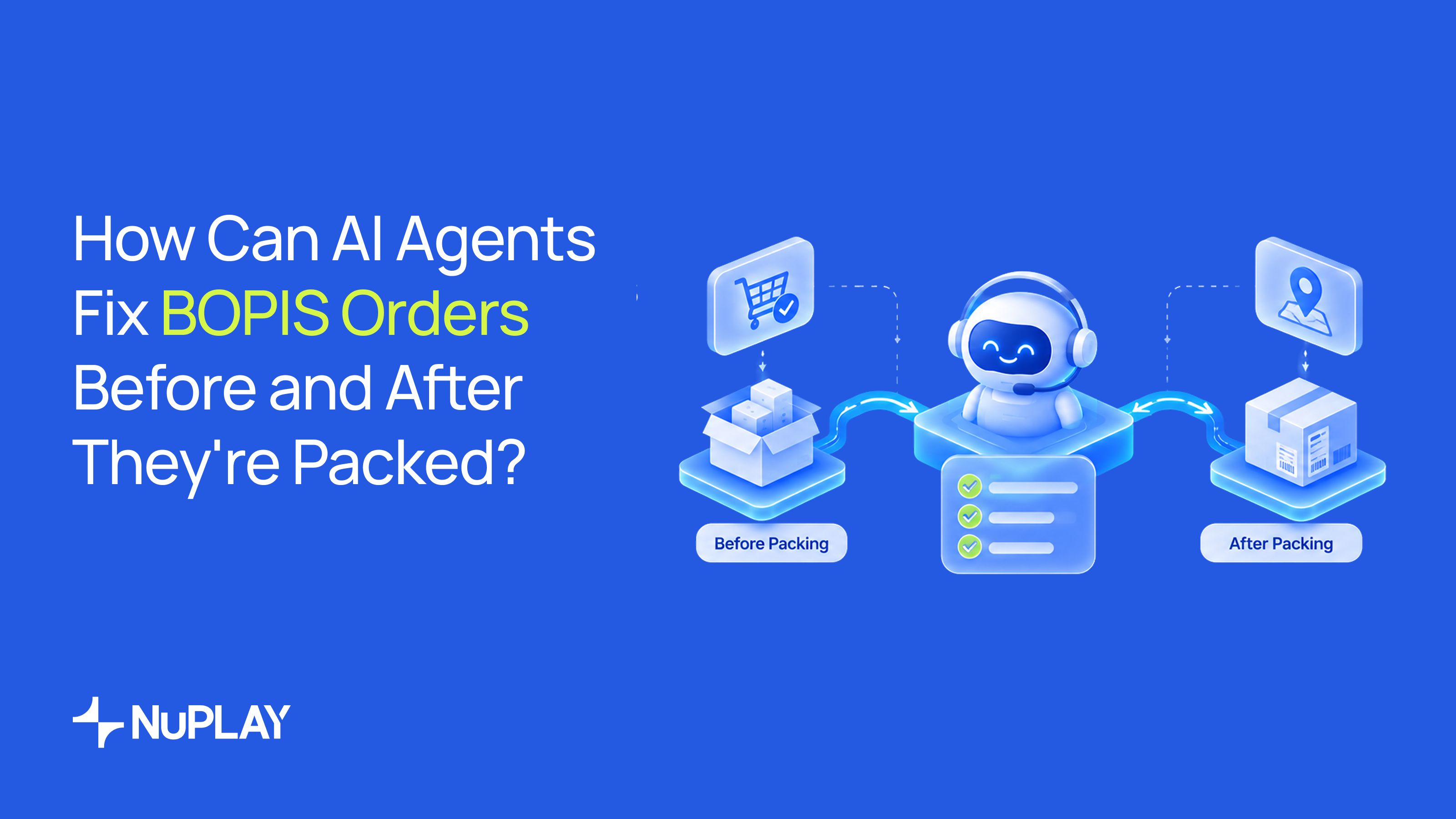
- Online pickup orders: problem orders flagged, substitutes suggested and customer approval collected. See our guide to BOPIS.
- "Is my order ready?" calls: order status answered from live data, with updates sent before customers call. See our guide to WISMO.
- New-hire "How do I...?" questions: procedures and systems explained on the floor, by voice.
Lookups come first because they build the trust that actions need later. Once associates rely on the agent for stock and policy, letting it hold stock, message customers and request approvals feels like a natural next step.
How does NuPlay's in-store associate agent work?
NuPlay's in-store associate agent resolves 95% of store associate queries autonomously (NuPlay). It is built for the hard cases above as much as the easy ones.
- Conflicting inventory: it reviews cycle counts and compliance audits against the retailer's standard, routes exceptions to the right owner and tracks each fix to close.
- Policy: every order, return, exchange, refund and loyalty decision cites the policy clause applied.
- Handover: when a case needs a person, it arrives with the history, intent and full customer context attached.
- Store tasks: promo packets and HQ directives become sequenced tasks with owners, with completion verified by photo.
- Customers first: delay alerts and pickup updates go out before the customer asks.
Three platform layers sit underneath. NuLoop is the self-improvement layer: it learns from every run and improves the workflow without a rebuild. NuContext is the shared context and memory layer, so the agent remembers what the store, the order and the customer already told it. NuPulse is the real-time monitoring layer, so store leaders see what the agent is doing and how well.
The agent works over voice, chat, web, email, SMS, mobile and messaging. It connects to POS, ERP and CRM; enterprise systems such as Workday, SAP, Salesforce, Oracle and ServiceNow; and commerce platforms such as Shopify, Salesforce Commerce Cloud and Magento. NuPlay holds ISO 27001, ISO 42001 and SOC 2 Type 2, and customer data is never used for training.
How do you measure an in-store AI agent's impact?
Track adoption, control and customer impact from the first week, against a baseline taken before go-live. Without a baseline, a strong result looks the same as a lucky month.
Checklist: what to ask before you deploy an in-store AI agent
- Which systems does it read, and what does it do when they disagree?
- How does it know which policy is current, and does it cite the clause it applied?
- Does it tell associates how sure it is, and route questions it can't answer?
- Which actions can it take alone, which need the associate to confirm, and which need a manager?
- Can associates flag a wrong answer in one tap, and who fixes it?
- Does it work by voice, in the languages your associates speak?
- What will you measure, and have you set a baseline?