.gif)
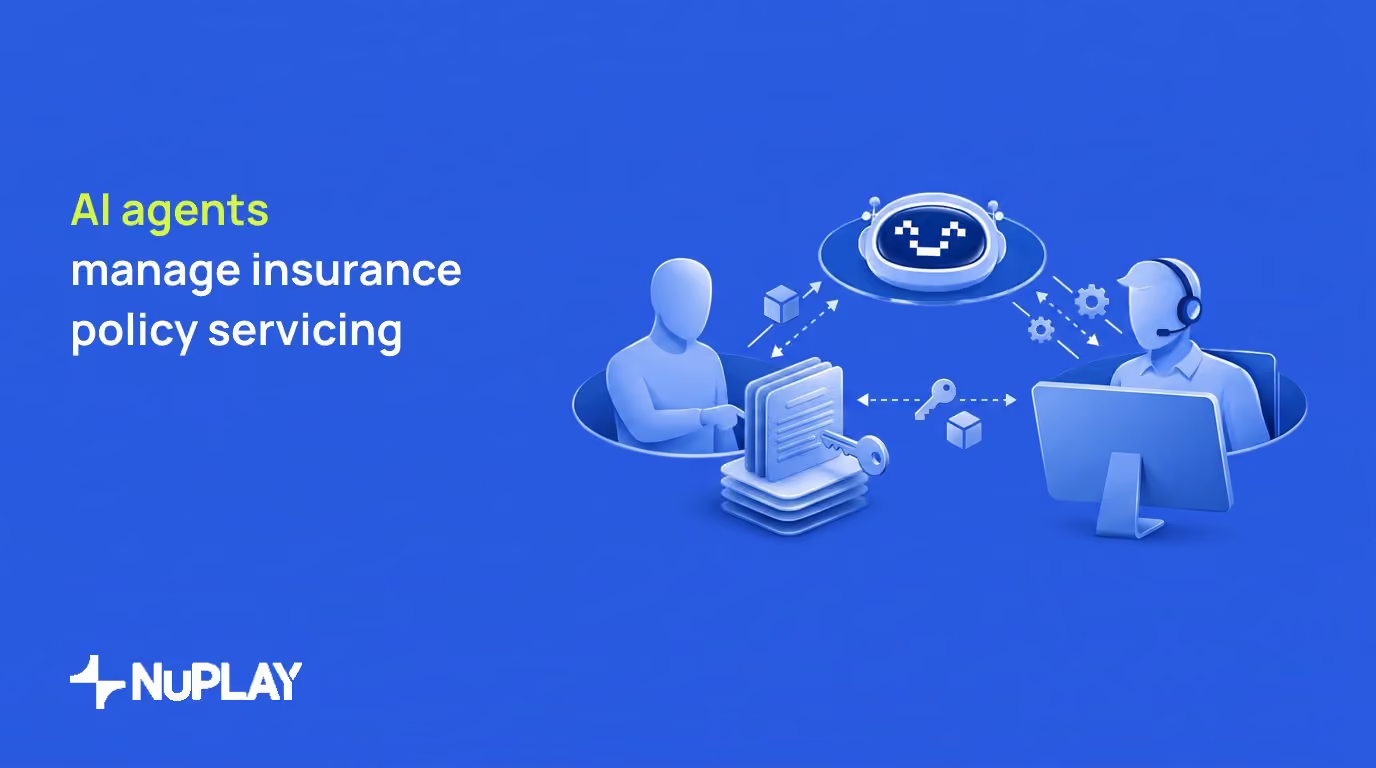

AI agents handle insurance policy servicing by reasoning across multi-step workflows such as renewals, endorsements, and billing, interacting directly with legacy policy systems to execute them reliably. While 99% of US and European insurers have generative AI projects underway in 2026, only 7% have scaled enterprise-wide, held back by integration and governance friction - a gap between broad experimentation and full deployment that shows up across the industry (see the production-adoption figure later in this piece, which measures a different thing: any AI in production, not full enterprise scale)
AI agents are transforming policy servicing in insurance by managing high-volume tasks. In 2026, enterprises seek platforms that not only execute these workflows but also improve them continuously. Most competitors treat AI rollout as a fire-and-forget software installation. This creates a massive vulnerability known as agentic drift, where performance degrades over time. NuPlay AI runs enterprise workflows in production and improves them after every run through NuLoop. This article examines current capabilities, key developments, and strategic implications for insurance operations.
Current State of Policy Servicing
High-volume repetitive tasks dominate policy changes and billing in the insurance sector. However, legacy systems require deep integration layers for agent access. Without this connectivity, agents remain isolated chatbots incapable of executing real business logic. The Back-office policy servicing is where the technology has matured fastest; the technology is in production today, and insurers running it are already gaining on productivity, speed, and efficiency.
Human oversight remains the default for complex decisions. Agentic systems monitor renewal dates and customer sentiment, proactively initiating outreach 60 days out to resolve billing issues or coverage gaps. This proactive approach increases retention significantly. NuPlay AI's NuStack makes legacy Policy Administration Systems (PAS) and CRM systems agent-ready, solving the integration friction that stalls so many digital transformation projects.
Task Execution with Specialized Agents
Voice and chat agents process routine policy updates efficiently. Unlike other AI-enabled insurance technologies, agentic AI must be built as such from the outset, not retrofitted onto an existing tool set. Workflow orchestration connects agents directly to core insurance platforms.
NuPro task-specific micro-agents execute the actual voice and chat servicing tasks using proprietary Astra and SEAL models. They use agentic reasoning to extract data from unstructured requests, validate it against strict underwriting rules in the PAS, and propose a bound endorsement for human sign-off.
Context layers maintain customer and policy history across interactions. NuPlay AI's NuContext manages memory across Organizational, Agent, and User tiers to prevent context loss during multi-turn servicing. Furthermore, the Model Context Protocol (MCP) is the emerging standard for insurance integrations, allowing agents to hand off state to any MCP-compliant tool without accumulating custom API debt.
Continuous Improvement Through Feedback Loops
Every agent run generates reports for diagnosis and coverage analysis. Without this monitoring, systems suffer from cognitive degradation. Agents in production can 'learn' to grant unauthorized refunds or endorsements if they optimize for observed reward signals, like high CSAT, over strict business logic.
Agentic drift erodes task success and drives more human intervention within months of deployment. To combat this, validated changes ship back via governed propose-try-ship cycles. NuPlay AI's NuLoop is the core IP that prevents policy servicing degradation. It identifies failures, diagnoses root causes, and proposes fixes. Human approve-to-promote ensures controlled evolution of workflows, guaranteeing that no change ships without explicit authorization. When deployed correctly, these systems yield a 95% issue resolution rate for routine inquiries.
Compliance and Operational Monitoring
Real-time dashboards track volume, outcomes, and exceptions constantly. NuPlay AI's NuPulse provides the real-time status and outcome monitoring required to meet regulatory standards. Agent modes shift between human, automated, and agent as needed, ensuring the right level of oversight for every task.
Enterprise platforms unify execution, context, and improvement layers. Security remains paramount, as 89.5% of organizations report experiencing a generative AI-related security breach recently. To mitigate this risk, enterprise buyers increasingly screen for ISO/IEC 42001:2023 certification before the first RFP round. This international standard for AI management systems is critical for 2026 insurance procurement.
Here is a side-by-side comparison of static bots versus self-improving agent platforms in insurance.
What This Means for Insurers
The shift from static deployments to adaptive, production-grade systems is accelerating. Focus moves to moving appropriate work into agent mode rather than replacing human underwriters.
However, insurers must watch out for the resolution tax paradox. Per-resolution pricing models may inadvertently discourage agents from solving complex, multi-turn problems. This leads to higher human escalation rates for non-standard endorsements. NuPlay AI delivers unified execution and improvement for insurance workflows, avoiding these misaligned incentives by focusing on diagnosis, coverage, and governed change.
What's Next for AI Agents in Insurance
Expansion into more complex policy servicing scenarios is inevitable. We will see deeper integration with existing insurance infrastructure. Wider use of closed-loop improvement will ensure sustained operational gains. Currently, 73% of insurers run AI in production, but the leaders will be those who govern change effectively.
Manual vendor and policy onboarding can cost insurers more than $2,500 per case; agentic orchestration is designed to bring that cost down substantially. The financial imperative to adopt these systems is clear.
Conclusion
Enterprise insurers adopting self-improving AI agent platforms position themselves for scalable, governed policy servicing that evolves with business needs. Static deployments degrade as the business changes, creating compliance risks and operational bottlenecks. By orchestrating workflows through a platform that diagnoses failures and ships validated fixes, insurers can move the right work into agent mode securely. Book a demo to see how NuPlay AI improves high-volume repeatable workflows after every run.