.gif)
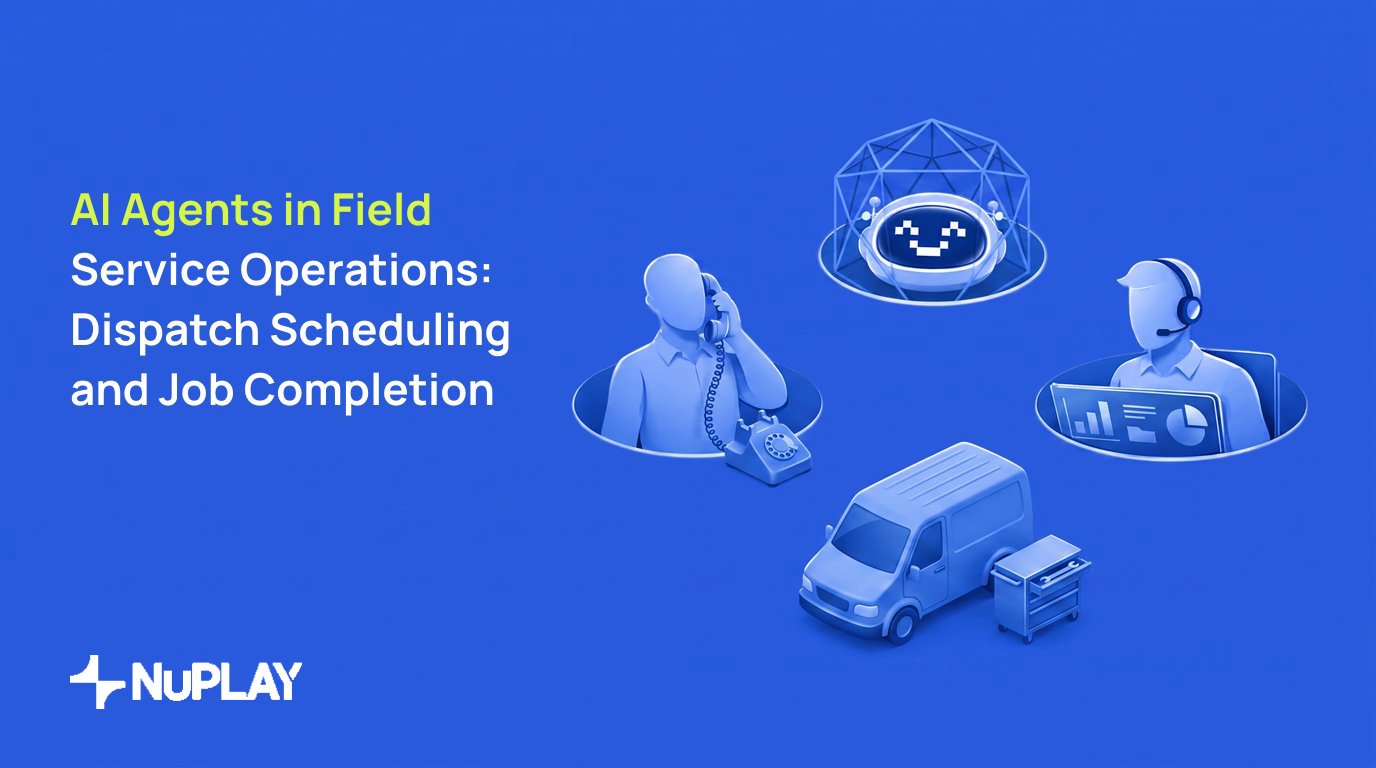

AI field service operations are moving from pilots to production across home services and related industries in 2026. Enterprises are applying agentic systems to dispatch, scheduling, and job completion to handle high-volume repeatable workflows. This shift focuses on governed automation that improves after every run rather than static deployments that degrade over time.
Most guides treat AI rollout as a fire-and-forget installation. They ignore the reality that static agents break when business rules change. NuPlay AI runs enterprise workflows in production and improves them after every run through a closed feedback loop. This keeps agents, the systems they operate, and the context they draw on aligned under one platform. This article explores how operations leaders are using these systems to solve the massive coordination challenges inherent to field service.
Current State of AI Field Service Operations
Production deployments in home services and retail operations are accelerating. The focus has shifted sharply to dispatch optimization and real-time routing. However, a massive execution gap exists. Many enterprises pilot AI orchestration, but few scale it to organization-wide production because of governance friction.
This gap is often caused by a misunderstanding of how these systems degrade. The canonical AI agent benchmark is a lie of omission. It captures performance on day one and says nothing about performance after the next change, as evaluation experts warn. Production agents exist in a world of constant background change.
To survive this change, enterprises require deep integration with existing workforce management systems. NuPlay AI's NuStack makes legacy field service systems agent-ready and orchestrates the end-to-end workflow. Without this build layer, orchestration efficiency drops. Currently, 81% of respondents say that without agentic orchestration, achieving a fully autonomous enterprise is impossible. The demographic reality adds pressure. With 50% of HVAC technicians in the US over 55, automation is no longer optional; it is a survival requirement.
Advances in Intelligent Dispatch
Agent-driven assignment based on skills, location, and availability replaces manual whiteboards. NuPlay AI's NuPro micro-agents handle the actual execution of dispatch tasks natively on proprietary models. These agents adjust in real time for cancellations, traffic delays, and emergency escalations.
Intelligent dispatch requires deep context. Context layers pull from organizational and user data to ensure the right technician goes to the right job. This level of orchestration drives a 30-40% reduction in fuel costs by optimizing routes dynamically. Closed-loop monitoring of these dispatch outcomes ensures that the routing logic improves continually based on actual field results.
Dynamic Scheduling Improvements
Scheduling models must refine themselves after each job. Multi-tier context tracks customer preferences, property constraints, and technician certifications. Orchestration across field teams and back-office systems ensures that a schedule change reflects immediately in the billing and inventory modules.
This requires governed changes through report, diagnose, propose, try, and ship cycles. NuPlay AI's NuLoop ensures scheduling models improve after every job by diagnosing failures and shipping validated fixes. This closed feedback loop is the core differentiator for production systems. Without it, agentic drift takes over. Agentic drift is the behavioral degradation of agents in production over time, steadily reducing task success rates within months of deployment.
Automated Job Completion Workflows
Job completion is historically the most error-prone phase of field service. Agents now handle documentation, photos, and customer sign-offs autonomously. When a technician finishes a job, the agent updates the inventory and billing systems directly.
This transition of tasks from human to agent mode yields massive efficiency gains. Organizations report a 35% improvement in first-time fix rates because agents orchestrate real-time data lookups and diagnostic support before the technician even arrives. NuPlay AI's NuPulse provides the real-time visibility into volume and success rates needed to monitor these job completions. Feedback collection feeds directly into the improvement loops, ensuring the next job runs smoother than the last.
What This Means for Enterprise Operations
For decision makers, this translates to reduced manual coordination in high-volume field workflows. A platform approach combining execution, context, and continuous improvement is replacing fragmented point tools. The accuracy-reliability gap is the industry's biggest blind spot.
By 2026, the divide in enterprise AI is between organizations that ship static pilots and those that build infrastructure for continuous, governed improvement. If a system cannot diagnose its own failures, it is a liability. This is why risk-managed rollout with approve-to-promote controls is mandatory. Under ISO 42001, organizations must maintain human accountability. This pattern ensures every AI-proposed fix is validated by a human before shipping to production. Enterprise buyers increasingly screen for this certification before the first RFP round.
The demographic pressure raised earlier in this article - half of US HVAC technicians over 55 - points to a second, related use case: capturing senior technicians' diagnostic knowledge in the agent's context layer before that expertise leaves the workforce, rather than only optimizing dispatch for the technicians who remain.
What's Next for AI Field Service Operations
We will see deeper integration of self-improving agents across the full job lifecycle. Expansion of agent modes will reach into collections and mortgage servicing, where field inspections require strict compliance tracking.
However, Gartner predicts that over 40% of agentic AI projects will be canceled by the end of 2027 due to escalating costs, unclear business value, or inadequate risk management. To avoid this, organizations must adopt unified platforms for build, execute, and monitor functions. Continued emphasis on governed change over static automation will separate the successful deployments from the failed pilots.
Conclusion
Enterprises adopting AI field service operations in 2026 gain production-grade dispatch, scheduling, and completion capabilities that improve through structured feedback loops. Static deployments break when business rules change, but a self-improving platform diagnoses its own failures and proposes governed updates. By moving the right work into agent mode with strict human oversight, operations leaders can scale their field teams efficiently. Book a demo to see how NuPlay AI orchestrates these complex workflows in real-world environments.