.gif)

How SLMs are built, fine-tuned, and trained
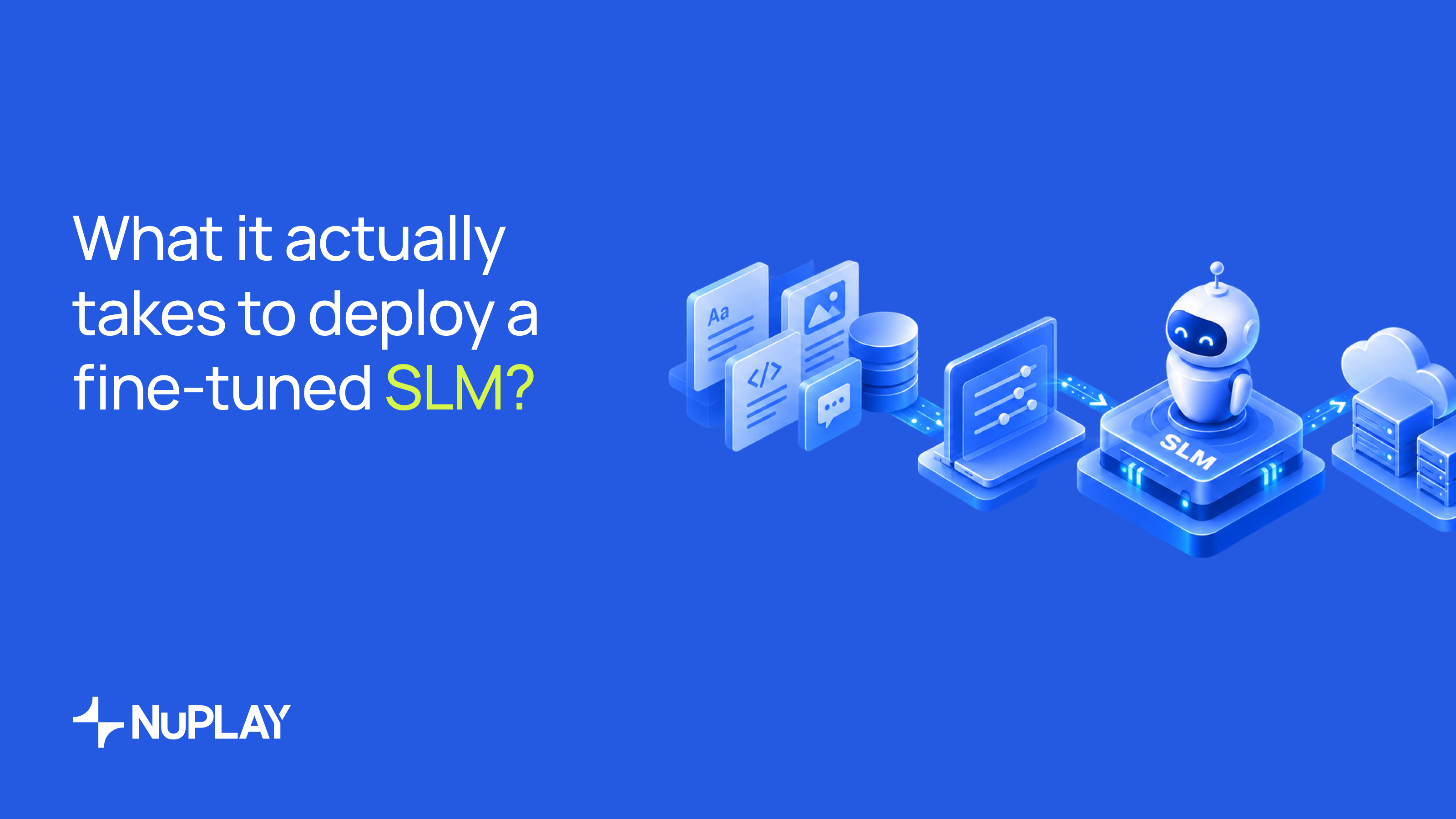
Before getting into what deployment actually takes, it helps to understand what actually happens on the way to a working small language model.
Starting architecture. An SLM typically starts from a smaller, efficient base built for fast, focused responses rather than maximum breadth - the opposite design goal of a large, general-purpose model.
Fine-tuning. That base is then trained further on domain-specific data - the actual conversations, policies, and decisions relevant to the business or task it's meant to serve. This is what turns a generic starting point into a model that actually understands a specific business, rather than one that's simply been told about it.
Data. Real conversation data does most of the work, but it's rarely enough on its own - synthetic edge cases usually get added to cover scenarios that matter but don't occur often enough in real data to train on reliably.
Optimization. Once fine-tuned, a model is often compressed, or quantized, for production use - a step that reduces memory and compute needs, which translates directly into lower latency and a smaller infrastructure footprint at deployment.
Evaluation. Before anything goes live, it's tested against real business outcomes and known failure modes - not just generic benchmarks that say little about how it'll actually perform on a specific enterprise's calls.
Continuous training. The best implementations don't stop after the initial build. Production feedback - corrected errors, edge cases the model missed - gets folded back into future training, so the model keeps improving as a business's needs evolve.
That's the full arc behind a genuinely fine-tuned SLM. What it doesn't answer is the question every enterprise actually has to make a call on: who does this work, and how much of it has to happen before a model is actually ready to handle real customer conversations?
Most enterprises land on the same two assumptions. Either deploying a fine-tuned SLM means building this entire process in-house - months of work, a team that doesn't exist yet, a timeline that keeps slipping - or it means settling for a vendor's model that's fast to turn on but never really went through that process for your business specifically.
Neither assumption is quite right. What deploying a genuinely fine-tuned SLM actually takes isn't always building it yourself - but it does mean the full lifecycle above has to happen for your business, one way or another.
What "fine-tuned" actually means
The word gets used loosely. A model with a longer system prompt, a few example conversations bolted on, or a custom "persona" layered over a general-purpose base often gets called fine-tuned - but none of that changes what the model actually knows.
Real fine-tuning means the model has learned from a business's own conversations, policies, and edge cases - the actual shape of how customers ask questions, the actual language used internally to answer them, the actual exceptions that come up often enough to matter. That's a different thing from prompting a generic model to sound like it knows your business.
The difference shows up exactly where it matters most: the calls that don't fit the obvious script.
What deploying a small language model actually requires
The build process above is the same regardless of who's doing it. What changes is who has to run it, for a specific enterprise, at production quality - and that's where two more stages come in, beyond the model itself.
Governance and guardrails. Enterprise voice interactions touch compliance, policy, and customer trust. That means the model's behavior needs to be predictable and auditable, with guardrails built into how it's trained, not bolted on as an afterthought.
Deployment and monitoring. Getting a model live is one milestone. Watching for drift as real-world conversations shift, and retraining before that drift becomes a customer-facing problem, is the ongoing work most people don't think about until it's already an issue.
None of this is optional if the goal is a model that's actually fine-tuned, rather than one that just claims to be. It's also exactly why most enterprises never make it past step one on their own.
The false choice most vendors sell
This dilemma barely exists for large language models - building one from scratch is out of reach for nearly every enterprise, full stop. It's specifically because SLMs are smaller and more approachable that "maybe we build our own" ends up on the table at all. That's exactly why this choice needs a clearer answer than it usually gets.
Faced with that full SLM lifecycle, most options on the market sit at one of two extremes.
Fully DIY - build an entire SLM pipeline from scratch: your own data preparation, fine-tuning, evaluation, and monitoring, run by a team with real data science and ML engineering expertise. Infrastructure, months of work, and a team that likely doesn't exist yet. Realistic for very few enterprises, and a significant bet even for the ones who can pull it off.
Fully generic - deploy a vendor's off-the-shelf SLM, wrapped in your branding and a prompt describing your business. Fast, but that SLM never actually went through fine-tuning for your business specifically - it's borrowing the appearance of customization without the substance of it.
Neither is the real answer for most businesses. What actually matters isn't whether you built the SLM pipeline yourself - it's whether the small language model that comes out the other end genuinely understands your customers. The option that gets skipped is an SLM that's gone through that full fine-tuning lifecycle for your specific enterprise, without requiring you to build and operate the pipeline yourself.
What real specialization changes
When a model has actually been through that process on a business's own data - not just prompted to imitate it - the difference shows up in outcomes that are easy to feel and hard to fake:
Fewer escalations. A model that's seen a business's real edge cases handles more of them correctly the first time, instead of routing anything unfamiliar to a human.
Higher resolution rate. Understanding a business's specific policies and products means fewer calls that end in "let me transfer you" because the model genuinely didn't know the answer.
Less handle time. A model trained on how a business's customers actually talk doesn't need extra back-and-forth to understand what's being asked - it recognizes the request the way a well-trained agent would.
None of this comes from a longer prompt. It comes from a model that's actually been through the full fine-tuning lifecycle for that business, not one that's been told about it once and asked to remember.
Owning the outcome, not the infrastructure
The real question most enterprise leaders are asking isn't "how do we build a model-tuning pipeline." It's "how do we get a model that genuinely understands our business into production, without that becoming a multi-quarter engineering project."
Those are different problems, and they call for different answers. A business doesn't need to own the data pipelines, the evaluation frameworks, or the monitoring infrastructure to get the benefit of a properly fine-tuned model - it needs the outcome that lifecycle produces: a model that already knows how its customers talk, without having to build the factory that gets it there.
Where Astra fits

Astra is built around exactly this idea. Astra SLM isn't a generic model with a custom prompt on top - it goes through that full lifecycle per enterprise from the start: trained on how each business actually talks to its customers, evaluated against real outcomes, and built to keep learning as that business evolves.
The pipeline is ours to run. The outcome - a model that genuinely understands your business - is what you get, without building any of it yourself.
The bottom line
Fine-tuning isn't a feature you switch on, and deploying a real one isn't a weekend project. It's the difference between a model that was told about your business once, and one that's actually been through the work of learning it - and that difference is exactly what shows up in fewer escalations, higher resolution, and calls that get handled the first time.
That's the standard Astra SLM is built to meet, without asking you to build the infrastructure to get there.