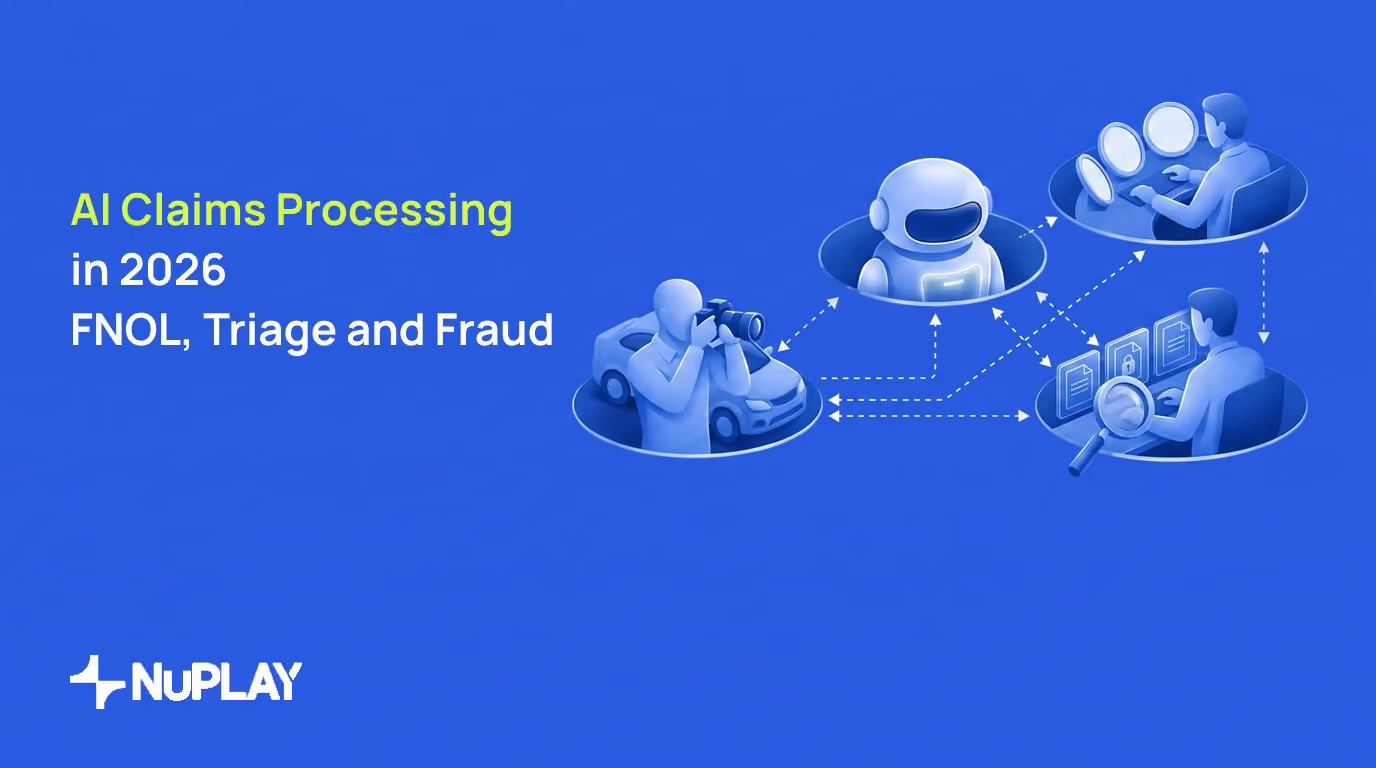

AI claims processing uses software agents to run the claims workflow: capturing first notice of loss (FNOL), reading documents, triaging by severity, flagging fraud signals and handing each file to an adjuster with a decision-ready summary. People approve coverage and payment decisions, and every step is logged for audit.
According to the 2025 J.D. Power U.S. Property Claims Satisfaction Study, the average time from first notice of loss to final payment is now more than 44 days, and claims finished within 10 days score 762 on a 1,000-point satisfaction scale. Insurers use claims processing automation to shorten the slow, manual steps in that cycle.
What is AI claims processing?
AI claims processing is the use of AI agents to carry out repeatable claims tasks, from intake and document reading to triage, fraud screening and routing, while adjusters keep the coverage and payment decision. It differs from basic rules automation because it can read unstructured documents, photos and call transcripts, not just fixed form fields.
The stages below are where insurers apply claims automation first. Each row shows what the software does and where a person stays in the loop.
How AI handles first notice of loss (FNOL)
FNOL is the first point where claims data is captured, and errors made here travel through the rest of the claim. An AI intake agent can take the report by phone, chat, email or web form, ask the follow-up questions a handler would ask, and write a structured record to the claims system.
It also checks the reported loss against the policy: is the policy active, is the loss type listed, are required details missing. Incomplete or ambiguous reports go to a person rather than moving forward with guesses. For a deeper look, see our guide to AI for FNOL handling.
Document intake and data extraction
Most claims arrive as a bundle: photos, estimates, invoices, police reports, medical records and emails. Intelligent document processing classifies each item, extracts the fields that matter (dates, amounts, parties, policy numbers) and validates them against the policy and the system of record.
Mismatches are flagged for review instead of passing through silently. This is the step that removes most re-keying, and it is usually the safest place to start because the output is easy to check against the source document.
Claims triage and routing
Triage decides how much human attention a claim needs. Software can score each claim on severity, complexity, coverage questions and fraud indicators, then send simple, low-value claims down a fast path and complex or high-value claims to a senior adjuster.
Routing can also account for line of business, adjuster skill, workload and geography. The insurer sets the thresholds. Anything below a confidence threshold, or above a value limit, goes to a person.
Fraud signals and referral
The Coalition Against Insurance Fraud estimates that insurance fraud steals at least $308.6B every year from American consumers and that fraud occurs in about 10% of property-casualty insurance losses. Claims software helps by surfacing signals a handler may miss across a large queue.
Typical signals include mismatched dates or amounts across documents, repeated details across unrelated claims, and photo or document anomalies. A signal is a reason to look, not a finding. The referral goes to the special investigations unit, which decides whether to investigate, and the claimant is treated according to the insurer's fair claims handling rules.
Subrogation identification
Subrogation is the insurer's right to recover payment from a responsible third party. Opportunities are often missed because nobody reads the file for recovery potential until after payment.
An agent that already reads the claim for intake and coverage can flag recovery signals at the same time, such as a third-party driver, a defective product or a contractor at fault, and route them to the recovery team. For the full workflow, read AI for insurance claims, subrogation and underwriting.
Adjuster handoff
The handoff is where automation pays off or fails. A good handoff gives the adjuster a single file: the structured facts, extracted documents, coverage checks, fraud flags, reasons for the routing, and a list of what is still open.
The adjuster then makes the decision, rather than collecting information first. If the agent cannot complete a step, it should say so and hand over the case with what it has, not hide the gap.
Compliance and audit trail
Claims decisions are regulated, so an AI workflow needs records that show what happened and who approved it. The National Association of Insurance Commissioners (NAIC) adopted its Model Bulletin on the Use of Artificial Intelligence by Insurance Companies in December 2023. It reminds insurers that decisions or actions made or supported by AI must comply with all applicable insurance laws and regulations.
In practice, that means four things to ask of any claims automation:
- Every classification, extraction and routing decision is logged and traceable.
- Human approval is required for coverage, denial and payment decisions.
- Data protection, access controls and retention match your jurisdiction.
- Changes to the workflow are reviewed and approved before they ship.
NuPlay AI maintains SOC 2 Type 2 and ISO 27001 certifications and supports HIPAA and GDPR compliance requirements. Buyers should still validate controls against their own claims workflow and state rules.
How to start: a controlled rollout
Start with one claim type and one stage, such as FNOL intake or document extraction, and measure it against your current process. Useful measures are time to first contact, share of claims routed correctly, rework, escalation rate and adjuster time per file.
NuPlay AI runs enterprise workflows in production and improves them after every run through NuLoop, with agents, the systems they operate, and the context they draw on under one platform. Improvements are proposed, tested against past runs and shipped only after a human approves. The closest insurance proof point is First Mid Insurance Group, which reported a 25% increase in team productivity and 100% of its workflows automated. That is a training workflow, not a claims result.
Comparing providers? See AI agent vendors for insurance carriers. For the voice channel, see AI for insurance claims: voice AI and processing costs. For servicing after the claim, see AI agents in insurance policy servicing.
Book a demo to see how a claims workflow runs on NuPlay AI.