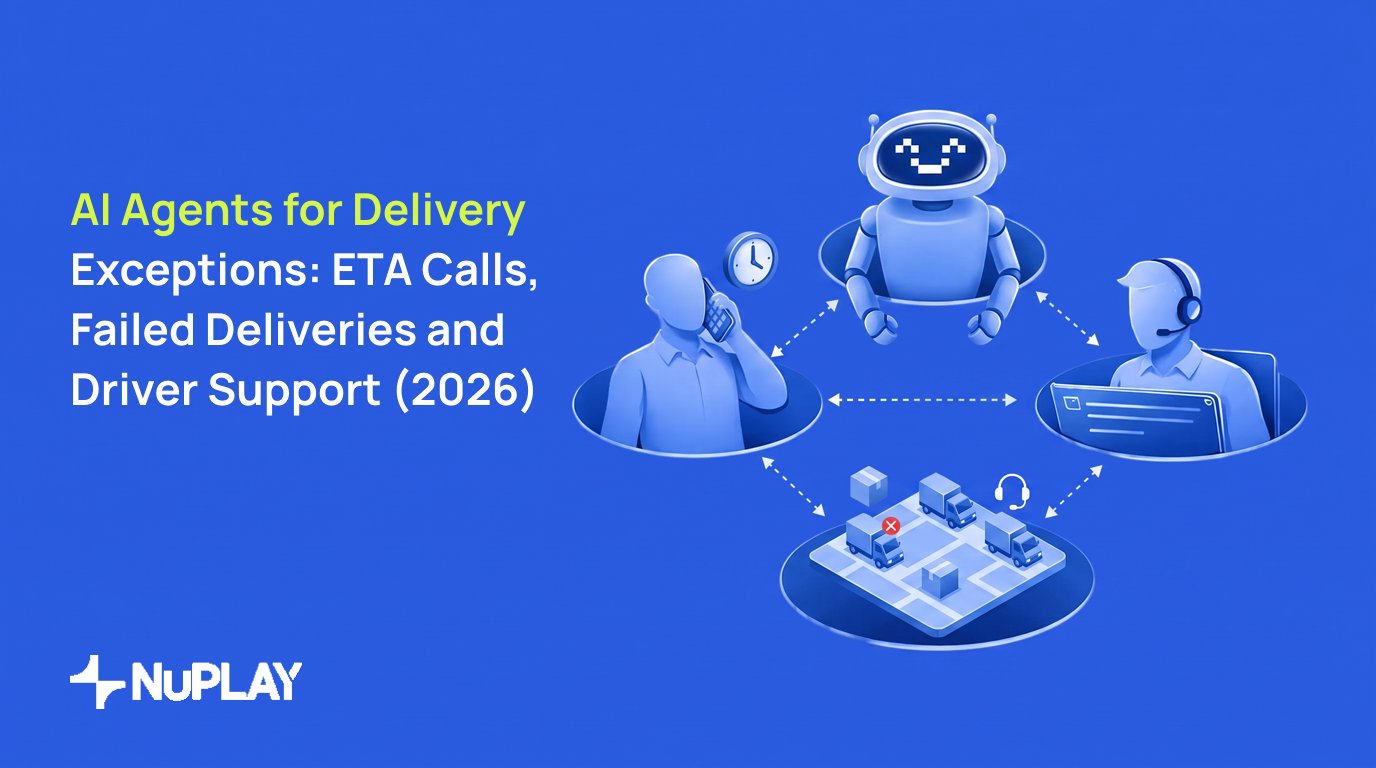

Artificial intelligence (AI) agents for delivery exceptions can monitor verified events, gather context, offer policy-approved choices, update customers and drivers, and escalate cases they cannot safely resolve. The control model is simple: automate routine actions, require confirmation before promises, and keep humans responsible for safety, fraud, financial disputes, and policy exceptions.
What are AI agents for delivery exceptions?
AI agents for delivery exceptions are software agents that detect or receive delivery problems, collect the relevant operational context, apply defined policies, communicate through approved channels, and either complete a permitted action or escalate the case.
A delivery exception is an event that stops a shipment or service visit from proceeding as planned. Examples include a late route, failed delivery attempt, address or access issue, damaged or missing item, customer refusal, or driver no-show.
The goal is not to promise that every exception will be resolved automatically. Instead, measure the elapsed time from a verified exception signal to a confirmed recovery plan, separately for each exception type. A recovery plan might be a confirmed reattempt slot, a corrected access instruction, a dispatcher escalation, or a claims case with the required evidence.
Start with a policy, not a prompt
Use a three-level authority model so the agent can act on routine cases while people retain decisions that create financial, safety, or customer-trust risk.
This model separates communication from authority. An agent may explain what happened or collect information without being allowed to approve a refund, change a delivery zone, or make a safety decision.
It also creates a clear stop condition. If required data is missing, the system of record rejects an update, or the request falls outside policy, the agent should stop and escalate rather than improvise.
The National Institute of Standards and Technology’s Artificial Intelligence Risk Management Framework: Generative Artificial Intelligence Profile identifies governance, pre-deployment testing, content provenance, and incident disclosure as primary considerations for managing generative artificial intelligence risk. Those considerations support treating the authority model, test records, source data, and incident process as part of the workflow design, not as later documentation. NIST AI 600-1, July 2024
Build the exception workflow in seven steps
1. Define the trigger
Start with the events that can create an exception:
- A driver-app event
- A delivery-management-system event
- A carrier feed
- A customer contact
- A dispatcher or partner update
For every trigger, record the source, timestamp, stop status, and confidence. A customer message that says “the driver is not here” should not automatically override a more recent verified stop status. The workflow needs a rule for handling conflicting signals.
2. Assemble decision-relevant context
Give the agent only the information needed for the decision and communication. Depending on the exception, that may include:
- Order and item details
- Latest route status
- The source of the ETA
- Available delivery capacity
- Service-level agreement rules
- Delivery preferences and contact permissions
- Prior delivery attempts
- Driver or dispatcher notes
- Relevant case history
Context should be current enough for the action being considered. A previously available reattempt slot is not a confirmed option until the delivery system accepts the reservation.
3. Classify the exception and apply policy
The agent should identify the exception type, check whether the requested action is eligible, and stop when required information is missing.
For example, “recipient unavailable” on a first attempt may allow the agent to offer approved slots. “Recipient unavailable” on a third attempt may require a human review, even if the customer asks for another delivery. Classification should therefore route the workflow, not grant unrestricted authority.
4. Select a permitted channel
Coordinate voice, chat, WhatsApp, and email around customer preference and consent. The message should explain:
- What happened
- Which approved choices are available
- What the customer needs to do next
- How to reach a person
Channel selection should be part of policy. Do not assume that a channel is permitted for every customer, jurisdiction, carrier, or type of contact.
5. Confirm before promising
The agent should reserve a slot, update an access note, or create a case only after the system of record confirms the action.
This confirmation gate is intended to reduce the risk of telling a customer that a new delivery time is confirmed when the booking system rejected the change. The customer-facing message should be generated from the confirmed result, not from the agent’s intention.
6. Send a structured field update
The driver or dispatcher needs a concise operational update, not the entire customer conversation. Include:
- Revised stop or delivery instruction
- Customer preference
- Completed action
- Relevant access or contact note
- Escalation status
- Any remaining decision required
A structured update makes it easier for the next person to act without asking the customer to repeat the situation.
7. Escalate with context
An escalation should include the exception type, source data, transcript or message history, supporting evidence, proposed next action, and the reason the agent stopped.
“Unable to resolve” is not enough. The receiving team should know whether the agent stopped because the ETA was uncertain, no permitted slot remained, the address appeared outside the delivery zone, or the case involved a safety or financial decision.
Worked example: recovering a failed delivery
Hypothetical example
At 3:05 p.m., a driver records “recipient unavailable” for order #4812. The agent confirms that this is the first failed attempt and that two policy-approved slots remain: Wednesday from 5–7 p.m. and Thursday from 9–11 a.m.
It messages the opted-in customer:
We could not complete delivery of order #4812. Choose 1 for Wednesday 5–7 p.m. or 2 for Thursday 9–11 a.m. Reply HELP to speak with our team.
The customer replies “2.”
The agent reserves Thursday’s slot through the delivery system, writes the decision and transcript to the order timeline, and sends a structured dispatcher update:
Reattempt confirmed: Thu 9–11 a.m.; customer unavailable at first attempt; no access issue reported.
The agent has completed a permitted recovery action. It has not changed the delivery policy, approved compensation, or made a promise before the system confirmed the slot.
The failure branch must be explicit. If neither slot is available, the request is outside the delivery zone, or this is a third failed attempt, the workflow should create an escalation rather than propose an unapproved resolution. The escalation can include the customer’s response, prior attempt count, available capacity, and the policy rule that prevented automatic action.
Launch narrow, test on real operating conditions, then expand
Begin with one or two high-volume, lower-risk exception types, such as customer-unavailable events and ETA-status inquiries. Avoid starting with damage claims, safety incidents, fraud reviews, or high-value disputes simply because those cases appear operationally urgent.
A controlled rollout can follow this sequence:
- Shadow mode for two to four weeks. The agent processes the cases and generates proposed actions, but humans retain decision authority. Compare the proposed action with what the operations team actually did.
- Review a practical sample. Where volume permits, review 100–200 recent cases per exception type. Include stale tracking data, ambiguous replies, policy-boundary requests, and failed integrations.
- Record the reason for every disagreement. Separate data problems, policy gaps, integration failures, classification errors, and communication problems.
- Re-test after changes. Run the historical set again after a policy, integration, prompt, or model change. A change that helps one exception type should not silently weaken another.
- Expand by risk and evidence. Add new exception types only when the workflow has clear authority limits, reliable source data, a tested escalation path, and a named operational owner.
Testing should include the conditions that make delivery exceptions difficult in practice. Examples include two conflicting ETAs, a customer who replies with an unsupported request, a driver note that lacks detail, an unavailable booking slot, and a system timeout after the customer has selected an option.
For United States outbound voice, the Federal Communications Commission’s February 2024 ruling says that Telephone Consumer Protection Act restrictions on artificial or prerecorded voices cover current artificial intelligence technologies that generate human voices. Such calls require prior express consent from the called party unless an emergency purpose or exemption applies. The FCC ruling is not a substitute for jurisdiction-specific legal review. Obtain legal advice on applicable consent, disclosure, recordkeeping, and opt-out requirements before using automated voice calls. FCC-24-17 Declaratory ruling text
Measure recovery quality, not just deflection
Report results by exception type. Do not combine customer-unavailable events with damage claims, safety incidents, or high-value disputes into one overall rate.
Track:
- Eligible exception resolution rate: The share of cases that met the rules for agent action and reached a confirmed permitted outcome.
- Median exception-to-plan time: The middle elapsed time from a verified exception signal to a confirmed recovery plan.
- 90th-percentile exception-to-plan time: The time within which nine out of ten measured cases reached a confirmed plan.
- First reattempt success rate: The share of reattempts that complete successfully on the first approved reattempt.
- Policy-violation rate: The share of cases where the agent took or communicated an action outside its authority. Set the target at zero.
- Repeat-contact rate: The share of cases that require another customer contact about the same exception.
- Escalation completeness: Whether the receiving team obtained the source data, transcript, evidence, proposed next action, and reason for escalation.
These measures expose different problems. A low resolution rate for safety or high-value dispute cases can indicate appropriate controls rather than poor performance. A high repeat-contact rate on routine ETA inquiries may indicate stale data, unclear messages, or an incomplete handoff.
Review measures alongside samples of actual cases. A dashboard can show that an action was marked complete, but only a case review may reveal that the customer received an update before the booking system confirmed it.
Where a self-improving workflow fits
For a logistics or retail team, the agent is only one part of the exception workflow. The systems it operates, the context it receives, the policy controls, and the review process also affect whether the workflow produces a usable recovery plan.
NuPlay AI describes its platform this way:
NuPlay runs enterprise workflows in production and improves them after every run through NuLoop, with agents, the systems they operate, and the context they draw on under one platform.
In the delivery-exception context, NuLoop records runs, identifies patterns, proposes scoped changes, replays them against past and simulated runs, and by default requires human approval before promotion. The stages are Report, Diagnose, Propose, Try, and Ship. This makes the improvement process a governed change process rather than an instruction to let an agent rewrite operational policy on its own. NuLoop
This approach is relevant to AI agents for consumer services, where customer, field-team, and partner workflows may share status, scheduling, escalation, and support tasks.