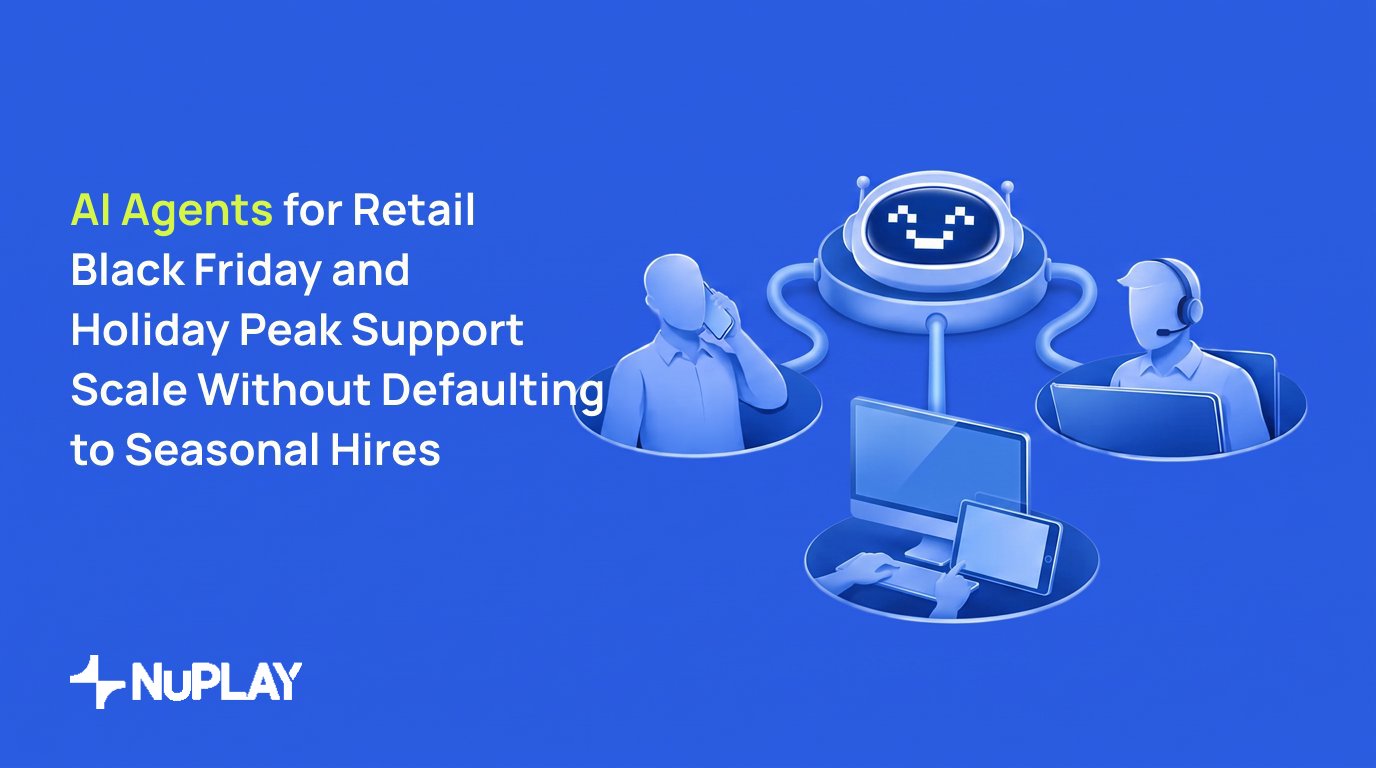

Artificial intelligence (AI) agents for holiday peak retail support can absorb predictable, policy-bound requests such as order tracking and standard return questions, giving people more capacity for exceptions. They do not make seasonal hiring automatically unnecessary. Results depend on current data, controlled actions, stress tests, transparent escalation, and a staffed human path for complex or high-risk cases.
What is AI agents for retail support?
In this context, an AI agent is software that uses a large language model (LLM) to produce an output or decision and, where authorized, complete steps in a support workflow. Unlike a static frequently asked questions page or a chatbot that only points to help-center links, an agent may retrieve current order information, apply a documented policy, or route a case with relevant context.
A peak-support workflow may span voice, chat, WhatsApp, and email. The control logic should remain consistent across channels: resolve clearly defined requests, verify live information before taking action, and transfer cases that exceed the agent’s authority.
For a retailer preparing for Black Friday on November 27, 2026, the practical question is not whether every support contact can be automated. It is which work is repetitive enough to automate, which actions require controls, and which situations should reach a person immediately.
Decide what the agent should resolve, assist with, or escalate
Use this decision grid to set the boundary before choosing technology or measuring containment.
The goal is not to maximize autonomous resolution. It is to set a defensible boundary for each decision.
The risk increases when an agent can change an order, issue value, or make a promise that the retailer cannot fulfill. A customer asking to cancel a low-value order before fulfillment may fit an agent workflow. The same request for a high-value order, a shipped order, or an order with conflicting status data should follow a different path.
This boundary also applies to the agent’s language. If the system cannot retrieve current fulfillment data, it should say that it cannot verify the status and transfer the request. It should not infer that an order has shipped, that a refund has been issued, or that a cancellation succeeded.
Build the minimum peak-ready foundation
Before introducing new automation, prepare the workflow, data, permissions, and human coverage around it. The National Institute of Standards and Technology (NIST) AI Risk Management Framework is intended for voluntary use and helps organizations incorporate trustworthiness considerations into the design, development, use, and evaluation of artificial intelligence systems. Its Generative Artificial Intelligence Profile focuses on risks and actions specific to generative systems.
Use the framework below as a practical preparation sequence.
1. Mine last season’s contacts
Group tickets and conversations by intent. Rank those intents by:
- Contact volume
- Handling time
- Repeat contact
- Operational risk
- The systems or teams needed to resolve them
Start with one or two narrow intents instead of attempting to cover every support workflow. Order tracking, delivery estimates, and standard policy questions are often easier to define than exceptions involving fraud, damaged goods, or disputed delivery.
The aim is to understand the work behind the queue. A request that sounds simple may require several checks before the retailer can answer it safely.
2. Turn tribal knowledge into approved source material
Write down the rules that support staff currently apply from memory. Confirm:
- Delivery promises and cutoff dates
- Return and exchange rules
- Cancellation conditions
- Store-pickup exceptions
- Promotion and price-adjustment rules
- Escalation ownership
- High-value order handling
Remove expired promotions and conflicting help-center content. An agent cannot apply a policy consistently when different pages or internal documents describe different rules.
Assign an owner to each policy source. That person should be responsible for reviewing changes before the agent can use them during peak trading.
3. Connect the records required to answer or act
A useful agent needs permissioned access to the current information required for its task. Depending on the workflow, that may include:
- Order and payment status
- Fulfillment and carrier status
- Inventory or pickup status
- Product and purchase-date information
- Customer verification data
- The current policy source
- The destination queue for escalation
If the required information cannot be retrieved reliably, the agent should disclose the limitation and transfer the conversation rather than guess.
This is especially important for account-changing actions. A cancellation, address change, replacement, or refund should depend on the current state of the order, not only on what the customer says or what an earlier system message reported.
4. Write action boundaries and handoff rules
Define which actions the agent may recommend, which it may complete after confirmation, and which require a person.
For each action, document:
- The identity checks required
- The order or customer conditions that must be true
- Whether a customer confirmation is required
- Whether a human approval is required
- What gets logged
- Which queue receives an exception
- What information the person receives
The handoff should include the transcript, customer verification state, order details, policy used, and actions already attempted. A customer should not have to repeat the same explanation because the first system failed to pass context to the next person.
5. Test the failure paths, not just the happy paths
Create a practical evaluation set of roughly 50 to 100 de-identified historical cases per initial intent. This is a planning recommendation, not a universal sample-size requirement.
Supplement ordinary cases with:
- Policy exceptions
- Incomplete or conflicting data
- Repeat contacts
- Shipped orders
- High-value orders
- Disputed deliveries
- Requests outside the agent’s scope
- Attempts to manipulate the agent into bypassing a control
- Handoffs made near queue-closing time
Review whether the agent chose the correct operating mode, not only whether its wording sounded helpful. A polished answer that triggers an incorrect cancellation is a failed outcome.
Worked example: “Please cancel my order”
The following is a hypothetical example of a controlled cancellation workflow.
A customer contacts support two hours after placing an order and asks to cancel. The agent verifies the customer using the retailer’s approved process, retrieves the live fulfillment status, and checks whether the item is still cancellable. If the order is eligible, it presents the cancellation for confirmation, records the action, and sends the confirmation. If the item has shipped, the agent does not say the order is cancelled. It explains the next approved return option or routes an exception to a person. If the order exceeds the retailer’s high-value threshold, the agent routes it to the priority queue before any action.
The success condition is not simply that the agent answered quickly. It is that the customer receives either a completed, auditable cancellation or a truthful next step without having to repeat the story.
A published Jomashop customer story describes a similar design principle. Its cancellation workflow checked live item status before telling a customer an order was cancelled, routed high-value orders through a priority path, and passed escalation context into the sales order. The story also describes a deliberately narrow initial scope covering order tracking, cancellations, and lost or delayed orders, while leaving other workflows outside the first launch.
That example does not establish a universal result for retailers. It shows why the workflow design matters:
- Verify before acting. The system confirms the customer using the retailer’s approved process.
- Check current status. It retrieves live fulfillment information before making a promise.
- Apply the relevant boundary. High-value or unclear cases follow a different route.
- Confirm the action. The customer knows whether the cancellation actually occurred.
- Preserve context. A person receives the details of what was checked and attempted.
Treat the 2026 peak as a control point, not a rushed transformation
As of November 11, 2026, Black Friday is close. If an account-changing workflow has not been tested with current order data, policies, permissions, and staffed escalation, introducing it immediately before peak creates avoidable risk.
For this year, prioritize preparation that reduces failure without expanding the automation boundary:
- Confirm that delivery, return, cancellation, and pickup policies are current.
- Review existing self-service content for conflicting or expired instructions.
- Staff the human queues that will receive exceptions.
- Confirm priority handling for high-value, fraud-sensitive, and disputed cases.
- Test the handoff with real queue ownership and operating hours.
- Capture contact reasons and failure cases for a post-season rollout.
For a future peak, use a staged sequence:
- Scope the first one or two intents.
- Clean and assign the source policies.
- Connect and permission the required records.
- Test ordinary cases and failure paths.
- Launch during staffed hours with a narrow boundary.
- Review outcomes before expanding coverage.
The schedule will depend on the workflow scope, systems, data quality, and approval process. Do not treat a short implementation target as a substitute for testing.
Watch for predictable failure cases:
- Stale shipping language
- An agent acting without live order status
- Weak customer verification
- A handoff with no clear owner
- A queue that closes before the transfer completes
- A dashboard that counts contacts but not incorrect actions
- Repeat contacts caused by an incomplete or misleading answer
A peak-ready system is not one that never transfers. It is one that transfers the right cases early and gives the receiving person enough context to act.
Measure whether the approach is working
Containment alone is not a service-quality measure. An agent can reduce transfers by giving customers incorrect answers or making them repeat a request through several failed paths.
Use a scorecard that balances capacity, correctness, and customer outcomes:
- Resolution rate by intent: Separate completed resolutions from simple deflections to a help page.
- Correct escalation and routing rate: Review samples to check whether cases reached the right queue.
- Repeat-contact rate: Set a retailer-defined period and track whether customers return for the same issue.
- Incorrect-action count: Record cancellations, refunds, replacements, or changes that had to be reversed.
- Reversal rate: Compare completed actions with later corrections.
- Human-team handling time: Measure the work left for people after automation begins, not only the average across all contacts.
- Customer effort or satisfaction: Compare agent-resolved cases with human-escalated cases.
- Backlog and abandonment: Watch whether unresolved work accumulates behind the automated front door.
- Service-level trends: Review performance during the actual peak period, including the queues receiving escalations.
Review these measures by intent. A strong result for delivery-status questions should not hide weak performance on cancellations or damaged goods.
Make the human path visible. Customers should know when they are interacting with an AI agent and how to reach a person when the request falls outside the agent’s authority. A clear handoff is part of the workflow design, not evidence that the automation failed.
How NuPlay AI fits this operating model
For retail context, see NuPlay AI’s retail solution.
NuPlay describes its platform this way:
NuPlay runs enterprise workflows in production and improves them after every run through NuLoop, with agents, the systems they operate, and the context they draw on under one platform. Source
In the NuLoop model, the governed sequence is Report, Diagnose, Propose, Try, Ship. Fixes are tested against past and simulated runs and, by default, require human approval to promote before shipping. That creates a process for identifying workflow gaps, proposing changes, testing them, and governing what reaches production. It is not a promise of unsupervised change.
For a peak-support program, this model is relevant only after the retailer has chosen the right workflows and set its action boundaries. The platform does not remove the need for current policies, live records, approval thresholds, or a staffed exception path.
Book a demo to see how a controlled agent workflow could apply to one of your peak-support intents.