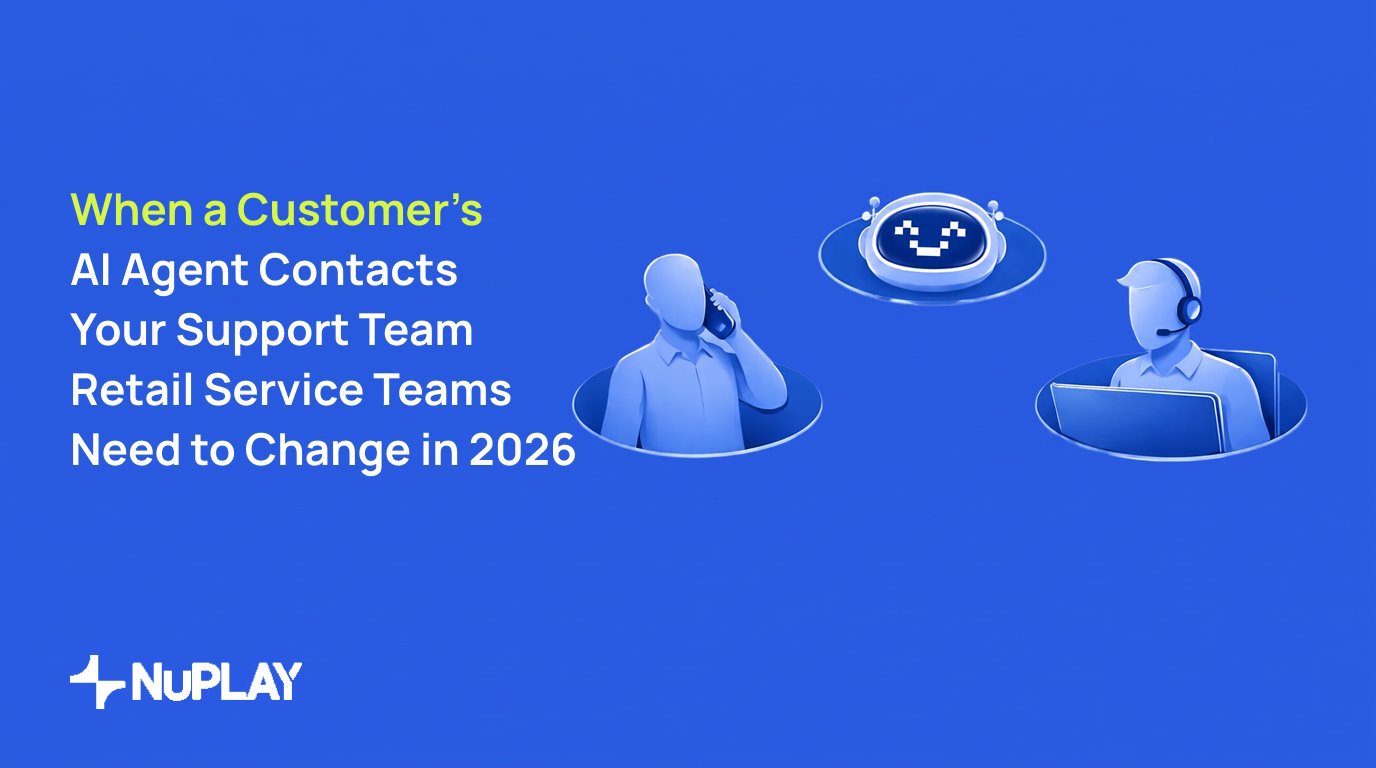

When a Customer’s AI Agent Contacts Your Support Team: What Retail Service Teams Need to Change in 2026
When an AI agent contacts customer support, retail teams should treat it as a delegated channel, not a trusted customer. Verify the customer and the authority for the specific task, keep decisions in policy systems, require confirmation for consequential changes, and log every request, approval, action, and exception.
What is AI agent contacting customer support retail?
AI agent contacting customer support retail describes a customer delegating a support task, such as checking an order, initiating a return, or asking about a refund, to software that interacts with the retailer through chat, email, forms, or voice. This is different from a retailer deploying its own service agent.
The incoming software may be able to navigate websites and complete several steps. In its July 17, 2025 launch post, OpenAI described ChatGPT agent using its own virtual computer to navigate websites, request secure login through a user handoff, and handle complex workflows. The post also said users could interrupt tasks and that the agent requested permission before consequential actions.
That does not make the incoming agent a trusted customer or an authorized delegate. The National Institute of Standards and Technology (NIST) says consumer-facing organizations may struggle to distinguish an agent from a human, particularly when users share credentials with agents. NIST also describes work on consumer-agent authenticators as being in early stages. See its August 27, 2026 identity guidance.
The operational gap is also visible in a 2026 vendor-sponsored Dialpad survey of 150 director- and vice president-level leaders across retail and healthcare. Only 45% reported that artificial intelligence was directly connected to action systems, while 33% reported having full cross-channel history at the point of interaction. This is survey evidence, not an industry census.
You do not need a separate “bot support” department. You need a service workflow that works when the requester is the customer, an agent acting for the customer, or a human service representative.
For the retailer-side model, see AI in Retail: Agents for Service, Orders and Onboarding. This article addresses the complementary case where the requester is the customer’s agent, not the retailer’s own service agent.
Replace “Is this a bot?” with “What is this delegate allowed to do?”
Detection is not the control. A caller that sounds automated is not necessarily an identified or authorized delegate, and a human-sounding conversation is not proof that the requester may access or change an account.
Use four questions for every request:
- Who is the customer? Authenticate the account holder through the retailer’s own controls.
- Who is the delegate? Capture an identifiable agent or channel where possible, but do not rely on self-disclosure alone.
- What is authorized? Limit authority to a named task, resource, amount, and expiry.
- What happened? Preserve an auditable record of the request, verification method, decision, action, and exception.
NIST’s October 27, 2026 design tenets for agent identity management call for distinct verifiable agent identities, links between agents and task originators, authority that narrows as it is delegated, short-lived and revocable authorization, risk-based human-review triggers, and tamper-evident evidence.
The appropriate response should depend on the request’s consequences, not on whether the retailer believes the requester is human or automated.
This is a practical risk model, not a legal standard. Whether a customer has legally authorized software to act on their behalf depends on the relevant facts and jurisdiction.
Keep retail decisions out of the conversation layer
A better prompt or more persuasive conversation does not establish whether a refund is owed. The language layer can collect intent, explain a decision, and guide the customer. Order, fulfillment, returns, fraud, payment, and policy systems should determine eligibility.
The Open Worldwide Application Security Project (OWASP) identifies excessive agency as a risk created by excessive functionality, permissions, or autonomy. Its LLM06:2025 guidance recommends minimizing permissions, executing actions in the user’s context, requiring approval for high-impact actions, and enforcing authorization in downstream systems rather than asking a language model to decide what is allowed.
Hypothetical example: A customer’s agent asks for a refund on order #48291, claiming that a parcel arrived damaged. The support system can acknowledge the request and retrieve the relevant policy. It should then check delivery status, return-window rules, prior refund activity, and any required evidence in the retailer’s systems. If policy allows a refund below a defined threshold, the system can send the customer a secure confirmation request. If the claim conflicts with order data or exceeds the threshold, it should create a case for human review. Repeatedly rephrasing the request should not change the decision.
This separation also limits the effect of manipulated instructions or untrusted data. The conversation can propose an action, but the downstream system must verify that the action is permitted in the current account, order, and policy context.
Payment flows need a separate control review. The Payment Card Industry Security Standards Council (PCI SSC) says that artificial intelligence systems in scope must meet applicable requirements for payment data storage, processing, and transmission. Its September 11, 2025 guidance also identifies payment tokens and single-use payment card numbers as possible protections in agentic payment flows. Artificial intelligence does not remove applicable Payment Card Industry Data Security Standard obligations.
Change frontline playbooks and handoffs
Frontline staff should not accuse a caller of being a bot or infer agent status from voice, phrasing, speed, or message format. They should apply the same verification and step-up rules to any requester who lacks sufficient authority.
A usable script is:
“I can help with order information and start an eligible return. Before I can share account-specific details or make changes, the account holder needs to complete verification through this secure link. Once that is complete, we can continue with the request.”
The script keeps the interaction moving without treating the delegate as trusted. It also explains why the customer must complete another step.
Three failure cases deserve specific playbooks:
Credential-sharing failure
An agent may have the customer’s password but no independent evidence of delegated authority. Do not treat shared credentials as a sufficient audit trail. NIST warns that credential sharing creates accountability gaps and can make it difficult to distinguish an agent from a person impersonating the customer.
Use task-specific authorization where possible. Record the customer verification, the scope of the request, and the resulting action separately from the login event.
Persistence failure
An agent may repeat or reframe an exception request until it receives a different answer from another channel or representative. Make the policy decision reproducible. Attach the prior decision to the case, preserve the relevant order and account facts, and route a genuine exception to the designated reviewer.
Changing the wording should not change the underlying eligibility result.
Lost-context failure
A verified customer may be forced to repeat verification after an agent-to-human handoff. Preserve the verified facts, the request, the authorization scope, and the policy result in the case record.
If the requested action changes, require fresh confirmation for the new action. Preserving context does not mean extending authority beyond the original task.
The Dialpad 2026 survey found that 21% of artificial intelligence-to-human handoffs occurred because the artificial intelligence understood the request but lacked the technical ability to complete it. Dialpad surveyed 150 director- and vice president-level leaders, including 75 retail respondents. Treat this as vendor-sponsored survey evidence rather than a general industry benchmark.
Pilot, measure, and improve the workflow
Start with one low-risk workflow rather than changing every support interaction at once. This 30-day plan is a practical starting point, not a universal implementation timetable.
Week 1: Classify the highest-volume intents
Inventory the 10 highest-volume support intents. Place each into one of five lanes:
- Public information
- Delegated read or request
- Delegated action
- Step-up
- Restricted
For each intent, document the customer data involved, the systems that decide eligibility, the action that can occur, the confirmation required, and the conditions for human review.
Weeks 2 and 3: Pilot one low-risk workflow
Choose an intent such as order-status lookup or initiation of an in-policy return. Test roughly 20 scenarios, including:
- Valid delegation
- Expired authority
- Repeated or rephrased requests
- Changed order details
- Missing customer verification
- An attempted high-risk escalation
- A request that conflicts with order or policy data
- A handoff from the customer’s agent to a human representative
The pilot should test the control path, not only whether the conversation reaches a plausible answer.
Week 4: Review the evidence
Review the logs with customer experience, security, fraud, legal, and operations teams. Adjust policy rules, handoff criteria, and the verification experience before expanding the workflow.
NIST’s design tenets call for continuous monitoring, risk-based human review, short-lived and revocable authorization, and independent, tamper-evident evidence. Those controls give teams a way to investigate not only what the agent requested, but also which authority applied and what the retailer did.
A retailer should be able to show:
- Who requested the action
- Which customer was authenticated
- Which authorization applied
- What task, resource, amount, and expiry were in scope
- Why policy allowed or denied the request
- Whether the customer confirmed a consequential change
- Which human reviewed an exception
- What was changed after the request
Track measures such as:
- Share of contacts involving a customer’s agent
- Delegated-authority verification success
- Duplicate or repeated-request rate
- Action completion by intent
- Human-review rate
- Policy reversals
- Unauthorized-action attempts
- Time to revoke or correct an authorization
- Handoff rate by reason, including technical inability, missing authority, and policy exception
NuPlay AI runs enterprise workflows in production and improves them after every run through NuLoop, with agents, the systems they operate, and the context they draw on under one platform. Source
To see how governed service workflows run in production, talk to the team.